Manhattan City outdoor‑dining review turns to safety, ADA and community agreements as 27 applications move through committee
January 14, 2025 | Manhattan City, New York County, New York
This article was created by AI summarizing key points discussed. AI makes mistakes, so for full details and context, please refer to the video of the full meeting. Please report any errors so we can fix them. Report an error »
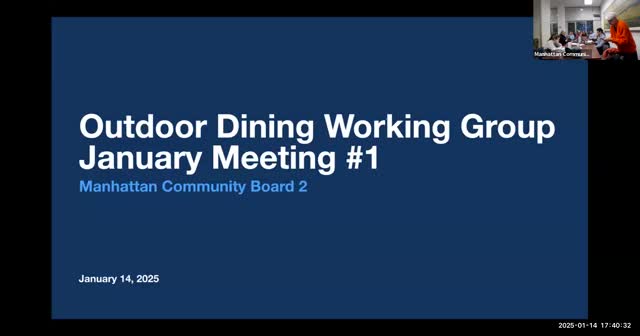
The Manhattan City Outdoor Dining Working Group convened Jan. 14 to review 27 applications for sidewalk and roadway cafes, drawing repeated objections from nearby residents and detailed technical questions from the committee about safety, accessibility and the accuracy of applicants’ plans.
Valerie Dela Rosa, chair of the Outdoor Dining Working Group, opened the meeting at 5:40 p.m. and outlined the committee’s process for reviewing each application under Dining Out NYC rules and Local Law 121 (2023). The committee repeatedly asked applicants to correct missing north arrows, mislocated manholes and transformer vaults, and inaccurate storefront or sidewalk measurements.
Why it matters: the group said the city’s temporary pandemic era programs have left a legacy of ad‑hoc installations and local friction. Many of the applications reviewed would require either FDNY “bridal‑lane” waivers or changes to proposals to meet clear‑path and visibility rules. Committee members warned that inconsistent DOT data and incomplete applications were slowing the review process and increasing neighborhood tension.
Major themes raised
- Safety and FDNY waivers: Committee members flagged multiple sites where proposed roadway cafes would leave a remaining travel lane below the FDNY’s guidance. Stella Fitzgerald and others repeatedly noted that FDNY guidance calls for maintaining 15 feet of unobstructed emergency travel or, where a waiver is requested, that the block be examined in context. For example, the committee’s measurement found Blue Ribbon’s roadway setup would leave roughly an 11 foot, 7 inch travel lane — a point of clear concern for residents and fire‑safety reviewers. Several applicants were told their files had been referred to FDNY for waiver review but that the DOT referral notices often did not include that status.
- ADA and clear path: The committee repeatedly reminded applicants of the minimum 36‑inch accessible route inside any seating area and the 5% accessible‑seating requirement (at least one accessible dining surface). Stella Fitzgerald cited multiple sidewalk cafe site plans that left only 2 feet 9 inches of usable space after DOT‑style clear‑path calculations — a width the committee said would not meet the accessibility standard.
- Plan accuracy and omissions: The working group asked applicants to correct or add north arrows, label primary building entrances, locate catch basins and manholes correctly, and show thermoplastic crosswalk markings. Committee members said DOT referrals sometimes arrive with incomplete or inaccurate plan data (wrong curb lines, missing bike lanes, etc.), which forces extra rounds of revisions.
- Neighborhood process and stipulations: Several applications prompted pushback from neighbors who said prior community agreements had prohibited roadway dining when a liquor license was issued. Augustine Hope of the West Village Residents Association told the committee, “We are vehemently opposed to this application,” citing an earlier negotiated condition that a particular operator would not install roadbed seating. In at least one case the applicant said a 2022 stipulation with the community had been negotiated before the current city outdoor‑dining program existed; neighbors said the stipulation should control current requests.
- Trash, deliveries and public space management: Residents at multiple blocks — including Cornelia, Mulberry and Cornelius Streets — described blocked sidewalks, overflowing commercial garbage cans and double‑parked delivery trucks squeezing travel lanes. The committee repeatedly asked applicants to show where commercial trash and service activities would occur so reviewers could assess pedestrian and curb impacts.
Representative exchanges from the meeting
- Augustine Hope, West Village Residents Association: “We are vehemently opposed to this application,” (public comment on a proposed roadway for OBRA at 569 Hudson Street) — citing a prior liquor‑license stipulation that barred roadbed seating. Augustine’s comments were echoed by other neighbors who asked why an applicant would file for a roadway cafe after agreeing with the community to avoid one.
- Andrea Yena, applicant for Amber/OBRA (speaking to objections): “I don’t want to do anything that it bothered the neighborhood. I wanna, you know, make sure that everybody’s happy,” and she said a local hospitality partner ‘‘helped me a lot’’ but denied that partner controlled her business.
- Kathy Arntzen (Cornelia Street resident): cited narrow sidewalks, the presence of a manhole near the storefront and FDNY concerns, saying, “I think that’s a little bit narrow for fire trucks to get down in an emergency.”
What the committee requested of applicants
- Add or correct: north arrows, accurate storefront frontage, crosswalk and thermoplastic markings, manhole and transformer vault locations, primary building entrance labeling.
- Confirm vertical‑screen and overhead‑covering heights where signs or stop‑sign approaches require barriers to be 46 inches or lower.
- State whether flooring or ramps will be used (DOT rules require an accessible 36‑inch route and at least a single accessible dining surface).
- If a site touches residential primary entrances, show a plan that confines cafe elements to the restaurant’s own frontage or otherwise documents permission and mitigation.
Outcome and next steps
- The working group did not cast final votes on the individual applications at the public hearing; the committee moved many applications (including ones with FDNY waiver referrals) into business session for more detailed action and requested corrected site plans and signed modification forms from applicants.
- Committee members said they will forward a package of required corrections to each applicant and expect signed, notarized modifications to be returned on the deadlines set by the office before DOT proceeds with public hearings. Where FDNY waivers are pending, the committee signaled that narrower travel lanes or cafes across from one another will face heightened scrutiny.
Ending note: The committee emphasized that this meeting exposed recurring process and data problems at DOT (incomplete referrals, inconsistent site plan detail) and friction between applicants and affected neighborhoods. Members urged applicants to engage earlier with neighbors and to return corrected, complete site plans so reviews can move forward without delay.
Valerie Dela Rosa, chair of the Outdoor Dining Working Group, opened the meeting at 5:40 p.m. and outlined the committee’s process for reviewing each application under Dining Out NYC rules and Local Law 121 (2023). The committee repeatedly asked applicants to correct missing north arrows, mislocated manholes and transformer vaults, and inaccurate storefront or sidewalk measurements.
Why it matters: the group said the city’s temporary pandemic era programs have left a legacy of ad‑hoc installations and local friction. Many of the applications reviewed would require either FDNY “bridal‑lane” waivers or changes to proposals to meet clear‑path and visibility rules. Committee members warned that inconsistent DOT data and incomplete applications were slowing the review process and increasing neighborhood tension.
Major themes raised
- Safety and FDNY waivers: Committee members flagged multiple sites where proposed roadway cafes would leave a remaining travel lane below the FDNY’s guidance. Stella Fitzgerald and others repeatedly noted that FDNY guidance calls for maintaining 15 feet of unobstructed emergency travel or, where a waiver is requested, that the block be examined in context. For example, the committee’s measurement found Blue Ribbon’s roadway setup would leave roughly an 11 foot, 7 inch travel lane — a point of clear concern for residents and fire‑safety reviewers. Several applicants were told their files had been referred to FDNY for waiver review but that the DOT referral notices often did not include that status.
- ADA and clear path: The committee repeatedly reminded applicants of the minimum 36‑inch accessible route inside any seating area and the 5% accessible‑seating requirement (at least one accessible dining surface). Stella Fitzgerald cited multiple sidewalk cafe site plans that left only 2 feet 9 inches of usable space after DOT‑style clear‑path calculations — a width the committee said would not meet the accessibility standard.
- Plan accuracy and omissions: The working group asked applicants to correct or add north arrows, label primary building entrances, locate catch basins and manholes correctly, and show thermoplastic crosswalk markings. Committee members said DOT referrals sometimes arrive with incomplete or inaccurate plan data (wrong curb lines, missing bike lanes, etc.), which forces extra rounds of revisions.
- Neighborhood process and stipulations: Several applications prompted pushback from neighbors who said prior community agreements had prohibited roadway dining when a liquor license was issued. Augustine Hope of the West Village Residents Association told the committee, “We are vehemently opposed to this application,” citing an earlier negotiated condition that a particular operator would not install roadbed seating. In at least one case the applicant said a 2022 stipulation with the community had been negotiated before the current city outdoor‑dining program existed; neighbors said the stipulation should control current requests.
- Trash, deliveries and public space management: Residents at multiple blocks — including Cornelia, Mulberry and Cornelius Streets — described blocked sidewalks, overflowing commercial garbage cans and double‑parked delivery trucks squeezing travel lanes. The committee repeatedly asked applicants to show where commercial trash and service activities would occur so reviewers could assess pedestrian and curb impacts.
Representative exchanges from the meeting
- Augustine Hope, West Village Residents Association: “We are vehemently opposed to this application,” (public comment on a proposed roadway for OBRA at 569 Hudson Street) — citing a prior liquor‑license stipulation that barred roadbed seating. Augustine’s comments were echoed by other neighbors who asked why an applicant would file for a roadway cafe after agreeing with the community to avoid one.
- Andrea Yena, applicant for Amber/OBRA (speaking to objections): “I don’t want to do anything that it bothered the neighborhood. I wanna, you know, make sure that everybody’s happy,” and she said a local hospitality partner ‘‘helped me a lot’’ but denied that partner controlled her business.
- Kathy Arntzen (Cornelia Street resident): cited narrow sidewalks, the presence of a manhole near the storefront and FDNY concerns, saying, “I think that’s a little bit narrow for fire trucks to get down in an emergency.”
What the committee requested of applicants
- Add or correct: north arrows, accurate storefront frontage, crosswalk and thermoplastic markings, manhole and transformer vault locations, primary building entrance labeling.
- Confirm vertical‑screen and overhead‑covering heights where signs or stop‑sign approaches require barriers to be 46 inches or lower.
- State whether flooring or ramps will be used (DOT rules require an accessible 36‑inch route and at least a single accessible dining surface).
- If a site touches residential primary entrances, show a plan that confines cafe elements to the restaurant’s own frontage or otherwise documents permission and mitigation.
Outcome and next steps
- The working group did not cast final votes on the individual applications at the public hearing; the committee moved many applications (including ones with FDNY waiver referrals) into business session for more detailed action and requested corrected site plans and signed modification forms from applicants.
- Committee members said they will forward a package of required corrections to each applicant and expect signed, notarized modifications to be returned on the deadlines set by the office before DOT proceeds with public hearings. Where FDNY waivers are pending, the committee signaled that narrower travel lanes or cafes across from one another will face heightened scrutiny.
Ending note: The committee emphasized that this meeting exposed recurring process and data problems at DOT (incomplete referrals, inconsistent site plan detail) and friction between applicants and affected neighborhoods. Members urged applicants to engage earlier with neighbors and to return corrected, complete site plans so reviews can move forward without delay.
View the Full Meeting & All Its Details
This article offers just a summary. Unlock complete video, transcripts, and insights as a Founder Member.
✓
Watch full, unedited meeting videos
✓
Search every word spoken in unlimited transcripts
✓
AI summaries & real-time alerts (all government levels)
✓
Permanent access to expanding government content
30-day money-back guarantee
