Town presentation links Toms Way well impacts to at least two distinct PFAS signatures
October 17, 2025 | Nantucket County, Massachusetts
This article was created by AI summarizing key points discussed. AI makes mistakes, so for full details and context, please refer to the video of the full meeting. Please report any errors so we can fix them. Report an error »
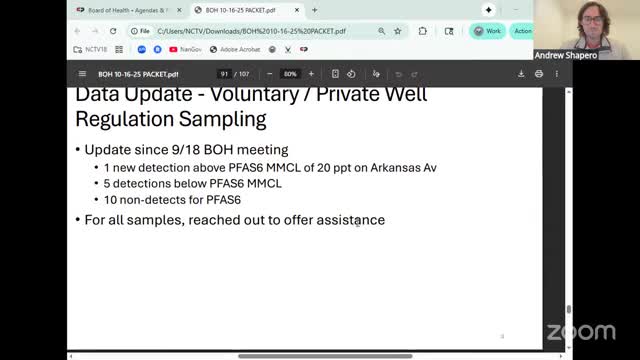
At its Oct. 16 meeting the Nantucket Board of Health received a preliminary conceptual site-model update for the Toms Way area showing multiple PFAS "fingerprints" that suggest more than one source of contamination in a compact area.
Andrew Shapiro, the town's environmental contamination administrator, presented a summary of consultant TRC's fingerprinting analysis and characterized Toms Way as "an area that has been highly impacted by PFAS contamination," with several exceedances of the state standard (20 parts per trillion) and several conditions MassDEP and town staff consider imminent hazards.
TRC compared the mix of PFAS compounds in wells and found a pattern: the northern end of Toms Way and the nearby town well showed a signature dominated by PFHxS and related six-carbon compounds, which consultants said is consistent with older formulations (examples cited included certain alkaline surfactants and specialty cleaners). The southern part of Toms Way showed a different mix — higher relative amounts of PFOA and shorter-chain PFAS such as PFBS — which TRC said could reflect newer formulations or a continuing source. Shapiro noted that the presence of 6:2 FTS in some samples suggests a potentially ongoing release because that compound is more environmentally mobile and has a shorter environmental half-life.
Shapiro emphasized extreme local variability: several highly impacted wells sit very close to wells that meet the state's screening level or were nondetect. He told the board, "This speaks to the importance of getting your well tested: the best source of data about your own drinking water is your own well test." The presentation also showed that MassDEP's Fairgrounds investigation did not identify a single, obvious surface source on town property, and the geothermal well sampled there (in the lower aquifer) was nondetect for PFAS.
Why it matters: Nantucket's aquifer is a sand-and-gravel system where contamination can move quickly; multiple nearby sources or releases can produce sharply different results over short distances. Board members and residents raised questions about stormwater, parking-lot drainage and possible historical foam releases at the Fairgrounds complex; consultants will consider those pathways as the investigation continues.
Next steps: TRC and town staff will continue to refine the conceptual model, expand sampling as needed, and coordinate with MassDEP. Shapiro said the town had received 25 new private-well reports after data freeze for the meeting and offered outreach to those households.
Quotes in context: "We're dealing with serious PFAS concentrations in this area," Shapiro said. On fingerprinting, he added that "the northern Toms Way area is an older blend of PFAS," while the southern end "is characterized by newer PFAS formulations and more mobile PFAS, potentially indicative of a continuing source."
Uncertainties: TRC described the current report as preliminary; lab qualifiers and limited foam sample volumes in other parts of the project were noted as constraints. Consultants will incorporate public comments and additional data into a final report planned for January.
Andrew Shapiro, the town's environmental contamination administrator, presented a summary of consultant TRC's fingerprinting analysis and characterized Toms Way as "an area that has been highly impacted by PFAS contamination," with several exceedances of the state standard (20 parts per trillion) and several conditions MassDEP and town staff consider imminent hazards.
TRC compared the mix of PFAS compounds in wells and found a pattern: the northern end of Toms Way and the nearby town well showed a signature dominated by PFHxS and related six-carbon compounds, which consultants said is consistent with older formulations (examples cited included certain alkaline surfactants and specialty cleaners). The southern part of Toms Way showed a different mix — higher relative amounts of PFOA and shorter-chain PFAS such as PFBS — which TRC said could reflect newer formulations or a continuing source. Shapiro noted that the presence of 6:2 FTS in some samples suggests a potentially ongoing release because that compound is more environmentally mobile and has a shorter environmental half-life.
Shapiro emphasized extreme local variability: several highly impacted wells sit very close to wells that meet the state's screening level or were nondetect. He told the board, "This speaks to the importance of getting your well tested: the best source of data about your own drinking water is your own well test." The presentation also showed that MassDEP's Fairgrounds investigation did not identify a single, obvious surface source on town property, and the geothermal well sampled there (in the lower aquifer) was nondetect for PFAS.
Why it matters: Nantucket's aquifer is a sand-and-gravel system where contamination can move quickly; multiple nearby sources or releases can produce sharply different results over short distances. Board members and residents raised questions about stormwater, parking-lot drainage and possible historical foam releases at the Fairgrounds complex; consultants will consider those pathways as the investigation continues.
Next steps: TRC and town staff will continue to refine the conceptual model, expand sampling as needed, and coordinate with MassDEP. Shapiro said the town had received 25 new private-well reports after data freeze for the meeting and offered outreach to those households.
Quotes in context: "We're dealing with serious PFAS concentrations in this area," Shapiro said. On fingerprinting, he added that "the northern Toms Way area is an older blend of PFAS," while the southern end "is characterized by newer PFAS formulations and more mobile PFAS, potentially indicative of a continuing source."
Uncertainties: TRC described the current report as preliminary; lab qualifiers and limited foam sample volumes in other parts of the project were noted as constraints. Consultants will incorporate public comments and additional data into a final report planned for January.
Don't Miss a Word: See the Full Meeting!
Go beyond summaries. Unlock every video, transcript, and key insight with a Founder Membership.
✓
Get instant access to full meeting videos
✓
Search and clip any phrase from complete transcripts
✓
Receive AI-powered summaries & custom alerts
✓
Enjoy lifetime, unrestricted access to government data
30-day money-back guarantee
