Commission pauses decision on Pocomo shore protection projects after debate over whether core-fiber arrays constitute coastal engineering structures
October 17, 2025 | Nantucket County, Massachusetts
This article was created by AI summarizing key points discussed. AI makes mistakes, so for full details and context, please refer to the video of the full meeting. Please report any errors so we can fix them. Report an error »
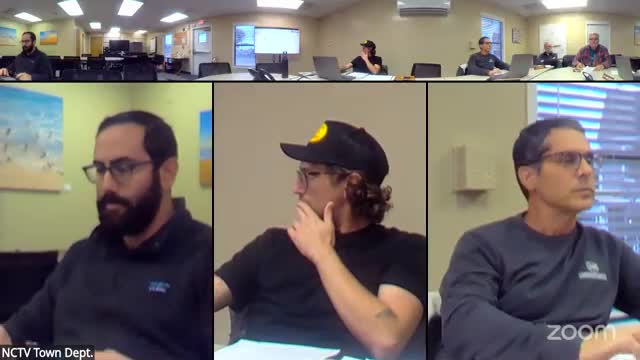
Two nearly identical shoreline applications for properties on Paco Mo Road were opened Oct. 16 and then continued after a lengthy technical and regulatory discussion about whether certain bioengineered assemblies should be classified as coastal engineering structures.
Mark Ritz of Site Design presented applications for 86 and 88 Paco Mo Road proposing "high-density coir rolls at the toe of the bank" with sand nourishment and plantings. "The array design is essentially identical to what was previously permitted at 84 Paco Mo a few years ago," Ritz said, adding the installations would be covered with sand and planted to stabilize the bank.
Commissioners spent substantial time debating whether the combination of coir-roll arrays and existing sand-drift fencing should be considered a coastal engineering structure (CES) that would trigger a waiver. One commissioner said: "Combining that type of array…with another sand drift fence that's going to do a secondary action and capture even more sediment, that combination is problematic for me." The commission noted there is an inconsistent permitting history in the neighborhood: in some recent cases the commission found the assemblage to be bioengineering and not a CES; in others the combination was treated as a CES.
Staff and commissioners emphasized that each property must be evaluated on its own facts but agreed the commission needs to reconcile prior, conflicting decisions for properties in the same stretch of shoreline before issuing a final determination. The commission also noted missing DEP numbers for some applications and the need to review permitting history in the area.
Given those outstanding jurisdictional and precedent questions, and because staff said they did not have all required documentation at the time, the applicants agreed to continue both applications to the Nov. 6 meeting.
The commission said it will schedule a separate regulatory discussion to consider how coir arrays, geotextiles and multiple rows of sand fencing should be treated under local regulations so similar cases are decided consistently in the future.
Mark Ritz of Site Design presented applications for 86 and 88 Paco Mo Road proposing "high-density coir rolls at the toe of the bank" with sand nourishment and plantings. "The array design is essentially identical to what was previously permitted at 84 Paco Mo a few years ago," Ritz said, adding the installations would be covered with sand and planted to stabilize the bank.
Commissioners spent substantial time debating whether the combination of coir-roll arrays and existing sand-drift fencing should be considered a coastal engineering structure (CES) that would trigger a waiver. One commissioner said: "Combining that type of array…with another sand drift fence that's going to do a secondary action and capture even more sediment, that combination is problematic for me." The commission noted there is an inconsistent permitting history in the neighborhood: in some recent cases the commission found the assemblage to be bioengineering and not a CES; in others the combination was treated as a CES.
Staff and commissioners emphasized that each property must be evaluated on its own facts but agreed the commission needs to reconcile prior, conflicting decisions for properties in the same stretch of shoreline before issuing a final determination. The commission also noted missing DEP numbers for some applications and the need to review permitting history in the area.
Given those outstanding jurisdictional and precedent questions, and because staff said they did not have all required documentation at the time, the applicants agreed to continue both applications to the Nov. 6 meeting.
The commission said it will schedule a separate regulatory discussion to consider how coir arrays, geotextiles and multiple rows of sand fencing should be treated under local regulations so similar cases are decided consistently in the future.
Don't Miss a Word: See the Full Meeting!
Go beyond summaries. Unlock every video, transcript, and key insight with a Founder Membership.
✓
Get instant access to full meeting videos
✓
Search and clip any phrase from complete transcripts
✓
Receive AI-powered summaries & custom alerts
✓
Enjoy lifetime, unrestricted access to government data
30-day money-back guarantee
