Senate passes three elections-related bills on campaign funds, ballot marking and petition reporting
January 28, 2025 | 2025 Legislative SD, South Dakota
This article was created by AI summarizing key points discussed. AI makes mistakes, so for full details and context, please refer to the video of the full meeting. Please report any errors so we can fix them. Report an error »
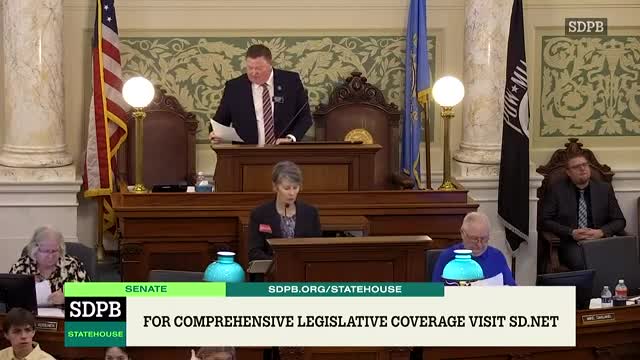
The South Dakota Senate passed three bills affecting elections and campaign rules and approved a set of consent-calendar measures during floor action.
Senators approved Senate Bill 11, a measure intended to limit amounts political committees may receive from inactive candidate campaign committees, by a roll-call vote of 30 yeas, 4 nays and 1 excused. Senator Roll, the bill’s floor sponsor, said the measure updates statute to define an "inactive candidate campaign" and to require those accounts to follow the same reporting rules as other political committees. "We're just saying you have to play by the same rules as everybody else that's operating in the political realm in South Dakota," Roll said during debate.
The chamber also passed Senate Bill 20, an act requiring voters to use a pen when marking ballots, as amended. Senators adopted Amendment 20D, which removed the phrase "or blue" from the bill’s language so the final statute specifies black ink. Senator Carley, who offered the amendment, said the state’s ES&S voting-machine manual specifies a black ink pen and that scanners process ballots in black-and-white; Carley argued removing blue would reduce confusion at polling places. "This just makes it simple. Follows the ES&S manual," Carley said. The amendment was approved by voice vote and the final passage of SB20 as amended was recorded as 34 yeas, 0 nays and 1 excused.
Senate Bill 23, which directs the Secretary of State to publish numbers pertaining to required petition signatures, was passed as amended. Senators approved Amendment 23A, which removes Section 2 of the original bill; as amended the bill requires the Secretary of State to post the required-signature number on the office website by the second January of every year while leaving existing legislative challenge authorities intact. Senator Pyszke said the amendment removes a problematic date-specific provision and keeps the challenge process within the legislature. SB23 passed on final reading with 26 yeas, 8 nays and 1 excused.
The Senate also adopted its consent calendar—bills reported out of committee without dissent—including measures on wholesale tobacco purchases, remote-seller registration, capital improvements for state buildings, trusts, long-term-care reporting requirements, and student/trainee funeral-service practice. The consent calendar passed by voice/roll-call with 34 yeas and 1 excused.
Votes at a glance: SB11 (campaign/inactive candidate accounts) — passed 30-4-1; SB20 (ballot pen requirement, amended to specify black ink) — passed 34-0-1; SB23 (publish petition-signature numbers, section removed) — passed 26-8-1; consent-calendar items — passed 34-0-1.
Taken together, the measures alter procedures that affect voters (pen color and ballot marking), candidates and political committees (inactive campaign accounts), and candidates or groups preparing nominating petitions (publication of signature targets). The bills will proceed to any additional steps required by legislative process.
Senators approved Senate Bill 11, a measure intended to limit amounts political committees may receive from inactive candidate campaign committees, by a roll-call vote of 30 yeas, 4 nays and 1 excused. Senator Roll, the bill’s floor sponsor, said the measure updates statute to define an "inactive candidate campaign" and to require those accounts to follow the same reporting rules as other political committees. "We're just saying you have to play by the same rules as everybody else that's operating in the political realm in South Dakota," Roll said during debate.
The chamber also passed Senate Bill 20, an act requiring voters to use a pen when marking ballots, as amended. Senators adopted Amendment 20D, which removed the phrase "or blue" from the bill’s language so the final statute specifies black ink. Senator Carley, who offered the amendment, said the state’s ES&S voting-machine manual specifies a black ink pen and that scanners process ballots in black-and-white; Carley argued removing blue would reduce confusion at polling places. "This just makes it simple. Follows the ES&S manual," Carley said. The amendment was approved by voice vote and the final passage of SB20 as amended was recorded as 34 yeas, 0 nays and 1 excused.
Senate Bill 23, which directs the Secretary of State to publish numbers pertaining to required petition signatures, was passed as amended. Senators approved Amendment 23A, which removes Section 2 of the original bill; as amended the bill requires the Secretary of State to post the required-signature number on the office website by the second January of every year while leaving existing legislative challenge authorities intact. Senator Pyszke said the amendment removes a problematic date-specific provision and keeps the challenge process within the legislature. SB23 passed on final reading with 26 yeas, 8 nays and 1 excused.
The Senate also adopted its consent calendar—bills reported out of committee without dissent—including measures on wholesale tobacco purchases, remote-seller registration, capital improvements for state buildings, trusts, long-term-care reporting requirements, and student/trainee funeral-service practice. The consent calendar passed by voice/roll-call with 34 yeas and 1 excused.
Votes at a glance: SB11 (campaign/inactive candidate accounts) — passed 30-4-1; SB20 (ballot pen requirement, amended to specify black ink) — passed 34-0-1; SB23 (publish petition-signature numbers, section removed) — passed 26-8-1; consent-calendar items — passed 34-0-1.
Taken together, the measures alter procedures that affect voters (pen color and ballot marking), candidates and political committees (inactive campaign accounts), and candidates or groups preparing nominating petitions (publication of signature targets). The bills will proceed to any additional steps required by legislative process.
Don't Miss a Word: See the Full Meeting!
Go beyond summaries. Unlock every video, transcript, and key insight with a Founder Membership.
✓
Get instant access to full meeting videos
✓
Search and clip any phrase from complete transcripts
✓
Receive AI-powered summaries & custom alerts
✓
Enjoy lifetime, unrestricted access to government data
30-day money-back guarantee
