House approves ban on eminent domain for pipelines that carry “carbon oxide”
January 28, 2025 | 2025 Legislative SD, South Dakota
This article was created by AI summarizing key points discussed. AI makes mistakes, so for full details and context, please refer to the video of the full meeting. Please report any errors so we can fix them. Report an error »
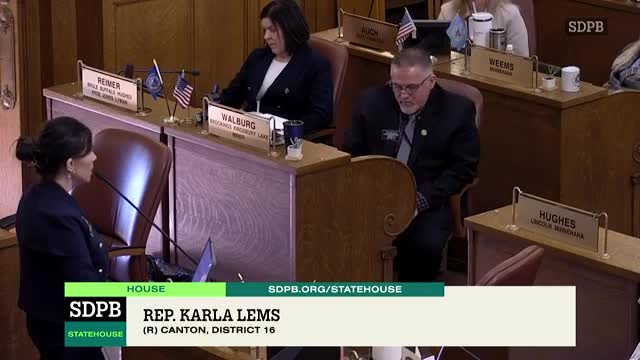
The South Dakota House of Representatives passed House Bill 1052 on final passage, prohibiting the use of eminent domain to acquire rights-of-way to construct or operate a pipeline “for the preponderant purpose of transporting carbon oxide.” Representative Lembs, the bill’s sponsor, framed the measure as restoring property-rights certainty to landowners who oppose forced takings.
The bill matters because supporters say eminent domain is a ‘‘big, heavy hammer’’ that can be abused and because multiple speakers tied the question to ongoing carbon sequestration and low‑carbon fuel projects in the state. Representative Lembs said the statute is ‘‘a simple bill’’ that would let companies negotiate for easements rather than use condemnation, and she cited Minnesota as an example where a similar limit did not stop pipeline projects.
Opponents argued the bill would undercut major economic projects tied to ethanol and sustainable aviation fuel that rely on CO2 transport and federal incentives. Representative Jamieson and others said companies have already invested substantial sums preparing applications and that changing the law now would create uncertainty for investors. Multiple members also referenced a recent South Dakota Supreme Court opinion sent to lower courts for additional record-building and cited the Public Utilities Commission (PUC) permitting process as central to the dispute.
Representative Hughes and other supporters pointed to the possible federal tax credits (referred to repeatedly on the floor as the federal “45Q” tax credit) and the scale of potential subsidies, arguing the public interest is in ensuring landowners are not compelled to give up property rights to capture federal dollars. Several members urged that the legislature — not courts or agencies — should set clear policy on whether CO2 can be treated as a commodity that triggers eminent domain.
On the final vote the clerk reported ayes 49, nays 19, excused 1; the bill was declared passed. The text of HB 1052 states that, “notwithstanding the provisions of any other law, a person may not exercise the right of eminent domain to acquire right of way for construct or operate a pipeline for the preponderant purpose of transporting carbon oxide.”
The floor debate illustrated the split between property‑rights concerns, regulatory and judicial questions about whether CO2 is a commodity, and economic arguments tied to ethanol plants and proposed sustainable aviation fuel facilities. The bill now moves to the Senate, where sponsors and opponents said they expect continued attention.
The bill matters because supporters say eminent domain is a ‘‘big, heavy hammer’’ that can be abused and because multiple speakers tied the question to ongoing carbon sequestration and low‑carbon fuel projects in the state. Representative Lembs said the statute is ‘‘a simple bill’’ that would let companies negotiate for easements rather than use condemnation, and she cited Minnesota as an example where a similar limit did not stop pipeline projects.
Opponents argued the bill would undercut major economic projects tied to ethanol and sustainable aviation fuel that rely on CO2 transport and federal incentives. Representative Jamieson and others said companies have already invested substantial sums preparing applications and that changing the law now would create uncertainty for investors. Multiple members also referenced a recent South Dakota Supreme Court opinion sent to lower courts for additional record-building and cited the Public Utilities Commission (PUC) permitting process as central to the dispute.
Representative Hughes and other supporters pointed to the possible federal tax credits (referred to repeatedly on the floor as the federal “45Q” tax credit) and the scale of potential subsidies, arguing the public interest is in ensuring landowners are not compelled to give up property rights to capture federal dollars. Several members urged that the legislature — not courts or agencies — should set clear policy on whether CO2 can be treated as a commodity that triggers eminent domain.
On the final vote the clerk reported ayes 49, nays 19, excused 1; the bill was declared passed. The text of HB 1052 states that, “notwithstanding the provisions of any other law, a person may not exercise the right of eminent domain to acquire right of way for construct or operate a pipeline for the preponderant purpose of transporting carbon oxide.”
The floor debate illustrated the split between property‑rights concerns, regulatory and judicial questions about whether CO2 is a commodity, and economic arguments tied to ethanol plants and proposed sustainable aviation fuel facilities. The bill now moves to the Senate, where sponsors and opponents said they expect continued attention.
Don't Miss a Word: See the Full Meeting!
Go beyond summaries. Unlock every video, transcript, and key insight with a Founder Membership.
✓
Get instant access to full meeting videos
✓
Search and clip any phrase from complete transcripts
✓
Receive AI-powered summaries & custom alerts
✓
Enjoy lifetime, unrestricted access to government data
30-day money-back guarantee
