Tigard adopts new food-cart code, bans drive-throughs and enacts revised fees
January 28, 2025 | Tigard, Washington County, Oregon
This article was created by AI summarizing key points discussed. AI makes mistakes, so for full details and context, please refer to the video of the full meeting. Please report any errors so we can fix them. Report an error »
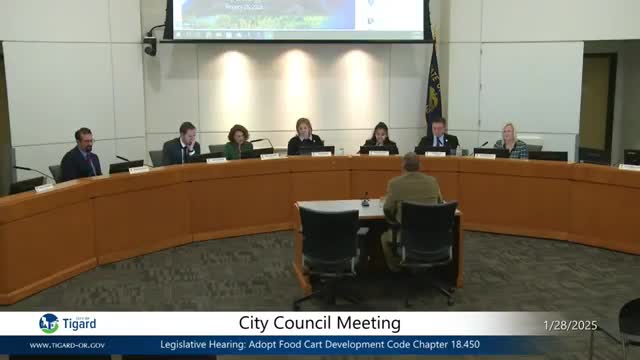
The Tigard City Council on Jan. 27 adopted Ordinance No. 25-1, creating a standalone chapter in the Tigard Community Development Code to regulate food carts and larger “food cart pods,” added a provision that prohibits drive-through service for food carts and pods, and approved an associated amendment to the citywide fees and charges schedule. The council declared the ordinance an emergency and voted unanimously to adopt the measures.
The code change moves food-cart approvals out of the city’s temporary-uses chapter and establishes two distinct categories: accessory food carts (1–3 carts on a property) and standalone food cart pods (groups of 4–20 carts that function as the principal use on a site). Assistant Community Development Director Scowler Warren told the council the new chapter was intended to create a clearer, lower-fee pathway for entrepreneurs while protecting public infrastructure and health and safety.
Warren said the draft standards require accessory carts to be on paved surfaces, meet normal setbacks, maintain minimum separation and fire-safety spacing, and prevent permanent utility hookups. For food cart pods, staff recommended locations only in zones that allow eating-and-drinking establishments; a permanent building with restroom access for customers (required where accessory structures exceed 800 square feet); stalls of no more than 375 square feet with permanent utility connections; prohibition on temporary storage containers such as shipping containers; and centralized management of fats, oils and grease (FOG).
“[We are] moving the food cart approvals out of our temporary uses chapter and into their own chapter,” Scowler Warren said in his presentation to council. He said the proposal came after the city began receiving requests for operations that intended to stay in place for years rather than weeks or months.
A person who identified themself in the meeting as a food-cart operator raised a public-comment plea during the hearing, describing a food-cart pod off Highway 217 and Greenberg Road that had opened in 2024. The operator said planners initially had provided a different expectation, that they and several vendors had invested and that the operator felt coerced into temporary-use paperwork after the city’s code was clarified. “I just don’t know what to do from here… I’m asking for some help,” the operator said.
Senior Planner Agnes Lindor, who joined Warren in answering council questions, said the city would proactively notify businesses in its database to compile a list of existing food-cart operations and provide a short time window for owners to report pre-existing food-cart uses. “It wouldn’t be 2026. It would be something like 60 to 90 day range,” Lindor said when asked about a deadline for operators to self-report existing uses so staff can record them as nonconforming.
Council members pressed staff on details including restroom standards, fee levels, and grease control. Lindor and Warren said restroom and hygiene requirements are enforced through public-health and building codes in addition to the development-code standards; they described the requirement for permanent restrooms as consistent with how other restaurant uses are regulated. On fees, Warren described the intent to keep accessory-cart application fees low and to charge a higher, scaled fee for standalone pods; in council discussion the proposed fee levels were referenced in the meeting record as “2.50 per cart” for accessory carts and “$5,000” for a pod application, and Warren said fees can be revisited if actual staff workload differs from estimates.
Councilor (surname) Robbins moved an amendment to the draft chapter to add a specific prohibition on drive-through services for food carts and food cart pods. The amendment passed by unanimous voice vote, and the council then voted unanimously to adopt Ordinance No. 25-1 as amended. The council also adopted Resolution No. 25-05 to update the citywide fees-and-charges schedule consistent with the new application types; that resolution was adopted by unanimous roll-call vote.
During the hearing, staff said they had consulted internal public-works and engineering staff, Clean Water Services, the Tigard Chamber of Commerce, other Oregon cities with food-cart programs, planning-commission members and local entrepreneurs. Staff also recommended two minor technical corrections to prior Tigard code text submitted earlier in a planning memo; those corrections carried no policy change.
Implementation steps staff described included a mailer to businesses to identify existing food-cart operations for nonconforming-use records, new application forms, and a revised fee schedule. Warren and Lindor told council that fees will be revisited if the city’s actual review workload proves higher or lower than estimated. The ordinance was adopted as an emergency, which staff said was intended to provide an expedited pathway for entrepreneurs seeking approvals now; staff also pointed to FOG management as an immediate infrastructure concern that the code will address.
Votes at a glance
- Amendment (add provision prohibiting drive-through services): passed, unanimous voice vote.
- Ordinance No. 25-1 (amending Tigard Community Development Code to regulate food carts and food cart pods; declaring an emergency): passed, unanimous roll-call vote.
- Resolution No. 25-05 (amending citywide fees and charges to add fees for the new application types; declaring an emergency): passed, unanimous roll-call vote.
What happens next: Staff will publish the new application materials, add the new fees to the fees-and-charges schedule, and send outreach to property owners/operators to identify pre-existing food-cart operations that may be recorded as nonconforming uses. Staff told council they will monitor implementation and can adjust fees and process steps based on actual workloads and impacts.
Sources quoted: Scowler Warren, Assistant Community Development Director; Agnes Lindor, Senior Planner; public commenter (food-cart operator).
The code change moves food-cart approvals out of the city’s temporary-uses chapter and establishes two distinct categories: accessory food carts (1–3 carts on a property) and standalone food cart pods (groups of 4–20 carts that function as the principal use on a site). Assistant Community Development Director Scowler Warren told the council the new chapter was intended to create a clearer, lower-fee pathway for entrepreneurs while protecting public infrastructure and health and safety.
Warren said the draft standards require accessory carts to be on paved surfaces, meet normal setbacks, maintain minimum separation and fire-safety spacing, and prevent permanent utility hookups. For food cart pods, staff recommended locations only in zones that allow eating-and-drinking establishments; a permanent building with restroom access for customers (required where accessory structures exceed 800 square feet); stalls of no more than 375 square feet with permanent utility connections; prohibition on temporary storage containers such as shipping containers; and centralized management of fats, oils and grease (FOG).
“[We are] moving the food cart approvals out of our temporary uses chapter and into their own chapter,” Scowler Warren said in his presentation to council. He said the proposal came after the city began receiving requests for operations that intended to stay in place for years rather than weeks or months.
A person who identified themself in the meeting as a food-cart operator raised a public-comment plea during the hearing, describing a food-cart pod off Highway 217 and Greenberg Road that had opened in 2024. The operator said planners initially had provided a different expectation, that they and several vendors had invested and that the operator felt coerced into temporary-use paperwork after the city’s code was clarified. “I just don’t know what to do from here… I’m asking for some help,” the operator said.
Senior Planner Agnes Lindor, who joined Warren in answering council questions, said the city would proactively notify businesses in its database to compile a list of existing food-cart operations and provide a short time window for owners to report pre-existing food-cart uses. “It wouldn’t be 2026. It would be something like 60 to 90 day range,” Lindor said when asked about a deadline for operators to self-report existing uses so staff can record them as nonconforming.
Council members pressed staff on details including restroom standards, fee levels, and grease control. Lindor and Warren said restroom and hygiene requirements are enforced through public-health and building codes in addition to the development-code standards; they described the requirement for permanent restrooms as consistent with how other restaurant uses are regulated. On fees, Warren described the intent to keep accessory-cart application fees low and to charge a higher, scaled fee for standalone pods; in council discussion the proposed fee levels were referenced in the meeting record as “2.50 per cart” for accessory carts and “$5,000” for a pod application, and Warren said fees can be revisited if actual staff workload differs from estimates.
Councilor (surname) Robbins moved an amendment to the draft chapter to add a specific prohibition on drive-through services for food carts and food cart pods. The amendment passed by unanimous voice vote, and the council then voted unanimously to adopt Ordinance No. 25-1 as amended. The council also adopted Resolution No. 25-05 to update the citywide fees-and-charges schedule consistent with the new application types; that resolution was adopted by unanimous roll-call vote.
During the hearing, staff said they had consulted internal public-works and engineering staff, Clean Water Services, the Tigard Chamber of Commerce, other Oregon cities with food-cart programs, planning-commission members and local entrepreneurs. Staff also recommended two minor technical corrections to prior Tigard code text submitted earlier in a planning memo; those corrections carried no policy change.
Implementation steps staff described included a mailer to businesses to identify existing food-cart operations for nonconforming-use records, new application forms, and a revised fee schedule. Warren and Lindor told council that fees will be revisited if the city’s actual review workload proves higher or lower than estimated. The ordinance was adopted as an emergency, which staff said was intended to provide an expedited pathway for entrepreneurs seeking approvals now; staff also pointed to FOG management as an immediate infrastructure concern that the code will address.
Votes at a glance
- Amendment (add provision prohibiting drive-through services): passed, unanimous voice vote.
- Ordinance No. 25-1 (amending Tigard Community Development Code to regulate food carts and food cart pods; declaring an emergency): passed, unanimous roll-call vote.
- Resolution No. 25-05 (amending citywide fees and charges to add fees for the new application types; declaring an emergency): passed, unanimous roll-call vote.
What happens next: Staff will publish the new application materials, add the new fees to the fees-and-charges schedule, and send outreach to property owners/operators to identify pre-existing food-cart operations that may be recorded as nonconforming uses. Staff told council they will monitor implementation and can adjust fees and process steps based on actual workloads and impacts.
Sources quoted: Scowler Warren, Assistant Community Development Director; Agnes Lindor, Senior Planner; public commenter (food-cart operator).
Don't Miss a Word: See the Full Meeting!
Go beyond summaries. Unlock every video, transcript, and key insight with a Founder Membership.
✓
Get instant access to full meeting videos
✓
Search and clip any phrase from complete transcripts
✓
Receive AI-powered summaries & custom alerts
✓
Enjoy lifetime, unrestricted access to government data
30-day money-back guarantee
