Oregon City Historic Review Board weighs tighter thresholds, ADU options for McLoughlin conservation district
January 28, 2025 | Oregon City, Clackamas County, Oregon
This article was created by AI summarizing key points discussed. AI makes mistakes, so for full details and context, please refer to the video of the full meeting. Please report any errors so we can fix them. Report an error »
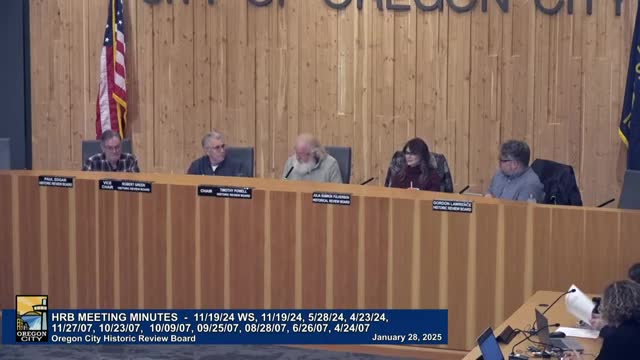
Oregon City — On Jan. 28 the Oregon City Historic Review Board heard a two‑hour presentation and discussion on proposed changes to how the board reviews additions and new construction for non‑designated properties in the McLoughlin conservation district.
The board’s consultant, Kristen Minor, and city planning staff reviewed options to clarify Section 17.1740 of the municipal code and to define a searchable, administrable threshold for when an owner’s alteration or addition should require Historic Review Board (HRB) review rather than routine staff permitting. Christina, a planner with Oregon City’s planning staff, said the city will run a postcard and online survey for McLoughlin residents and property owners in mid‑February, hold an open house March 6 and present preliminary survey results at the HRB meeting on March 25.
Why it matters: McLoughlin contains roughly 1,000 tax lots and about 200 locally designated resources; the remainder are non‑designated properties that can be altered without full HRB review unless changes exceed a defined threshold. The board is trying to balance preserving historic character with allowing modest change — including small accessory dwelling units (ADUs) — and to make review triggers clear and enforceable for staff and the public.
What the staff and consultant recommended and why
Kristen Minor, a historic preservation consultant formerly with the Portland Historic Landmarks Commission, told the board the project seeks “to re‑examine the definition of new construction, which serves as the threshold for which projects get reviewed by the HRB on non‑contributing properties.” She said the district’s survey adopted in 2002 sets the current eligibility period and that the district’s date of eligibility “now extends to 1953.” Minor recommended retaining a footprint (area)‑based trigger and combining it with other measurable factors — most often height or a height/footprint matrix — instead of using project cost or a materials‑loss test, which she said would be difficult for staff to apply consistently.
Key points of the discussion
- Retain footprint as a primary trigger: Board members and staff said footprint or area remains the most straightforward metric for intake because it typically corresponds to projects requiring building permits. Several members favored keeping a percentage threshold (the code currently references a cumulative 30% size threshold) but asked staff to clarify whether that 30% refers to gross floor area, enclosed area, or some other defined measure.
- Gross floor area suggested as a clear base: Planning staff said the existing code can be usefully clarified by tying the percentage to the code definition of gross floor area (total enclosed floor area), which would exclude open, unenclosed porches and make the measurement more administrable.
- Height and volume: Consultant and staff recommended against using height alone as a trigger because many additions do not substantially increase height, and percentage‑based height rules can be difficult to interpret. Several board members favored a combined matrix (e.g., footprint plus a limitation that additions not exceed the existing building height) so that any single trigger would bring a project to the board for public review.
- Complexity of volumetric measures: Multiple board members and staff warned that cubic‑volume calculations (true “volume” tests) are hard for staff to administer and for property owners to understand on intake. The board leaned toward simpler, explainable rules that can be read and applied over the phone or at counter intake.
- Age and eligibility: Minor noted that one way to narrow review is to treat properties that are within the survey’s period of significance (currently to 1953) differently from later construction. The board discussed whether to phrase the code to reference “contributing by age” rather than a specific year so the policy would remain flexible if the HRB later adopts a new survey.
- Location/visibility: Board members raised the idea of treating additions that are set behind front facades differently than those that alter front facades or are highly visible from the street. Staff said a simple metric tied to how far an addition sits behind the principal facade (rather than an amorphous visibility test) could be enforceable at intake.
- Freestanding outbuildings and ADUs: The HRB discussed whether to expand the existing allowance (currently equivalent to a single‑car garage) to explicitly allow slightly larger outbuildings or small ADUs. Members expressed support for enabling well‑designed small ADUs—one example size discussed was roughly 400 square feet—so long as clear design standards or a pre‑approved package minimize the risk of incompatible infill.
Public outreach and schedule
City staff will mail a postcard with a QR code to all McLoughlin residents and property owners in mid‑February and open the online survey through mid‑March. The HRB was asked to identify up to one additional board member (in addition to Chair Powell) to attend the March 6 McLoughlin Neighborhood Association open house; city rules prohibit more than two board members attending in order to avoid creating a quorum at an outreach event. Staff said they will provide a first close of the survey results before the HRB meeting on March 25 and keep the survey open through the spring. Minor’s contract ends June 24; staff said the goal is for the HRB to forward a formal recommendation on code language to the City Commission in the fall if the board chooses to proceed.
Dependency on state housing rules
Staff and the consultant discussed pending state housing regulations intended to allow more housing types. Christina told the board the city expects to seek an exemption; the city expects an exemption decision in late April and is auditing code provisions to document how Oregon City already provides adjustment and variance options for housing. The HRB was told to proceed in the near term assuming the city will seek an exemption but to be prepared to respond if the exemption is partial.
Quotes
"The project seeks to re‑examine the definition of new construction, which serves as the threshold for which projects get reviewed by the HRB on non‑contributing properties," Kristen Minor, the historic preservation consultant, told the board.
"We are working on a survey for McLoughlin residents and property owners," Christina, a planner with Oregon City, said. "The survey will be mailed mid‑February and we will hold an open house March 6."
Votes at a glance
- Swearing‑in: Julia Fulkerson — oath administered at the meeting (appointment recorded; no contested vote).
- Election: Chair — Vice Chair Powell was elected chair by roll call (ayes: Edgar, Green, Fulkerson, Lawrence, Powell; outcome: approved).
- Election: Vice Chair — Dave Green was elected vice chair by roll call (ayes: Edgar, Fulkerson, Lawrence, Chair Powell; Green abstained; outcome: approved).
- Consent: Approval of 11 sets of minutes — motion approved by roll call (ayes: Edgar, Fulkerson, Lawrence, Green, Chair Powell; outcome: approved).
What the board directed staff to do
- Refine clear, objective definitions for area/footprint (staff suggested tying the code to the gross floor area definition used elsewhere in the zoning code).
- Configure a public outreach plan (postcard, online survey, March 6 open house) and report initial survey results at the March 25 HRB meeting.
- Work with the city attorney on possible designs for a simplified or pre‑approved design path for small outbuildings/ADUs and to confirm legal risk around thresholds and exemptions.
Next steps
Staff will finalize the survey materials and mailing, present survey results and initial code‑language options at the March 25 meeting, and return with additional framing and examples for board discussion. Minor’s consultant work is scheduled to conclude after the June 24 meeting; if the HRB makes a formal recommendation then staff will prepare materials for a City Commission legislative hearing in the fall.
Ending note
Board members repeatedly asked for simple, explainable thresholds that planning staff can apply at counter intake and that property owners can understand without specialized calculations. The board directed staff to continue refining footprint‑based thresholds, to test a footprint/height matrix as a practical alternative to volumetric calculations, and to present outreach results and concrete code options at the next meeting.
The board’s consultant, Kristen Minor, and city planning staff reviewed options to clarify Section 17.1740 of the municipal code and to define a searchable, administrable threshold for when an owner’s alteration or addition should require Historic Review Board (HRB) review rather than routine staff permitting. Christina, a planner with Oregon City’s planning staff, said the city will run a postcard and online survey for McLoughlin residents and property owners in mid‑February, hold an open house March 6 and present preliminary survey results at the HRB meeting on March 25.
Why it matters: McLoughlin contains roughly 1,000 tax lots and about 200 locally designated resources; the remainder are non‑designated properties that can be altered without full HRB review unless changes exceed a defined threshold. The board is trying to balance preserving historic character with allowing modest change — including small accessory dwelling units (ADUs) — and to make review triggers clear and enforceable for staff and the public.
What the staff and consultant recommended and why
Kristen Minor, a historic preservation consultant formerly with the Portland Historic Landmarks Commission, told the board the project seeks “to re‑examine the definition of new construction, which serves as the threshold for which projects get reviewed by the HRB on non‑contributing properties.” She said the district’s survey adopted in 2002 sets the current eligibility period and that the district’s date of eligibility “now extends to 1953.” Minor recommended retaining a footprint (area)‑based trigger and combining it with other measurable factors — most often height or a height/footprint matrix — instead of using project cost or a materials‑loss test, which she said would be difficult for staff to apply consistently.
Key points of the discussion
- Retain footprint as a primary trigger: Board members and staff said footprint or area remains the most straightforward metric for intake because it typically corresponds to projects requiring building permits. Several members favored keeping a percentage threshold (the code currently references a cumulative 30% size threshold) but asked staff to clarify whether that 30% refers to gross floor area, enclosed area, or some other defined measure.
- Gross floor area suggested as a clear base: Planning staff said the existing code can be usefully clarified by tying the percentage to the code definition of gross floor area (total enclosed floor area), which would exclude open, unenclosed porches and make the measurement more administrable.
- Height and volume: Consultant and staff recommended against using height alone as a trigger because many additions do not substantially increase height, and percentage‑based height rules can be difficult to interpret. Several board members favored a combined matrix (e.g., footprint plus a limitation that additions not exceed the existing building height) so that any single trigger would bring a project to the board for public review.
- Complexity of volumetric measures: Multiple board members and staff warned that cubic‑volume calculations (true “volume” tests) are hard for staff to administer and for property owners to understand on intake. The board leaned toward simpler, explainable rules that can be read and applied over the phone or at counter intake.
- Age and eligibility: Minor noted that one way to narrow review is to treat properties that are within the survey’s period of significance (currently to 1953) differently from later construction. The board discussed whether to phrase the code to reference “contributing by age” rather than a specific year so the policy would remain flexible if the HRB later adopts a new survey.
- Location/visibility: Board members raised the idea of treating additions that are set behind front facades differently than those that alter front facades or are highly visible from the street. Staff said a simple metric tied to how far an addition sits behind the principal facade (rather than an amorphous visibility test) could be enforceable at intake.
- Freestanding outbuildings and ADUs: The HRB discussed whether to expand the existing allowance (currently equivalent to a single‑car garage) to explicitly allow slightly larger outbuildings or small ADUs. Members expressed support for enabling well‑designed small ADUs—one example size discussed was roughly 400 square feet—so long as clear design standards or a pre‑approved package minimize the risk of incompatible infill.
Public outreach and schedule
City staff will mail a postcard with a QR code to all McLoughlin residents and property owners in mid‑February and open the online survey through mid‑March. The HRB was asked to identify up to one additional board member (in addition to Chair Powell) to attend the March 6 McLoughlin Neighborhood Association open house; city rules prohibit more than two board members attending in order to avoid creating a quorum at an outreach event. Staff said they will provide a first close of the survey results before the HRB meeting on March 25 and keep the survey open through the spring. Minor’s contract ends June 24; staff said the goal is for the HRB to forward a formal recommendation on code language to the City Commission in the fall if the board chooses to proceed.
Dependency on state housing rules
Staff and the consultant discussed pending state housing regulations intended to allow more housing types. Christina told the board the city expects to seek an exemption; the city expects an exemption decision in late April and is auditing code provisions to document how Oregon City already provides adjustment and variance options for housing. The HRB was told to proceed in the near term assuming the city will seek an exemption but to be prepared to respond if the exemption is partial.
Quotes
"The project seeks to re‑examine the definition of new construction, which serves as the threshold for which projects get reviewed by the HRB on non‑contributing properties," Kristen Minor, the historic preservation consultant, told the board.
"We are working on a survey for McLoughlin residents and property owners," Christina, a planner with Oregon City, said. "The survey will be mailed mid‑February and we will hold an open house March 6."
Votes at a glance
- Swearing‑in: Julia Fulkerson — oath administered at the meeting (appointment recorded; no contested vote).
- Election: Chair — Vice Chair Powell was elected chair by roll call (ayes: Edgar, Green, Fulkerson, Lawrence, Powell; outcome: approved).
- Election: Vice Chair — Dave Green was elected vice chair by roll call (ayes: Edgar, Fulkerson, Lawrence, Chair Powell; Green abstained; outcome: approved).
- Consent: Approval of 11 sets of minutes — motion approved by roll call (ayes: Edgar, Fulkerson, Lawrence, Green, Chair Powell; outcome: approved).
What the board directed staff to do
- Refine clear, objective definitions for area/footprint (staff suggested tying the code to the gross floor area definition used elsewhere in the zoning code).
- Configure a public outreach plan (postcard, online survey, March 6 open house) and report initial survey results at the March 25 HRB meeting.
- Work with the city attorney on possible designs for a simplified or pre‑approved design path for small outbuildings/ADUs and to confirm legal risk around thresholds and exemptions.
Next steps
Staff will finalize the survey materials and mailing, present survey results and initial code‑language options at the March 25 meeting, and return with additional framing and examples for board discussion. Minor’s consultant work is scheduled to conclude after the June 24 meeting; if the HRB makes a formal recommendation then staff will prepare materials for a City Commission legislative hearing in the fall.
Ending note
Board members repeatedly asked for simple, explainable thresholds that planning staff can apply at counter intake and that property owners can understand without specialized calculations. The board directed staff to continue refining footprint‑based thresholds, to test a footprint/height matrix as a practical alternative to volumetric calculations, and to present outreach results and concrete code options at the next meeting.
Don't Miss a Word: See the Full Meeting!
Go beyond summaries. Unlock every video, transcript, and key insight with a Founder Membership.
✓
Get instant access to full meeting videos
✓
Search and clip any phrase from complete transcripts
✓
Receive AI-powered summaries & custom alerts
✓
Enjoy lifetime, unrestricted access to government data
30-day money-back guarantee
