Walz budget would cut statewide sales tax rate, expand tax to many services
January 28, 2025 | 2025 Legislature MN, Minnesota
This article was created by AI summarizing key points discussed. AI makes mistakes, so for full details and context, please refer to the video of the full meeting. Please report any errors so we can fix them. Report an error »
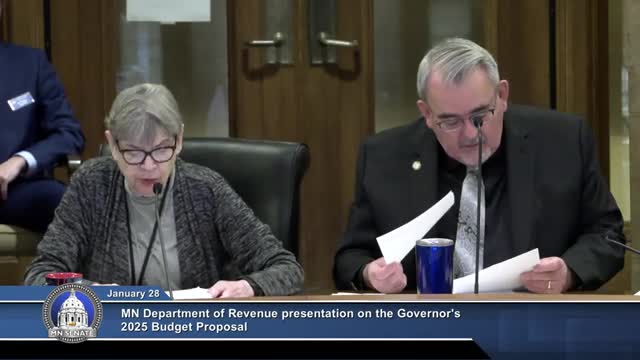
Commissioner Paul Marquardt, commissioner of revenue, presented Governor Tim Walz and Lieutenant Governor Flanagan's tax proposals to the Minnesota Senate Tax Committee, outlining a proposal to lower the state general sales tax rate and to extend the tax to additional professional services.
Marquardt told the committee the plan would reduce the statewide general sales tax rate by 0.075 percentage point, from 6.5% to 6.425%, and would broaden the base to include many professional services such as legal, brokerage, banking and accounting services. "This would be the first sales tax rate cut in state history," Marquardt said, and he described the change as paired with base broadening to move Minnesota toward a more service‑oriented tax base.
The governor's package would also preserve existing carve‑outs for specific items and services (for example, legal aid and child tax credits) and would not impose business‑to‑business taxes, Marquardt said, adding that the administration intends to avoid so‑called "tax pyramiding" that layers taxes on business inputs. He described the estimated fiscal effect as a $95 million annual reduction tied to the rate cut and roughly $203 million a year in new revenue from taxing expanded services, yielding a net increase reflected in the governor's revenue estimates for the next biennia.
Why it matters: Committee members pressed for more detail and asked the administration to return with bill language, precise revenue estimates and spreadsheets showing distributional impacts. Several senators said they welcomed a conversation about "fair taxes" but worried the combined package could raise more revenue overall than the headline rate cut suggests.
Committee discussion and follow up: Senators raised questions about administrative and legal limits. Senator Drazkowski pointed out a statutory provision he summarized as "a fee is a tax," and asked whether fees or novel charging arrangements could be treated differently. Marquardt replied that carve‑outs were included in the revenue estimate and that language will be scrutinized when bill text arrives. Senators also asked whether the change could violate the Streamlined Sales and Use Tax Agreement; Marquardt said the department would review that issue when bill language is drafted.
Policy details recorded in the hearing materials and the presentation: the reduction of 0.075 percentage point, the projected $95 million annual revenue loss from the rate cut, an approximately $203 million annual increase from expanding services, and administration statements that the package would solve a portion of a long‑term structural deficit (the presentation cited solving roughly half of a stated $3.5 billion long‑term structural gap). Marquardt also listed related tax items in the governor's package: an expansion of the research and development credit, a sustainable aviation fuel (SAF) credit, fraud‑prevention funding, a short‑line railroad modernization credit timing change, and a proposed pass‑through audit unit for corporate franchise tax compliance.
The chair and committee members instructed staff and the Department of Revenue to provide language and detailed revenue estimates; the committee did not take testimony on the tax provisions at this hearing and deferred public testimony until bill language is available. Marquardt and legislative staff said they will return with more granular estimates and clarifying spreadsheets.
Ending: The committee left the matter open and scheduled further consideration once formal bill language and updated revenue estimates are provided. Members emphasized they will scrutinize distributional impacts and potential local government cost shifts in later hearings.
Marquardt told the committee the plan would reduce the statewide general sales tax rate by 0.075 percentage point, from 6.5% to 6.425%, and would broaden the base to include many professional services such as legal, brokerage, banking and accounting services. "This would be the first sales tax rate cut in state history," Marquardt said, and he described the change as paired with base broadening to move Minnesota toward a more service‑oriented tax base.
The governor's package would also preserve existing carve‑outs for specific items and services (for example, legal aid and child tax credits) and would not impose business‑to‑business taxes, Marquardt said, adding that the administration intends to avoid so‑called "tax pyramiding" that layers taxes on business inputs. He described the estimated fiscal effect as a $95 million annual reduction tied to the rate cut and roughly $203 million a year in new revenue from taxing expanded services, yielding a net increase reflected in the governor's revenue estimates for the next biennia.
Why it matters: Committee members pressed for more detail and asked the administration to return with bill language, precise revenue estimates and spreadsheets showing distributional impacts. Several senators said they welcomed a conversation about "fair taxes" but worried the combined package could raise more revenue overall than the headline rate cut suggests.
Committee discussion and follow up: Senators raised questions about administrative and legal limits. Senator Drazkowski pointed out a statutory provision he summarized as "a fee is a tax," and asked whether fees or novel charging arrangements could be treated differently. Marquardt replied that carve‑outs were included in the revenue estimate and that language will be scrutinized when bill text arrives. Senators also asked whether the change could violate the Streamlined Sales and Use Tax Agreement; Marquardt said the department would review that issue when bill language is drafted.
Policy details recorded in the hearing materials and the presentation: the reduction of 0.075 percentage point, the projected $95 million annual revenue loss from the rate cut, an approximately $203 million annual increase from expanding services, and administration statements that the package would solve a portion of a long‑term structural deficit (the presentation cited solving roughly half of a stated $3.5 billion long‑term structural gap). Marquardt also listed related tax items in the governor's package: an expansion of the research and development credit, a sustainable aviation fuel (SAF) credit, fraud‑prevention funding, a short‑line railroad modernization credit timing change, and a proposed pass‑through audit unit for corporate franchise tax compliance.
The chair and committee members instructed staff and the Department of Revenue to provide language and detailed revenue estimates; the committee did not take testimony on the tax provisions at this hearing and deferred public testimony until bill language is available. Marquardt and legislative staff said they will return with more granular estimates and clarifying spreadsheets.
Ending: The committee left the matter open and scheduled further consideration once formal bill language and updated revenue estimates are provided. Members emphasized they will scrutinize distributional impacts and potential local government cost shifts in later hearings.
Don't Miss a Word: See the Full Meeting!
Go beyond summaries. Unlock every video, transcript, and key insight with a Founder Membership.
✓
Get instant access to full meeting videos
✓
Search and clip any phrase from complete transcripts
✓
Receive AI-powered summaries & custom alerts
✓
Enjoy lifetime, unrestricted access to government data
30-day money-back guarantee
