Senate File 249 would expand existing teacher master's tax credit to special education degrees
January 28, 2025 | 2025 Legislature MN, Minnesota
This article was created by AI summarizing key points discussed. AI makes mistakes, so for full details and context, please refer to the video of the full meeting. Please report any errors so we can fix them. Report an error »
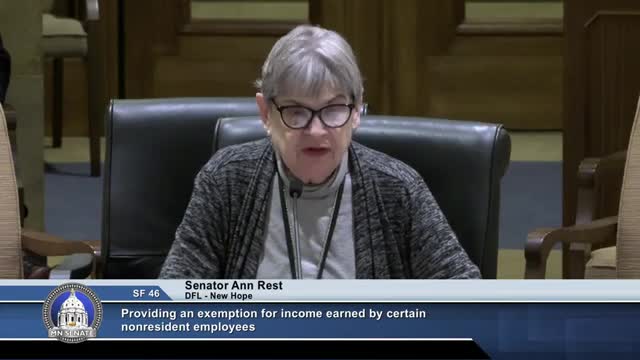
Senator Johnson Stewart introduced Senate File 249 to the Senate Tax Committee, proposing to expand an existing nonrefundable teacher master's degree income tax credit to include special education master's degrees and to relax timing requirements for licensure.
"This bill expands the eligibility for current credit to include taxpayers earning a master's degree in special education," Senator Johnson Stewart said while explaining that the bill would allow teachers who obtain licensure within six months of finishing a qualifying master's program to claim the credit.
Under current Minnesota law, the nonrefundable credit provides up to $2,500 to current teachers who complete a master's degree in a core content area and meet licensure timing and pedagogy restrictions. SF 249 would add special education fields — including developmental disabilities, early childhood special education, deaf and hard of hearing education, blind and visually impaired education, emotional or behavior disorders, autism spectrum disorders, and learning disabilities — and would remove the prohibition on pedagogy components for special education degrees.
Two testifiers from the deaf and hard‑of‑hearing community described workforce shortages and financial barriers. Stevie Middlebrook, a second‑grade teacher at Metro Deaf School and a current master's student, told the committee she initially struggled to afford graduate school and that vocational rehabilitation and a university grant were not available to all candidates. "Minnesota has only one teacher preparation program for deaf and hard of hearing education," Middlebrook said, adding that the credit could help address shortages.
Alicia Lane, government relations director at the Minnesota Commission of the Deaf, DeafBlind and Hard of Hearing, said the state faces a severe shortage of teachers qualified to serve deaf and hard‑of‑hearing students and that the credit had bipartisan appeal to recruit and retain educators.
Action: The committee laid Senate File 249 over for inclusion in an omnibus tax bill; the bill as introduced retains the current $2,500 nonrefundable credit and sets an effective date of tax year 2025. The committee asked staff to provide prior revenue estimates; staff noted the credit is scalable and may be adjusted in omnibus negotiations.
Ending: Advocates urged the committee to adopt the change to expand the teaching pipeline for special education students; the sponsor and testifiers said they will continue to work with staff on technical drafting and estimates.
"This bill expands the eligibility for current credit to include taxpayers earning a master's degree in special education," Senator Johnson Stewart said while explaining that the bill would allow teachers who obtain licensure within six months of finishing a qualifying master's program to claim the credit.
Under current Minnesota law, the nonrefundable credit provides up to $2,500 to current teachers who complete a master's degree in a core content area and meet licensure timing and pedagogy restrictions. SF 249 would add special education fields — including developmental disabilities, early childhood special education, deaf and hard of hearing education, blind and visually impaired education, emotional or behavior disorders, autism spectrum disorders, and learning disabilities — and would remove the prohibition on pedagogy components for special education degrees.
Two testifiers from the deaf and hard‑of‑hearing community described workforce shortages and financial barriers. Stevie Middlebrook, a second‑grade teacher at Metro Deaf School and a current master's student, told the committee she initially struggled to afford graduate school and that vocational rehabilitation and a university grant were not available to all candidates. "Minnesota has only one teacher preparation program for deaf and hard of hearing education," Middlebrook said, adding that the credit could help address shortages.
Alicia Lane, government relations director at the Minnesota Commission of the Deaf, DeafBlind and Hard of Hearing, said the state faces a severe shortage of teachers qualified to serve deaf and hard‑of‑hearing students and that the credit had bipartisan appeal to recruit and retain educators.
Action: The committee laid Senate File 249 over for inclusion in an omnibus tax bill; the bill as introduced retains the current $2,500 nonrefundable credit and sets an effective date of tax year 2025. The committee asked staff to provide prior revenue estimates; staff noted the credit is scalable and may be adjusted in omnibus negotiations.
Ending: Advocates urged the committee to adopt the change to expand the teaching pipeline for special education students; the sponsor and testifiers said they will continue to work with staff on technical drafting and estimates.
View the Full Meeting & All Its Details
This article offers just a summary. Unlock complete video, transcripts, and insights as a Founder Member.
✓
Watch full, unedited meeting videos
✓
Search every word spoken in unlimited transcripts
✓
AI summaries & real-time alerts (all government levels)
✓
Permanent access to expanding government content
30-day money-back guarantee
