Maryland Port Administration budget rises, officials warn bridge collapse still suppresses volumes
February 06, 2025 | Public Safety, Transportation, and Environment Subcommittee, Budget and Taxation Committee, SENATE, SENATE, Committees, Legislative, Maryland
This article was created by AI summarizing key points discussed. AI makes mistakes, so for full details and context, please refer to the video of the full meeting. Please report any errors so we can fix them. Report an error »
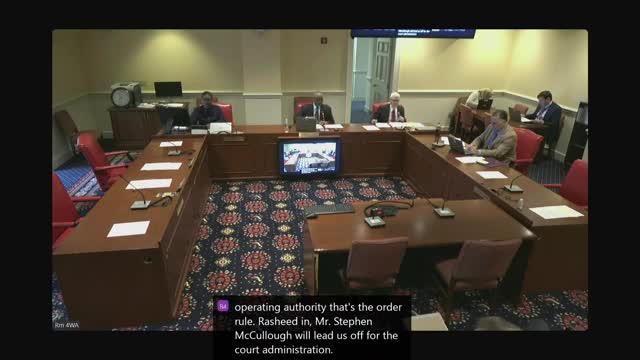
Maryland Port Administration officials and fiscal analysts told the Public Safety, Transportation, and Environment Subcommittee on Feb. 20 that the port’s fiscal 2026 operating allowance increases but key performance metrics remain below 2023 levels after the Francis Scott Key Bridge collapse.
Steven McCullough of the Department of Legislative Services said the port’s operating budget allowance increases by about $5.8 million—nearly 11 percent—while the capital program and revenue picture remain constrained because port volumes declined in 2024 following the bridge collapse and the partial port closure. “The operating revenues of the port don't quite meet, and cover, the operating budget,” McCullough said during his presentation of the DLS analysis.
The news matters because port operating revenues and throughput are central to jobs and supply chains that rely on the Port of Baltimore. Department officials and MPA leadership told legislators the port is recovering but not yet back to its 2023 record volume year.
Jonathan Daniels, executive director of the Maryland Port Administration, said the port handled 9.1 million tons of general cargo in fiscal 2024 and described the year as “our second highest tonnage year on record, even with the closure” tied to the Key Bridge collapse. Daniels credited partners and labor for recent operational records at Seagirt Marine Terminal and said the port has increased weekly container services from 12 to 16 and added five new container services expected in 2025.
MPA and DLS gave lawmakers a series of budget details and program updates: the 2026 capital allowance for MPA totals about $428 million (including non‑budget funds), the six‑year capital program centers on system preservation (about 57 percent) and expansion/efficiency (about 26 percent), and the capital program includes nearly $200 million in discretionary grants awarded under the Infrastructure Investment and Jobs Act. McCullough also said eight IIJA grants for the port total “just under $200,000,000.”
Officials emphasized several funding and project items lawmakers pressed them to track. DLS noted a close‑out error that caused about $4 million in general funds for the Howard Street Tunnel to revert; those funds are being restored through a fiscal 2025 deficiency. Daniels described progress on the Howard Street Tunnel work and the ability of CSX to reroute double‑stacked trains, which permits extended closures of the tunnel for construction and may shorten the completion timeline.
MPA highlighted an EPA award of $147 million intended to accelerate decarbonization and electrification at the Port of Baltimore. Daniels said the EPA funds will support procurement of zero‑emission vehicles and charging infrastructure and that the project is expected to reduce air emissions by an estimated 35 percent compared with 2020 levels.
On the security and staffing side, DLS flagged a recommended deletion of funding for one new cybersecurity position in the MPA operating allowance. McCullough said DLS recommended deleting the new pin and reclassifying an existing vacancy instead; the department, through Daniels and Secretary Paul Wiedefeld of the Maryland Department of Transportation, declined to concur and said cybersecurity and physical security remain priorities. Daniels said the port has about 15 pins available and that 10 are “in the pipeline.”
Lawmakers pressed MPA about a legislative add for drone‑based security that the Board of Public Works reduced in 2024; Daniels said the port currently does not employ the drone system and relies on existing law‑enforced facility security plans and contracted security partners. On staffing, Daniels said the MPA’s vacancy rate has fallen to 6.51 percent from 17.6 percent in 2023 following human resources changes.
Lawmakers also pressed MPA on an at‑risk pier and salt handling operation at North Locust Point. Tim Castle, executive vice president of Canton Port Services and Project Stevedoring, which operates the North Locust Point Marine Terminal, testified the terminal “will close at the end of this year without infrastructure investment” and warned that his operation is “the only bulk terminal south of the bridges and tunnels in the Port of Baltimore” for commodities such as road salt. Castle said his facility delivered 300,000 tons of road salt to area municipalities last month and that loss of the facility would hamper winter distribution.
MPA said it will invest about $400,000 to study the condition of a North Locust Point pier; initial engineering work will inform whether rehabilitation or replacement is required, and MPA officials said they will provide the committee with the study results once available.
Officials closed by noting workforce and apprenticeship investments and by asking the subcommittee to continue close monitoring of federal grant reimbursements. Daniels said the port is working with local higher‑education partners, community colleges and HBCUs on apprenticeship programs and internships and that the port remains “a steadfast steward of the environment” while pursuing economic recovery.
Looking ahead, DLS and MPA staff asked the subcommittee to track quarterly reporting on the Howard Street Tunnel project, to monitor federal grant reimbursements, and to follow up on the North Locust Point pier condition study.
Ending: The subcommittee did not take votes on the presentation. Lawmakers requested follow‑up reporting on EPA and other federal reimbursements and on the North Locust Point engineering study.
Steven McCullough of the Department of Legislative Services said the port’s operating budget allowance increases by about $5.8 million—nearly 11 percent—while the capital program and revenue picture remain constrained because port volumes declined in 2024 following the bridge collapse and the partial port closure. “The operating revenues of the port don't quite meet, and cover, the operating budget,” McCullough said during his presentation of the DLS analysis.
The news matters because port operating revenues and throughput are central to jobs and supply chains that rely on the Port of Baltimore. Department officials and MPA leadership told legislators the port is recovering but not yet back to its 2023 record volume year.
Jonathan Daniels, executive director of the Maryland Port Administration, said the port handled 9.1 million tons of general cargo in fiscal 2024 and described the year as “our second highest tonnage year on record, even with the closure” tied to the Key Bridge collapse. Daniels credited partners and labor for recent operational records at Seagirt Marine Terminal and said the port has increased weekly container services from 12 to 16 and added five new container services expected in 2025.
MPA and DLS gave lawmakers a series of budget details and program updates: the 2026 capital allowance for MPA totals about $428 million (including non‑budget funds), the six‑year capital program centers on system preservation (about 57 percent) and expansion/efficiency (about 26 percent), and the capital program includes nearly $200 million in discretionary grants awarded under the Infrastructure Investment and Jobs Act. McCullough also said eight IIJA grants for the port total “just under $200,000,000.”
Officials emphasized several funding and project items lawmakers pressed them to track. DLS noted a close‑out error that caused about $4 million in general funds for the Howard Street Tunnel to revert; those funds are being restored through a fiscal 2025 deficiency. Daniels described progress on the Howard Street Tunnel work and the ability of CSX to reroute double‑stacked trains, which permits extended closures of the tunnel for construction and may shorten the completion timeline.
MPA highlighted an EPA award of $147 million intended to accelerate decarbonization and electrification at the Port of Baltimore. Daniels said the EPA funds will support procurement of zero‑emission vehicles and charging infrastructure and that the project is expected to reduce air emissions by an estimated 35 percent compared with 2020 levels.
On the security and staffing side, DLS flagged a recommended deletion of funding for one new cybersecurity position in the MPA operating allowance. McCullough said DLS recommended deleting the new pin and reclassifying an existing vacancy instead; the department, through Daniels and Secretary Paul Wiedefeld of the Maryland Department of Transportation, declined to concur and said cybersecurity and physical security remain priorities. Daniels said the port has about 15 pins available and that 10 are “in the pipeline.”
Lawmakers pressed MPA about a legislative add for drone‑based security that the Board of Public Works reduced in 2024; Daniels said the port currently does not employ the drone system and relies on existing law‑enforced facility security plans and contracted security partners. On staffing, Daniels said the MPA’s vacancy rate has fallen to 6.51 percent from 17.6 percent in 2023 following human resources changes.
Lawmakers also pressed MPA on an at‑risk pier and salt handling operation at North Locust Point. Tim Castle, executive vice president of Canton Port Services and Project Stevedoring, which operates the North Locust Point Marine Terminal, testified the terminal “will close at the end of this year without infrastructure investment” and warned that his operation is “the only bulk terminal south of the bridges and tunnels in the Port of Baltimore” for commodities such as road salt. Castle said his facility delivered 300,000 tons of road salt to area municipalities last month and that loss of the facility would hamper winter distribution.
MPA said it will invest about $400,000 to study the condition of a North Locust Point pier; initial engineering work will inform whether rehabilitation or replacement is required, and MPA officials said they will provide the committee with the study results once available.
Officials closed by noting workforce and apprenticeship investments and by asking the subcommittee to continue close monitoring of federal grant reimbursements. Daniels said the port is working with local higher‑education partners, community colleges and HBCUs on apprenticeship programs and internships and that the port remains “a steadfast steward of the environment” while pursuing economic recovery.
Looking ahead, DLS and MPA staff asked the subcommittee to track quarterly reporting on the Howard Street Tunnel project, to monitor federal grant reimbursements, and to follow up on the North Locust Point pier condition study.
Ending: The subcommittee did not take votes on the presentation. Lawmakers requested follow‑up reporting on EPA and other federal reimbursements and on the North Locust Point engineering study.
Don't Miss a Word: See the Full Meeting!
Go beyond summaries. Unlock every video, transcript, and key insight with a Founder Membership.
✓
Get instant access to full meeting videos
✓
Search and clip any phrase from complete transcripts
✓
Receive AI-powered summaries & custom alerts
✓
Enjoy lifetime, unrestricted access to government data
30-day money-back guarantee
