MDTA says Key Bridge rebuild underway; agency projects revenue shortfalls and may seek toll changes
February 06, 2025 | Public Safety, Transportation, and Environment Subcommittee, Budget and Taxation Committee, SENATE, SENATE, Committees, Legislative, Maryland
This article was created by AI summarizing key points discussed. AI makes mistakes, so for full details and context, please refer to the video of the full meeting. Please report any errors so we can fix them. Report an error »
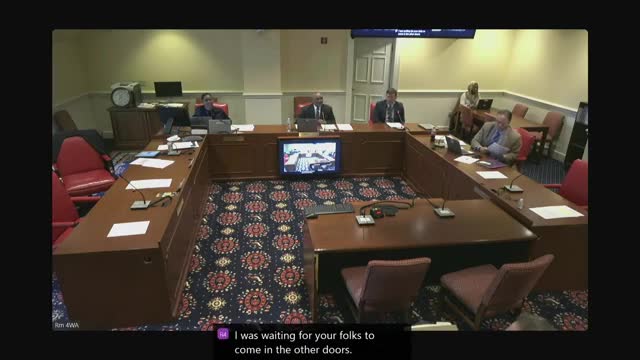
The Maryland Transportation Authority (MDTA) told the Public Safety, Transportation, and Environment Subcommittee on Feb. 20 that reconstruction of the Francis Scott Key Bridge is proceeding under an expedited schedule but that the authority’s financial forecast shows stress that may require systemwide toll adjustments during the forecast period.
Samuel Quist of the Department of Legislative Services told lawmakers MDTA’s fiscal 2026 operating budget is about $595 million and the capital allowance is about $1.06 billion, driven in large part by Key Bridge reconstruction and related projects. Quist said MDTA projects a decline in total revenues tied to the bridge closure and other factors and that DLS’s forecast shows key financial metrics—such as unencumbered cash and debt service coverage—worsening over the projection period.
Paul Wiedefeld, Maryland’s secretary of transportation, and Bruce Gardner, MDTA executive director, gave lawmakers a progress update on the rebuild and outlined funding sources. Wiedefeld said a progressive design‑build contract was awarded five months after the collapse, preconstruction work is underway and demolition and construction are planned to begin later this year. “We started pre construction activities which included underwater surveys and soil samplings,” he said.
MDTA executives described a mix of near‑term funds and expected federal reimbursement. Gardner said MDTA has received $350 million in insurance proceeds; $25 million of those proceeds have been used for salvage and debris costs. He said the authority expected to receive $10 million in Federal Emergency Relief quick‑release funds imminently and the balance of an initial $60 million quick‑release award “shortly.” MDTA will use insurance proceeds under federal rules and seek reimbursement for remaining costs from federal funds when appropriate.
DLS’s traffic and revenue modeling estimates a net revenue loss of about $131.8 million attributable to the Key Bridge collapse over fiscal 2024–2030, though the analysis accounts for some shift of traffic to other MDTA facilities. MDTA reported toll revenue from the Key Bridge of $44.8 million in fiscal 2024 and noted that revenues from other facilities—Fort McHenry Tunnel and I‑95—account for roughly half of total toll revenue.
MDTA also described projected debt and borrowing. DLS noted the General Assembly raised MDTA’s debt cap from $3.0 billion to $4.0 billion in chapter 2 of 2024; MDTA projects total debt outstanding to reach about $2.6 billion in fiscal 2026 and to peak near the revised cap in later years as construction and financing proceed.
Quist said the agency’s financial forecast shows the debt service coverage ratio dropping below 2.0 in fiscal 2028 and unencumbered cash declining to the authority’s policy threshold in fiscal 2026; MDTA told the committee it anticipates starting a toll‑setting process in early calendar 2027 to preserve financial standards. Gardner described the statutory toll‑setting process required by law: the MDTA board proposes a toll, conducts two public comment periods and public hearings at affected facilities, and takes final action—typically a process of about 10 months—pursuant to Transportation Article 4‑3‑12.
Lawmakers also asked about potential non‑reimbursable costs and design choices. MDTA said the rebuild remains largely within the existing footprint, which supports federal reimbursement. Officials said certain aesthetic or lane‑expansion enhancements could be subject to different reimbursement rules and would require further evaluation.
MDTA noted other active programs and risks: Fitch affirmed MDTA’s AA rating with a stable outlook while Moody’s affirmed the rating but placed MDTA on negative outlook citing uncertainties related to the Key Bridge reconstruction and declining debt service coverage. Gardner said MDTA is pursuing customer‑collection improvements—expanding E‑ZPass interoperability, reciprocity agreements with other states and enhanced notice and collection practices—to raise revenue without immediate rate adjustments.
The subcommittee requested copies of MDTA’s financial plan for toll setting and asked MDTA to provide timely updates on federal reimbursements and the key bridge funding timeline. No formal votes were taken at the hearing.
Samuel Quist of the Department of Legislative Services told lawmakers MDTA’s fiscal 2026 operating budget is about $595 million and the capital allowance is about $1.06 billion, driven in large part by Key Bridge reconstruction and related projects. Quist said MDTA projects a decline in total revenues tied to the bridge closure and other factors and that DLS’s forecast shows key financial metrics—such as unencumbered cash and debt service coverage—worsening over the projection period.
Paul Wiedefeld, Maryland’s secretary of transportation, and Bruce Gardner, MDTA executive director, gave lawmakers a progress update on the rebuild and outlined funding sources. Wiedefeld said a progressive design‑build contract was awarded five months after the collapse, preconstruction work is underway and demolition and construction are planned to begin later this year. “We started pre construction activities which included underwater surveys and soil samplings,” he said.
MDTA executives described a mix of near‑term funds and expected federal reimbursement. Gardner said MDTA has received $350 million in insurance proceeds; $25 million of those proceeds have been used for salvage and debris costs. He said the authority expected to receive $10 million in Federal Emergency Relief quick‑release funds imminently and the balance of an initial $60 million quick‑release award “shortly.” MDTA will use insurance proceeds under federal rules and seek reimbursement for remaining costs from federal funds when appropriate.
DLS’s traffic and revenue modeling estimates a net revenue loss of about $131.8 million attributable to the Key Bridge collapse over fiscal 2024–2030, though the analysis accounts for some shift of traffic to other MDTA facilities. MDTA reported toll revenue from the Key Bridge of $44.8 million in fiscal 2024 and noted that revenues from other facilities—Fort McHenry Tunnel and I‑95—account for roughly half of total toll revenue.
MDTA also described projected debt and borrowing. DLS noted the General Assembly raised MDTA’s debt cap from $3.0 billion to $4.0 billion in chapter 2 of 2024; MDTA projects total debt outstanding to reach about $2.6 billion in fiscal 2026 and to peak near the revised cap in later years as construction and financing proceed.
Quist said the agency’s financial forecast shows the debt service coverage ratio dropping below 2.0 in fiscal 2028 and unencumbered cash declining to the authority’s policy threshold in fiscal 2026; MDTA told the committee it anticipates starting a toll‑setting process in early calendar 2027 to preserve financial standards. Gardner described the statutory toll‑setting process required by law: the MDTA board proposes a toll, conducts two public comment periods and public hearings at affected facilities, and takes final action—typically a process of about 10 months—pursuant to Transportation Article 4‑3‑12.
Lawmakers also asked about potential non‑reimbursable costs and design choices. MDTA said the rebuild remains largely within the existing footprint, which supports federal reimbursement. Officials said certain aesthetic or lane‑expansion enhancements could be subject to different reimbursement rules and would require further evaluation.
MDTA noted other active programs and risks: Fitch affirmed MDTA’s AA rating with a stable outlook while Moody’s affirmed the rating but placed MDTA on negative outlook citing uncertainties related to the Key Bridge reconstruction and declining debt service coverage. Gardner said MDTA is pursuing customer‑collection improvements—expanding E‑ZPass interoperability, reciprocity agreements with other states and enhanced notice and collection practices—to raise revenue without immediate rate adjustments.
The subcommittee requested copies of MDTA’s financial plan for toll setting and asked MDTA to provide timely updates on federal reimbursements and the key bridge funding timeline. No formal votes were taken at the hearing.
Don't Miss a Word: See the Full Meeting!
Go beyond summaries. Unlock every video, transcript, and key insight with a Founder Membership.
✓
Get instant access to full meeting videos
✓
Search and clip any phrase from complete transcripts
✓
Receive AI-powered summaries & custom alerts
✓
Enjoy lifetime, unrestricted access to government data
30-day money-back guarantee
