Bozeman study commission frames 18-month timetable and outreach plan for charter study
February 06, 2025 | Bozeman City, Gallatin County, Montana
This article was created by AI summarizing key points discussed. AI makes mistakes, so for full details and context, please refer to the video of the full meeting. Please report any errors so we can fix them. Report an error »
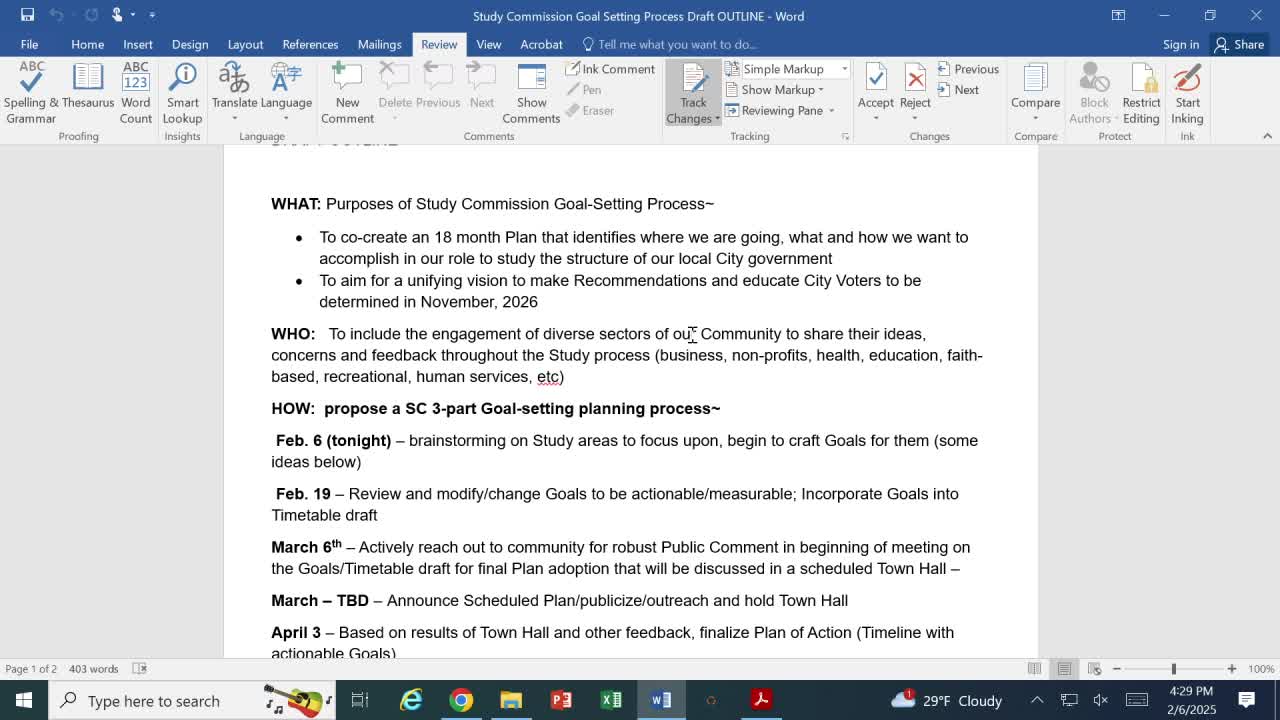
The Bozeman Study Commission spent the bulk of its Feb. 6 session shaping goals and a timetable for an 18-month review of the city’s charter and governance, saying the group will prioritize education, broad community engagement and a final report that could lead to ballot action.
Members proposed a compact set of ends: 1) develop a comprehensive understanding of how Bozeman’s current government operates and where the charter affects operations; 2) run a transparent, inclusive public study process that solicits input from diverse neighborhoods and stakeholders; 3) distill issues and dispense accessible information (one-pagers, FAQs and background summaries) so residents can give informed feedback; and 4) prepare a draft and final report that will be presented in the required public hearings and, if applicable, lead to recommended charter changes for a future ballot.
Commissioners agreed on an 18-month planning horizon that would aim outreach and education at voters in the months before a November 2026 election if the commission’s recommendations require a ballot measure. Staff reminded the commission of a statutory publication requirement tied to the study timeline: the body must publish a timetable within 90 days of the commission’s organizational meeting. The group set two near-term deadlines to meet that requirement: a focused meeting on Feb. 19 to draft and refine the timetable and an absolute deadline on March 6 to finalize it for publication if needed.
Members debated a structure for the work: several described a repeated three-part cycle for each subject area—education (what exists and how it works), engagement (town halls, sector meetings, surveys and targeted outreach) and distillation (issue briefs and draft recommendations). Commissioners proposed that some topic briefs (for example, how mayoral succession and the deputy-mayor provision work today) be developed as short “pros-and-cons” documents for both the commission and the public.
City staff and the city attorney offered to provide foundational education sessions about the charter and legal limits. City Attorney Greg Sullivan told commissioners that an hour-long briefing could give a baseline understanding of how the charter and state law interact; he warned that the charter’s relationship with state law and the limits on municipal self-government can be nuanced and can’t be fully covered in a short block of time.
Commissioners discussed outreach logistics: holding multiple sessions at varied times and locations, using the city’s e-notification system and digital tools, planning town halls with refreshments and an educational component, and contracting outside vendors for surveys, best-practice research or to draft major report sections if the commission chooses. Members also proposed adding a short preamble or “North Star” statement to agendas to remind participants of the commission’s purpose.
Commissioners asked staff to produce a timetable that captures hard dates (publication deadlines and required hearings) while allowing overlapping education and engagement activities. Several commissioners volunteered to draft topic briefs that summarize pros, cons and key questions for public discussion. The commission did not vote on policy changes at this meeting; instead it agreed to return with a draft timetable and a short goals statement at its next meeting.
Members proposed a compact set of ends: 1) develop a comprehensive understanding of how Bozeman’s current government operates and where the charter affects operations; 2) run a transparent, inclusive public study process that solicits input from diverse neighborhoods and stakeholders; 3) distill issues and dispense accessible information (one-pagers, FAQs and background summaries) so residents can give informed feedback; and 4) prepare a draft and final report that will be presented in the required public hearings and, if applicable, lead to recommended charter changes for a future ballot.
Commissioners agreed on an 18-month planning horizon that would aim outreach and education at voters in the months before a November 2026 election if the commission’s recommendations require a ballot measure. Staff reminded the commission of a statutory publication requirement tied to the study timeline: the body must publish a timetable within 90 days of the commission’s organizational meeting. The group set two near-term deadlines to meet that requirement: a focused meeting on Feb. 19 to draft and refine the timetable and an absolute deadline on March 6 to finalize it for publication if needed.
Members debated a structure for the work: several described a repeated three-part cycle for each subject area—education (what exists and how it works), engagement (town halls, sector meetings, surveys and targeted outreach) and distillation (issue briefs and draft recommendations). Commissioners proposed that some topic briefs (for example, how mayoral succession and the deputy-mayor provision work today) be developed as short “pros-and-cons” documents for both the commission and the public.
City staff and the city attorney offered to provide foundational education sessions about the charter and legal limits. City Attorney Greg Sullivan told commissioners that an hour-long briefing could give a baseline understanding of how the charter and state law interact; he warned that the charter’s relationship with state law and the limits on municipal self-government can be nuanced and can’t be fully covered in a short block of time.
Commissioners discussed outreach logistics: holding multiple sessions at varied times and locations, using the city’s e-notification system and digital tools, planning town halls with refreshments and an educational component, and contracting outside vendors for surveys, best-practice research or to draft major report sections if the commission chooses. Members also proposed adding a short preamble or “North Star” statement to agendas to remind participants of the commission’s purpose.
Commissioners asked staff to produce a timetable that captures hard dates (publication deadlines and required hearings) while allowing overlapping education and engagement activities. Several commissioners volunteered to draft topic briefs that summarize pros, cons and key questions for public discussion. The commission did not vote on policy changes at this meeting; instead it agreed to return with a draft timetable and a short goals statement at its next meeting.
Don't Miss a Word: See the Full Meeting!
Go beyond summaries. Unlock every video, transcript, and key insight with a Founder Membership.
✓
Get instant access to full meeting videos
✓
Search and clip any phrase from complete transcripts
✓
Receive AI-powered summaries & custom alerts
✓
Enjoy lifetime, unrestricted access to government data
30-day money-back guarantee
