Committee backs 60-day window to let some solar customers transfer renewable certificates
May 09, 2025 | Environment & Energy, HOUSE OF REPRESENTATIVES, Committees, Legislative , Vermont
This article was created by AI summarizing key points discussed. AI makes mistakes, so for full details and context, please refer to the video of the full meeting. Please report any errors so we can fix them. Report an error »
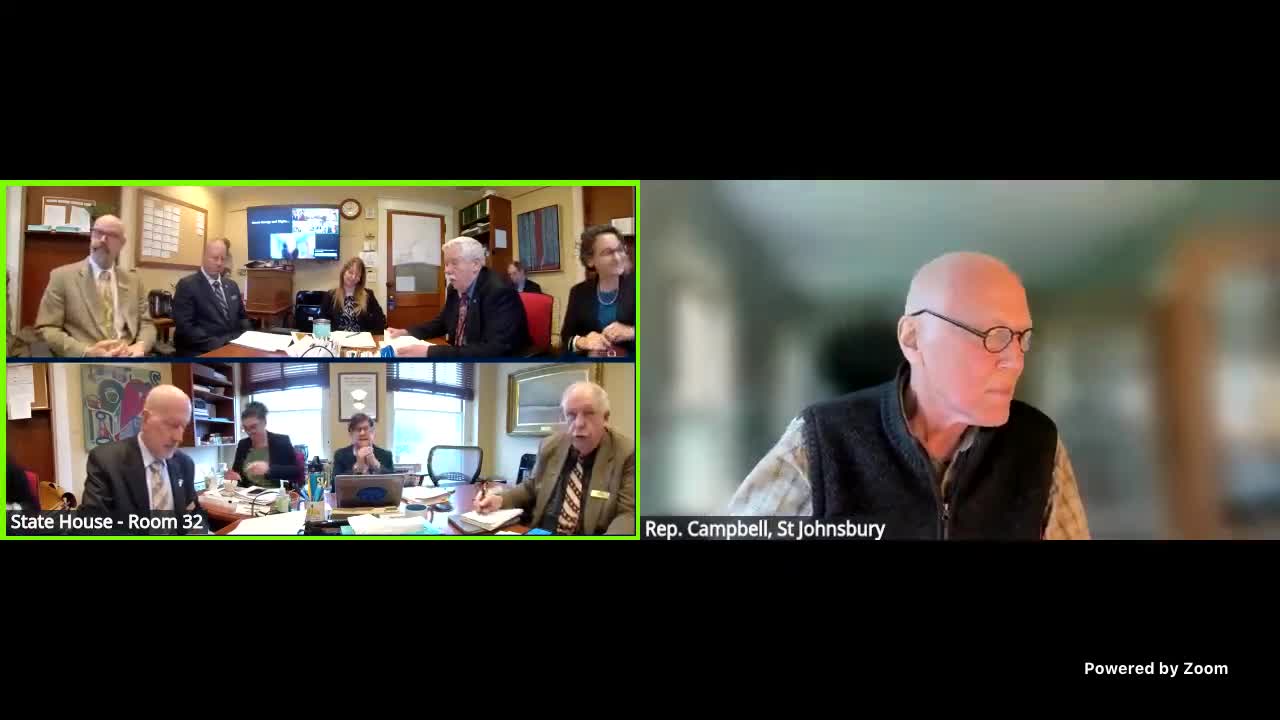
House Energy and Digital Infrastructure on May 9 took a straw poll to concur with a Senate amendment to S 50 that would give certain net‑metered solar customers a one‑time opportunity to transfer renewable energy certificates (RECs) to their utility.
The amendment creates a limited look‑back: “The Public Utility Commission shall allow [a] customer who owns a net metering system that was commissioned between 01/01/2023 and 07/01/2025 to change the customer's decision to retain the attributes once,” legislative counsel Ellen Jegowsky told the committee, reading the amendment’s text. The window for customers to submit a request to the Public Utility Commission (PUC) is Sept. 2, 2025, a period described in committee discussion as roughly 60 days.
Why it matters: the change aims to give customers whose systems already came online a single chance to reverse or adjust an earlier choice about keeping RECs — a choice that the committee’s underlying bill otherwise makes available only prospectively. Committee members and witnesses said the provision responds to a small number of customers who contacted lawmakers saying they or their installers made an error when enrolling in net metering.
Committee discussion and technical points came from PUC and industry representatives. Greg, identified in the record as PUC staff, said the commission was aware of only one customer who had raised the issue; the sponsoring senator had identified a second. "We would only be aware of it if someone comes to us," Greg told the committee. "It is quite possible that there are people out there in this very small window that made a mistake and chose not to come to us."
Industry and utility witnesses said the universe of net‑metered systems that came online in the relevant timeframe is larger, but only a small share likely retained their RECs. One industry speaker said "there are a couple thousand people who signed up for net metering in that window," but estimated "maybe a hundred" at most kept their RECs. "Of those, the only ones who would act are the ones who'd regret that decision," the witness added.
Committee members asked whether the amendment makes payments retroactive and whether transferring RECs would affect other ratepayers. Rep. Southworth asked, "If someone decides to do this, are payments retroactive?" The committee was told explicitly that payments would not be retroactive: "They're not retroactive," Ellen Jegowsky said. Dylan, speaking for a utility perspective, explained that if a customer returns a REC to a utility the utility would retire it to satisfy obligations rather than sell it, so the utility would not generate revenue from that REC. Dylan added that the small expected number of transfers makes a large impact to rates unlikely, but conceded there is a marginal cost to utilities.
Rob Kleppner, speaking from the industry perspective, said his understanding was that utilities typically offer a lower effective rate when they obtain RECs because the utility can use or monetize those RECs: "My sense is it shouldn't hit other ratepayers at all," he said, while inviting correction from other industry experts.
On outreach, Representative Campbell asked how eligible customers would be notified. Committee members and witnesses said installers are likely to be aware and to pass information to customers because installers often complete enrollment paperwork on customers’ behalf.
The committee took a voice straw poll to concur with the Senate’s amendment; members indicated support and the chair reported the results in the affirmative. Committee members noted the vote was a straw poll only because the committee no longer holds the bill; S 50 is on the notice calendar and the full House is expected to vote on the Senate amendment Tuesday. If the House concurs, the bill would be sent to the governor with the amendment unchanged.
Discussion versus decision: committee members debated scope, likely number of affected customers, and potential rate impacts (discussion). The panel asked PUC and utility representatives for information and clarified that the proposal is not intended to be retroactive for payments (clarification/direction). The committee’s formal action was a straw poll to concur with the Senate amendment; the recorded formal floor vote will occur in the House on Tuesday (formal action: straw poll to concur; next formal vote scheduled on House floor).
The amendment creates a limited look‑back: “The Public Utility Commission shall allow [a] customer who owns a net metering system that was commissioned between 01/01/2023 and 07/01/2025 to change the customer's decision to retain the attributes once,” legislative counsel Ellen Jegowsky told the committee, reading the amendment’s text. The window for customers to submit a request to the Public Utility Commission (PUC) is Sept. 2, 2025, a period described in committee discussion as roughly 60 days.
Why it matters: the change aims to give customers whose systems already came online a single chance to reverse or adjust an earlier choice about keeping RECs — a choice that the committee’s underlying bill otherwise makes available only prospectively. Committee members and witnesses said the provision responds to a small number of customers who contacted lawmakers saying they or their installers made an error when enrolling in net metering.
Committee discussion and technical points came from PUC and industry representatives. Greg, identified in the record as PUC staff, said the commission was aware of only one customer who had raised the issue; the sponsoring senator had identified a second. "We would only be aware of it if someone comes to us," Greg told the committee. "It is quite possible that there are people out there in this very small window that made a mistake and chose not to come to us."
Industry and utility witnesses said the universe of net‑metered systems that came online in the relevant timeframe is larger, but only a small share likely retained their RECs. One industry speaker said "there are a couple thousand people who signed up for net metering in that window," but estimated "maybe a hundred" at most kept their RECs. "Of those, the only ones who would act are the ones who'd regret that decision," the witness added.
Committee members asked whether the amendment makes payments retroactive and whether transferring RECs would affect other ratepayers. Rep. Southworth asked, "If someone decides to do this, are payments retroactive?" The committee was told explicitly that payments would not be retroactive: "They're not retroactive," Ellen Jegowsky said. Dylan, speaking for a utility perspective, explained that if a customer returns a REC to a utility the utility would retire it to satisfy obligations rather than sell it, so the utility would not generate revenue from that REC. Dylan added that the small expected number of transfers makes a large impact to rates unlikely, but conceded there is a marginal cost to utilities.
Rob Kleppner, speaking from the industry perspective, said his understanding was that utilities typically offer a lower effective rate when they obtain RECs because the utility can use or monetize those RECs: "My sense is it shouldn't hit other ratepayers at all," he said, while inviting correction from other industry experts.
On outreach, Representative Campbell asked how eligible customers would be notified. Committee members and witnesses said installers are likely to be aware and to pass information to customers because installers often complete enrollment paperwork on customers’ behalf.
The committee took a voice straw poll to concur with the Senate’s amendment; members indicated support and the chair reported the results in the affirmative. Committee members noted the vote was a straw poll only because the committee no longer holds the bill; S 50 is on the notice calendar and the full House is expected to vote on the Senate amendment Tuesday. If the House concurs, the bill would be sent to the governor with the amendment unchanged.
Discussion versus decision: committee members debated scope, likely number of affected customers, and potential rate impacts (discussion). The panel asked PUC and utility representatives for information and clarified that the proposal is not intended to be retroactive for payments (clarification/direction). The committee’s formal action was a straw poll to concur with the Senate amendment; the recorded formal floor vote will occur in the House on Tuesday (formal action: straw poll to concur; next formal vote scheduled on House floor).
Don't Miss a Word: See the Full Meeting!
Go beyond summaries. Unlock every video, transcript, and key insight with a Founder Membership.
✓
Get instant access to full meeting videos
✓
Search and clip any phrase from complete transcripts
✓
Receive AI-powered summaries & custom alerts
✓
Enjoy lifetime, unrestricted access to government data
30-day money-back guarantee
