Lawmakers revise community housing infrastructure bill and set $14 million cap on education tax increment commitments
May 09, 2025 | Ways & Means, HOUSE OF REPRESENTATIVES, Committees, Legislative , Vermont
This article was created by AI summarizing key points discussed. AI makes mistakes, so for full details and context, please refer to the video of the full meeting. Please report any errors so we can fix them. Report an error »
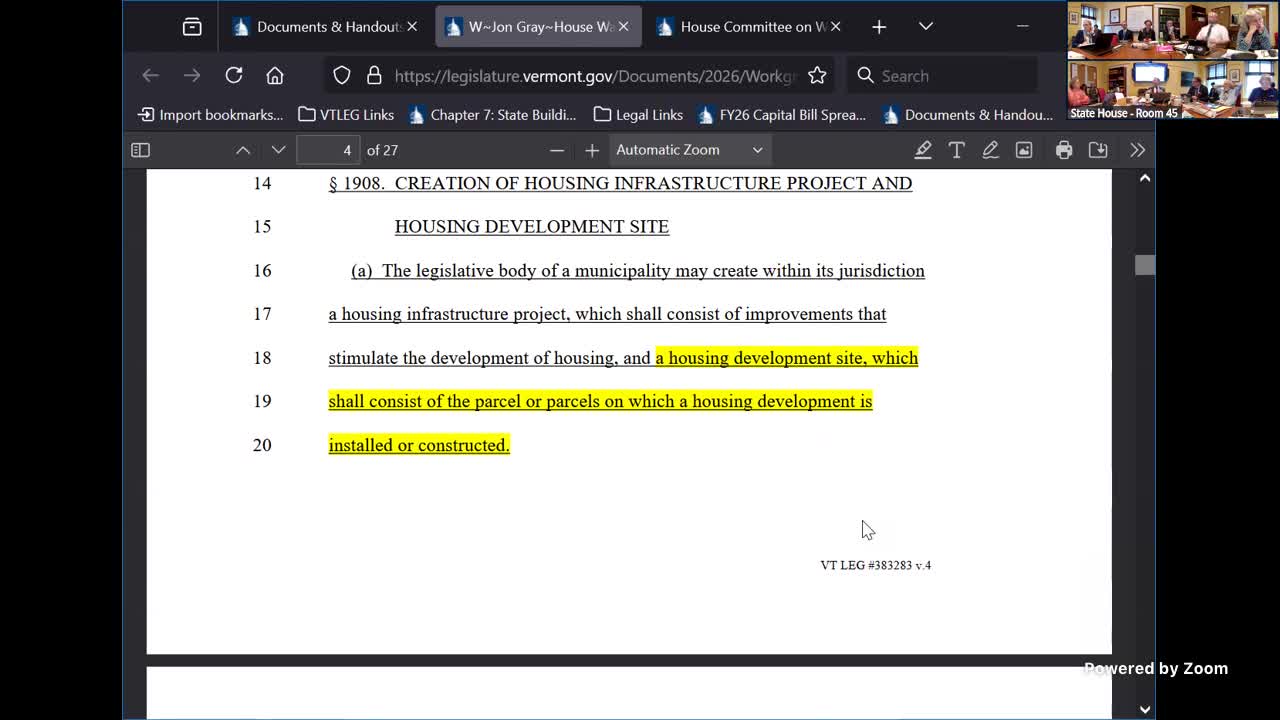
A legislative working session on May 9 reviewed amended language for a draft community and housing infrastructure bill (S.127), focusing on definitions of affordable housing, the list of eligible infrastructure improvements, which parcels count as a project site, the roles of two review bodies, and a $14,000,000 cap on education property tax increment commitments.
John Gray, Office of Legislative Counsel, walked the group through the draft changes, saying on the definitions work: "on page 1, we're starting with updates to the affordable housing definitions." He described the amended affordable-housing definition as housing "that’s subject to a housing subsidy covenant" and noted the draft picks up covenants required under an existing title-27 definition and specifies affordability "in perpetuity." Gray said the draft defines an "affordable housing development" as a housing development in which "at least 20% of the units are affordable housing units," and removes a prior minimum-5-unit floor found in a title-24 construct.
The draft also narrows the enumerated "improvements" that the program may fund. Gray said the earlier draft had included power and telecommunications but that language was removed and replaced by a more limited, exhaustive list that explicitly references wastewater, stormwater, public roads, sidewalks and streetscapes. In discussing the language, a committee member asked whether "public roads, streets and bridges" should be limited to publicly owned facilities; Gray advised that if the drafters intend to require public ownership they should attach the qualifier consistently.
The bill text tightens what counts as the "housing development site." Gray said the new language defines the site as "the parcel or parcels on which that housing development is installed or constructed and nothing else," excluding immediately adjacent parcels and thereby reducing the geographic area that could generate increment for a project.
The draft moves a key "but‑for" or financial buffer test from the general administrative entity to a separate board. Under the revised structure, Gray said, "the board shall review each application to determine two things: whether the proposed housing development furthers the purposes of section 19o7... and they’re also going to conduct the buffer test." He described that the administrative agency (referred to in the draft as "Pepsi" in the transcript) would retain rulemaking and process responsibilities but would have a narrowed project-criterion check limited to a floor-area requirement (the draft calls for at least 65% of the project’s floor area to be dedicated to housing).
The session also addressed limits on how much education property tax increment the housing program may commit. Gray summarized draft language that "Betsy shall not approve" an education property tax increment potential greater than $14,000,000, explaining that the number is rounded from a calculation tied to a uniform-rate change in fiscal year 2025. Representative Volker asked two clarifying questions about that limit — whether it was total or annual and whether skewing projects toward affordable housing would make the cap go farther. Gray replied that, as drafted, the cap applies exclusively to the housing infrastructure program (referred to in the discussion as CHIP) and that clarification was needed about whether the cap is cumulative or annual; participants then discussed changing the text to make it a cumulative cap rather than an annual one.
The draft would also change the timing for setting the "OTP" (original taxable property/value) for projects: rather than fixing OTP at district creation (as done in some TIF-like districts), the draft sets OTP upon approval of financing. Gray said that approach would make the OTP reflect a project's permits and value at the time of approval rather than at an earlier district-creation date.
Other notable draft changes reviewed included: a potential reduction in the share of education increment retained for the program (discussion recorded about moving from 70% to 60% pending Representative Feltes' input); a five-year administrative check-in that allows the administrative agency to reduce the retention percentage if financing is over-covered; and a scheduled expansion of eligible location categories to add a Tier‑2 designation effective Jan. 1, 2028, pending further input.
Gray and others identified members and designees intended for the review board, naming the Vermont Housing Conservation Board, the Department of Housing and Community Development, the Vermont Bond Bank, the Vermont Council on Rural Development, a representative of regional planning commissions, and the executive director of the Vermont School Boards Association as participants in the board composition described in the draft.
The working session made clear the group’s timeline for finishing language: "We do need to finalize our language by the end of the day so that, John can have everything he needs to offer us a clean copy so we can vote at 9AM on Tuesday before the floor. So that means that we all need to be here at 9AM on Tuesday," a committee member said at the start of the meeting. No formal votes or final approvals were recorded during this session; staff and legislators signaled further drafting and follow-up work would continue that afternoon and into the next week.
John Gray, Office of Legislative Counsel, walked the group through the draft changes, saying on the definitions work: "on page 1, we're starting with updates to the affordable housing definitions." He described the amended affordable-housing definition as housing "that’s subject to a housing subsidy covenant" and noted the draft picks up covenants required under an existing title-27 definition and specifies affordability "in perpetuity." Gray said the draft defines an "affordable housing development" as a housing development in which "at least 20% of the units are affordable housing units," and removes a prior minimum-5-unit floor found in a title-24 construct.
The draft also narrows the enumerated "improvements" that the program may fund. Gray said the earlier draft had included power and telecommunications but that language was removed and replaced by a more limited, exhaustive list that explicitly references wastewater, stormwater, public roads, sidewalks and streetscapes. In discussing the language, a committee member asked whether "public roads, streets and bridges" should be limited to publicly owned facilities; Gray advised that if the drafters intend to require public ownership they should attach the qualifier consistently.
The bill text tightens what counts as the "housing development site." Gray said the new language defines the site as "the parcel or parcels on which that housing development is installed or constructed and nothing else," excluding immediately adjacent parcels and thereby reducing the geographic area that could generate increment for a project.
The draft moves a key "but‑for" or financial buffer test from the general administrative entity to a separate board. Under the revised structure, Gray said, "the board shall review each application to determine two things: whether the proposed housing development furthers the purposes of section 19o7... and they’re also going to conduct the buffer test." He described that the administrative agency (referred to in the draft as "Pepsi" in the transcript) would retain rulemaking and process responsibilities but would have a narrowed project-criterion check limited to a floor-area requirement (the draft calls for at least 65% of the project’s floor area to be dedicated to housing).
The session also addressed limits on how much education property tax increment the housing program may commit. Gray summarized draft language that "Betsy shall not approve" an education property tax increment potential greater than $14,000,000, explaining that the number is rounded from a calculation tied to a uniform-rate change in fiscal year 2025. Representative Volker asked two clarifying questions about that limit — whether it was total or annual and whether skewing projects toward affordable housing would make the cap go farther. Gray replied that, as drafted, the cap applies exclusively to the housing infrastructure program (referred to in the discussion as CHIP) and that clarification was needed about whether the cap is cumulative or annual; participants then discussed changing the text to make it a cumulative cap rather than an annual one.
The draft would also change the timing for setting the "OTP" (original taxable property/value) for projects: rather than fixing OTP at district creation (as done in some TIF-like districts), the draft sets OTP upon approval of financing. Gray said that approach would make the OTP reflect a project's permits and value at the time of approval rather than at an earlier district-creation date.
Other notable draft changes reviewed included: a potential reduction in the share of education increment retained for the program (discussion recorded about moving from 70% to 60% pending Representative Feltes' input); a five-year administrative check-in that allows the administrative agency to reduce the retention percentage if financing is over-covered; and a scheduled expansion of eligible location categories to add a Tier‑2 designation effective Jan. 1, 2028, pending further input.
Gray and others identified members and designees intended for the review board, naming the Vermont Housing Conservation Board, the Department of Housing and Community Development, the Vermont Bond Bank, the Vermont Council on Rural Development, a representative of regional planning commissions, and the executive director of the Vermont School Boards Association as participants in the board composition described in the draft.
The working session made clear the group’s timeline for finishing language: "We do need to finalize our language by the end of the day so that, John can have everything he needs to offer us a clean copy so we can vote at 9AM on Tuesday before the floor. So that means that we all need to be here at 9AM on Tuesday," a committee member said at the start of the meeting. No formal votes or final approvals were recorded during this session; staff and legislators signaled further drafting and follow-up work would continue that afternoon and into the next week.
Don't Miss a Word: See the Full Meeting!
Go beyond summaries. Unlock every video, transcript, and key insight with a Founder Membership.
✓
Get instant access to full meeting videos
✓
Search and clip any phrase from complete transcripts
✓
Receive AI-powered summaries & custom alerts
✓
Enjoy lifetime, unrestricted access to government data
30-day money-back guarantee
