High Springs budget workshop: Parks director outlines sports-complex work, pavilion move, cameras and public Wi‑Fi
May 09, 2025 | High Springs, Alachua County, Florida
This article was created by AI summarizing key points discussed. AI makes mistakes, so for full details and context, please refer to the video of the full meeting. Please report any errors so we can fix them. Report an error »
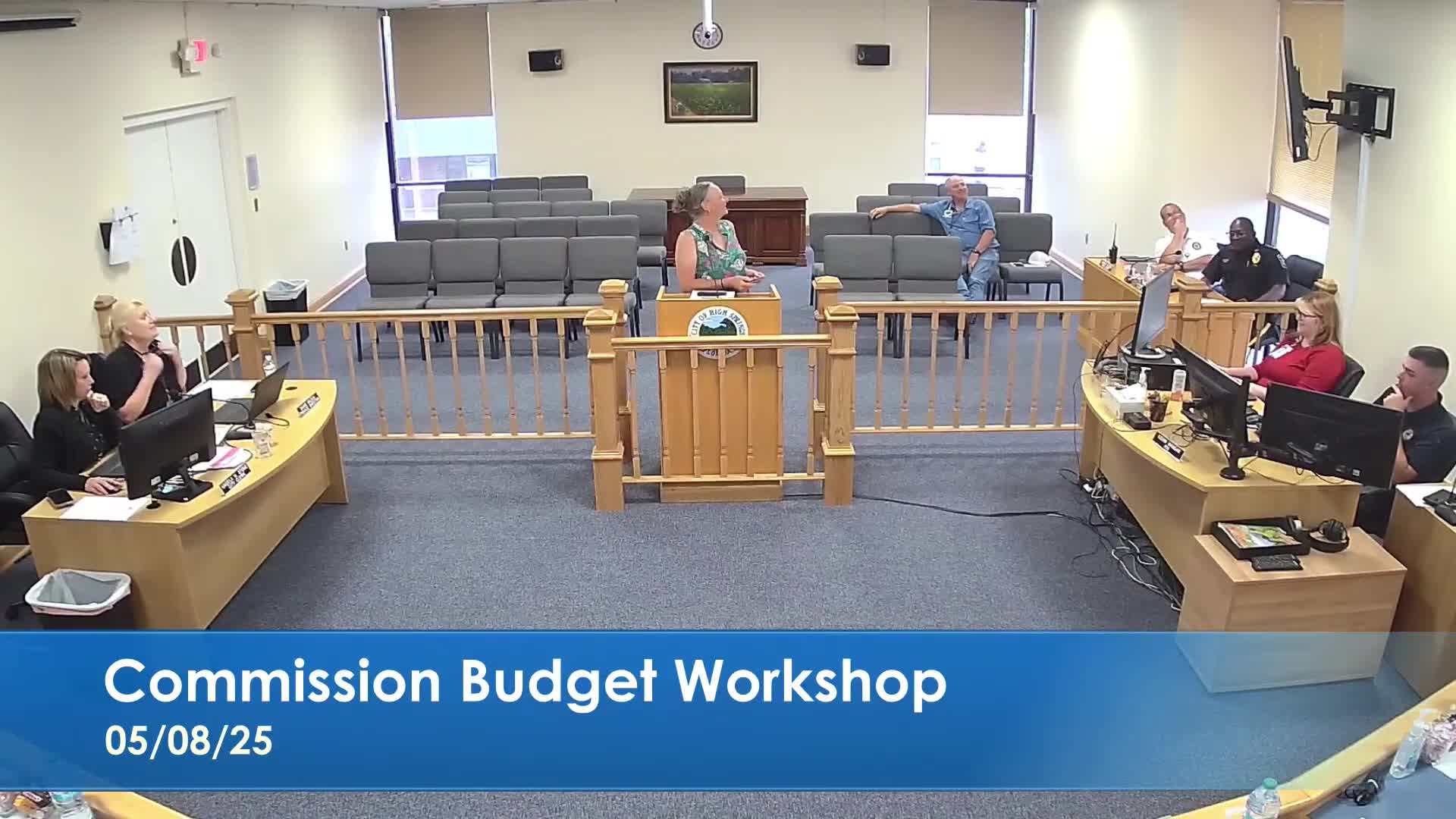
At a city budget workshop, High Springs Parks and Recreation Director Jennifer Appleby presented the department’s operating and capital priorities and answered commissioners’ questions about safety, equipment and funding.
The presentation matters because the department is proposing capital work that would be paid from existing Wild Spaces allocations and other fund lines, and the projects affect park safety, scheduled programming and facility operations for residents across the city.
Appleby said the department has four employees — two grounds maintenance staff, one grounds foreman and herself — and that operating and repair lines are allocated separately: “Repair and maintenance has more money allocated to it because those are usually high cost repairs,” she said, explaining the difference between recurring operating supplies and larger replacement or emergency costs. She listed utilities, property and liability insurance, vehicle and equipment repairs, tree maintenance and small equipment as ongoing costs and noted some contract services such as portable toilets for big events at the sports complex.
On capital work, Appleby said crews have begun field resurfacing at the sports complex and that the city plans to demolish an existing pavilion to free space and build a new pavilion/concession/bathroom structure behind the playground. She said the Lions Club will reuse the removed pavilion. Appleby also said the Canoe Outpost debt service remains on the books and that the Douglas Community Center parking lot needs paving; she described additional retrofit work inside the Douglas building, including soundproofing.
Appleby proposed using Wild Spaces funds for several items at Memorial Park, including cameras and public Wi‑Fi. She said much of the camera equipment “was already purchased previous,” and that the Memorial Park site was prioritized because the facility has been the target of break‑ins and vandalism and also houses wells. When a commissioner raised questions about video storage and monitoring, Appleby said the city is working with Emerald Data to determine recording schedules, storage capacity and monitoring options and that 24‑hour recording would require more storage and management.
The department also plans to pursue solar exterior lighting for parks to reduce electricity costs and address safety concerns at several sites, including Walter Howard and Catherine Taylor parks. Appleby said the parks master plan is finalized and expected to be presented at the next commission meeting.
On recreation programs, Appleby reported that registration and sponsorships cover most season costs. She said soccer teams were fully sponsored this season and called fees a pass‑through to pay league dues, permits and uniforms. She announced a new adult softball league that begins play in mid‑June; she said registration was open and that five teams had signed up so far. “Team fees are $3.50 for the team, and all that will go actually back into recreation,” Appleby said.
Commissioners asked about rental policies after one renter reportedly left the Civic Center kitchen unclean; Appleby said the city inspects rentals after events and withholds deposits when users leave facilities in poor condition. She also confirmed that if the department purchases new mowers or other large equipment the cost would come from the larger repair-and-maintenance capital line rather than small operating lines.
Appleby closed by thanking volunteers and partners for supporting programming and said she would bring the parks and recreation master plan to the commission for formal consideration.
Funding and next steps: Appleby identified several funding lines (operating, utilities, repair and maintenance, Wild Spaces and sponsorships) and described Wild Spaces as the likely source for cameras, paved parking at the Canoe Outpost/Douglas and some field equipment; she said staff will continue to refine costs and present recommendations to the commission.
The presentation matters because the department is proposing capital work that would be paid from existing Wild Spaces allocations and other fund lines, and the projects affect park safety, scheduled programming and facility operations for residents across the city.
Appleby said the department has four employees — two grounds maintenance staff, one grounds foreman and herself — and that operating and repair lines are allocated separately: “Repair and maintenance has more money allocated to it because those are usually high cost repairs,” she said, explaining the difference between recurring operating supplies and larger replacement or emergency costs. She listed utilities, property and liability insurance, vehicle and equipment repairs, tree maintenance and small equipment as ongoing costs and noted some contract services such as portable toilets for big events at the sports complex.
On capital work, Appleby said crews have begun field resurfacing at the sports complex and that the city plans to demolish an existing pavilion to free space and build a new pavilion/concession/bathroom structure behind the playground. She said the Lions Club will reuse the removed pavilion. Appleby also said the Canoe Outpost debt service remains on the books and that the Douglas Community Center parking lot needs paving; she described additional retrofit work inside the Douglas building, including soundproofing.
Appleby proposed using Wild Spaces funds for several items at Memorial Park, including cameras and public Wi‑Fi. She said much of the camera equipment “was already purchased previous,” and that the Memorial Park site was prioritized because the facility has been the target of break‑ins and vandalism and also houses wells. When a commissioner raised questions about video storage and monitoring, Appleby said the city is working with Emerald Data to determine recording schedules, storage capacity and monitoring options and that 24‑hour recording would require more storage and management.
The department also plans to pursue solar exterior lighting for parks to reduce electricity costs and address safety concerns at several sites, including Walter Howard and Catherine Taylor parks. Appleby said the parks master plan is finalized and expected to be presented at the next commission meeting.
On recreation programs, Appleby reported that registration and sponsorships cover most season costs. She said soccer teams were fully sponsored this season and called fees a pass‑through to pay league dues, permits and uniforms. She announced a new adult softball league that begins play in mid‑June; she said registration was open and that five teams had signed up so far. “Team fees are $3.50 for the team, and all that will go actually back into recreation,” Appleby said.
Commissioners asked about rental policies after one renter reportedly left the Civic Center kitchen unclean; Appleby said the city inspects rentals after events and withholds deposits when users leave facilities in poor condition. She also confirmed that if the department purchases new mowers or other large equipment the cost would come from the larger repair-and-maintenance capital line rather than small operating lines.
Appleby closed by thanking volunteers and partners for supporting programming and said she would bring the parks and recreation master plan to the commission for formal consideration.
Funding and next steps: Appleby identified several funding lines (operating, utilities, repair and maintenance, Wild Spaces and sponsorships) and described Wild Spaces as the likely source for cameras, paved parking at the Canoe Outpost/Douglas and some field equipment; she said staff will continue to refine costs and present recommendations to the commission.
Don't Miss a Word: See the Full Meeting!
Go beyond summaries. Unlock every video, transcript, and key insight with a Founder Membership.
✓
Get instant access to full meeting videos
✓
Search and clip any phrase from complete transcripts
✓
Receive AI-powered summaries & custom alerts
✓
Enjoy lifetime, unrestricted access to government data
30-day money-back guarantee
