Seagrass nursery network expands capacity and tests new methods to speed restoration
May 09, 2025 | Sebastian , Indian River County, Florida
This article was created by AI summarizing key points discussed. AI makes mistakes, so for full details and context, please refer to the video of the full meeting. Please report any errors so we can fix them. Report an error »
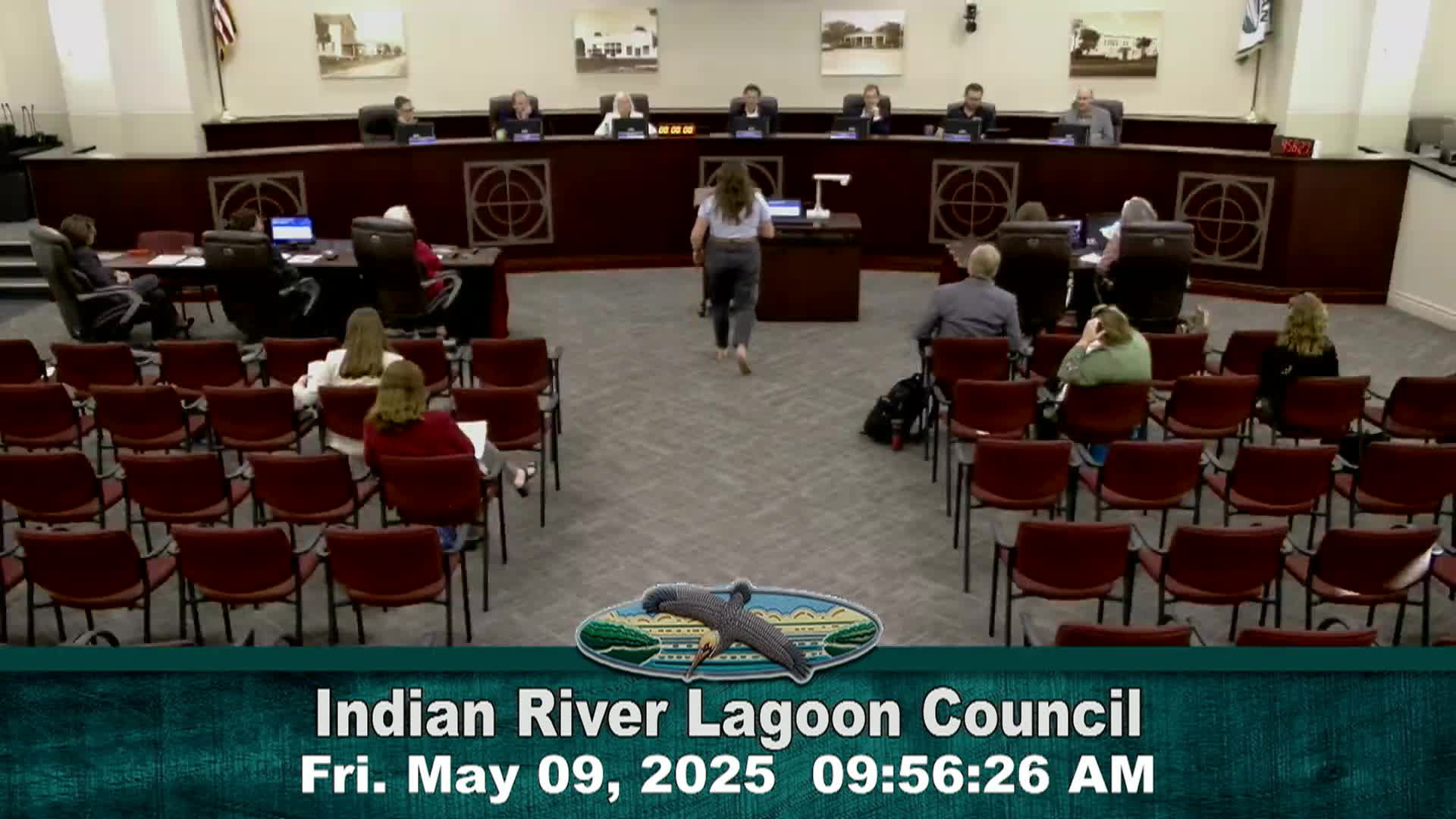
Marine Discovery Center, Restore Our Shores, Florida Oceanographic Society, Harbor Branch, and Sea and Shoreline described new nurseries, research and pilot plantings Friday as part of the Indian River Lagoon Council meeting.
The nursery partners said they have increased production capacity, tested experimental plantings and developed techniques to improve survival. Tess Taylor Tynes, conservation science coordinator at the Marine Discovery Center, described construction of 16 raceway tanks and a 12,000-gallon-per-hour effluent pond that will stage plants and restoration materials. "We are now focused on the last two items . . . creating our seagrass and clam stock," Tynes said.
Why it matters: managers agreed that nursery capacity must grow alongside water-quality work. Speakers asked for clearer permitting and faster pathways to deploy plants into the lagoon so production can translate to field benefits.
Nurseries and experiments
Tyler Provancha, conservation manager with Restore Our Shores, said his group has two nurseries and has planted 5,000 halodule shoots so far in 2025 for a comparison study with calerpa prolifera. "We've currently planted 5,000 shoots so far to do a comparison study," Provancha said. He described ongoing mesocosm experiments in collaboration with Mote Marine Laboratory, University of Central Florida and Florida Institute of Technology investigating sediment and fertilizer effects on outplant success.
Krista McCoy, director of conservation research at Florida Oceanographic Society, said her group upgraded 34 "front of house" nursery tanks and added wavemakers and other realism to test whether more natural conditions reduce transplant stress. "We're interested in identifying the genetic profile of our seagrasses and . . . what exactly are the genes that are driving resilience," McCoy said, describing a plan to match strains to stressors.
Harbor Branch research technician Richard Mulroy outlined a near-term expansion funded by the Harbor Branch Foundation and FWC: 24 additional tanks to reach 330 square meters of grow-out area and new mesocosms for controlled experiments on light, nutrients, temperature and flow.
Sea and Shoreline's director of marine aquaculture, John Thann, described a production facility north of Sebastian Inlet that currently houses 12 large vats and is permitted to plant 500,000 units this year across 97 acres. He demonstrated experimental planting bags to encourage root growth and a drone-deployment bag system developed with Bethune-Cookman University. "We need more plants. We need more plants. We need more plants," Thann said, urging agencies to streamline permits and approve deployment sites.
Technical advances and seed work
Partners reported several technical successes: seed collection across 70 sediment sampling sites (more Ruppia than Halodule seeds detected), nurseries documenting flowering and seed production, and in some cases induced or natural flowering that researchers want to replicate in lab conditions. Provancha reported finding 64 male Halodule flowers in a nursery subsection; Sea and Shoreline reported >10,000 seeds harvested from their nursery.
Permitting and deployment
Multiple presenters flagged permitting as a bottleneck. Thann described confusion over permit language for growing and deploying plant stock and asked the council to coordinate with permitting agencies to ease establishment of large-scale nurseries and deployment sites. Several speakers and council members said volunteers remain essential to maintenance and planting operations.
Next steps and outlook
Nurseries said their near-term priorities are scaling production, standardizing genetic and provenance practices, publishing experiments, and deploying plants at priority sites. The council also discussed routing a portion of recent federal funds to the nursery network in its funding decisions earlier in the meeting.
The nursery partners said they have increased production capacity, tested experimental plantings and developed techniques to improve survival. Tess Taylor Tynes, conservation science coordinator at the Marine Discovery Center, described construction of 16 raceway tanks and a 12,000-gallon-per-hour effluent pond that will stage plants and restoration materials. "We are now focused on the last two items . . . creating our seagrass and clam stock," Tynes said.
Why it matters: managers agreed that nursery capacity must grow alongside water-quality work. Speakers asked for clearer permitting and faster pathways to deploy plants into the lagoon so production can translate to field benefits.
Nurseries and experiments
Tyler Provancha, conservation manager with Restore Our Shores, said his group has two nurseries and has planted 5,000 halodule shoots so far in 2025 for a comparison study with calerpa prolifera. "We've currently planted 5,000 shoots so far to do a comparison study," Provancha said. He described ongoing mesocosm experiments in collaboration with Mote Marine Laboratory, University of Central Florida and Florida Institute of Technology investigating sediment and fertilizer effects on outplant success.
Krista McCoy, director of conservation research at Florida Oceanographic Society, said her group upgraded 34 "front of house" nursery tanks and added wavemakers and other realism to test whether more natural conditions reduce transplant stress. "We're interested in identifying the genetic profile of our seagrasses and . . . what exactly are the genes that are driving resilience," McCoy said, describing a plan to match strains to stressors.
Harbor Branch research technician Richard Mulroy outlined a near-term expansion funded by the Harbor Branch Foundation and FWC: 24 additional tanks to reach 330 square meters of grow-out area and new mesocosms for controlled experiments on light, nutrients, temperature and flow.
Sea and Shoreline's director of marine aquaculture, John Thann, described a production facility north of Sebastian Inlet that currently houses 12 large vats and is permitted to plant 500,000 units this year across 97 acres. He demonstrated experimental planting bags to encourage root growth and a drone-deployment bag system developed with Bethune-Cookman University. "We need more plants. We need more plants. We need more plants," Thann said, urging agencies to streamline permits and approve deployment sites.
Technical advances and seed work
Partners reported several technical successes: seed collection across 70 sediment sampling sites (more Ruppia than Halodule seeds detected), nurseries documenting flowering and seed production, and in some cases induced or natural flowering that researchers want to replicate in lab conditions. Provancha reported finding 64 male Halodule flowers in a nursery subsection; Sea and Shoreline reported >10,000 seeds harvested from their nursery.
Permitting and deployment
Multiple presenters flagged permitting as a bottleneck. Thann described confusion over permit language for growing and deploying plant stock and asked the council to coordinate with permitting agencies to ease establishment of large-scale nurseries and deployment sites. Several speakers and council members said volunteers remain essential to maintenance and planting operations.
Next steps and outlook
Nurseries said their near-term priorities are scaling production, standardizing genetic and provenance practices, publishing experiments, and deploying plants at priority sites. The council also discussed routing a portion of recent federal funds to the nursery network in its funding decisions earlier in the meeting.
Don't Miss a Word: See the Full Meeting!
Go beyond summaries. Unlock every video, transcript, and key insight with a Founder Membership.
✓
Get instant access to full meeting videos
✓
Search and clip any phrase from complete transcripts
✓
Receive AI-powered summaries & custom alerts
✓
Enjoy lifetime, unrestricted access to government data
30-day money-back guarantee
