Apple Valley approves voluntary assessment program to help homeowners remove diseased trees
May 09, 2025 | Apple Valley, Dakota County, Minnesota
This article was created by AI summarizing key points discussed. AI makes mistakes, so for full details and context, please refer to the video of the full meeting. Please report any errors so we can fix them. Report an error »
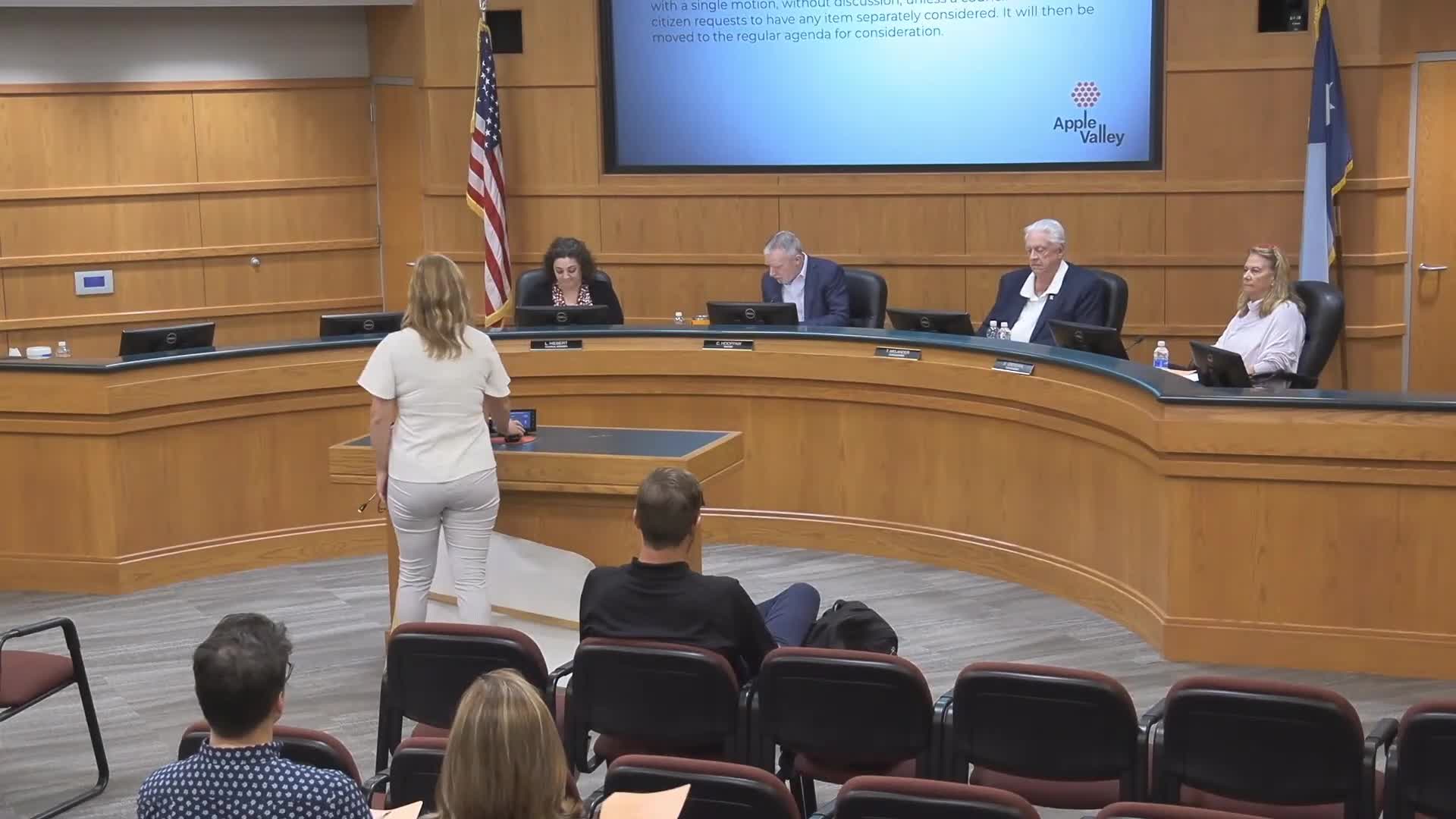
The Apple Valley City Council on May 8 approved a voluntary assessment program that allows homeowners to defer costs of removing diseased or hazardous trees by placing a special assessment on the property tax statement.
Samantha Berger, the city's natural resources coordinator, presented the program and said removal of diseased or hazardous trees is enforceable under the city's shade tree disease regulation (City ordinance 152.45). She explained homeowners who choose the program must sign a consent and waiver agreement and that the city would obtain multiple bids for removals and offer a range of removal options. "This assessment would cover the cost of removal including labor and associated fees," Berger said.
Berger said owners may repay the assessment over multiple years; unpaid balances would carry an 8% interest rate, but property owners who pay the full amount within 30 days may avoid interest. The city fee schedule also lists a $60 administration fee. As an example presented in the staff slides, a removal costing $750 would be assessed over two years under the program’s terms. Berger told the council the program has historically had low participation — typically fewer than three properties per year.
Council members asked about budget impacts and the upfront cost to the city. Joe (assistant finance director) told the council the city would front staff time and any upfront dollars and would recover expenses through the assessment over the selected repayment period: "The cost will just be the staff time upfront, and then it'll recover the cost over 1, 2, 3, or 4 years, depending on how much it cost initially for the tree removal. So the cost will come back to the city." Council member Hebert moved to approve the program; Council member Melander seconded the motion. The council approved the program by voice vote.
Staff said the city will continue to obtain multiple bids in the removal process and that homeowners may choose less‑costly removal options (for example, removing only hazardous components or leaving stumps in place). Staff noted there is a small risk of higher overall cost to homeowners because interest may apply if they choose multi‑year repayment.
Samantha Berger, the city's natural resources coordinator, presented the program and said removal of diseased or hazardous trees is enforceable under the city's shade tree disease regulation (City ordinance 152.45). She explained homeowners who choose the program must sign a consent and waiver agreement and that the city would obtain multiple bids for removals and offer a range of removal options. "This assessment would cover the cost of removal including labor and associated fees," Berger said.
Berger said owners may repay the assessment over multiple years; unpaid balances would carry an 8% interest rate, but property owners who pay the full amount within 30 days may avoid interest. The city fee schedule also lists a $60 administration fee. As an example presented in the staff slides, a removal costing $750 would be assessed over two years under the program’s terms. Berger told the council the program has historically had low participation — typically fewer than three properties per year.
Council members asked about budget impacts and the upfront cost to the city. Joe (assistant finance director) told the council the city would front staff time and any upfront dollars and would recover expenses through the assessment over the selected repayment period: "The cost will just be the staff time upfront, and then it'll recover the cost over 1, 2, 3, or 4 years, depending on how much it cost initially for the tree removal. So the cost will come back to the city." Council member Hebert moved to approve the program; Council member Melander seconded the motion. The council approved the program by voice vote.
Staff said the city will continue to obtain multiple bids in the removal process and that homeowners may choose less‑costly removal options (for example, removing only hazardous components or leaving stumps in place). Staff noted there is a small risk of higher overall cost to homeowners because interest may apply if they choose multi‑year repayment.
Don't Miss a Word: See the Full Meeting!
Go beyond summaries. Unlock every video, transcript, and key insight with a Founder Membership.
✓
Get instant access to full meeting videos
✓
Search and clip any phrase from complete transcripts
✓
Receive AI-powered summaries & custom alerts
✓
Enjoy lifetime, unrestricted access to government data
30-day money-back guarantee
