Boston people-operations officials outline FY26 hiring, training and pay pilots; no new formal policy votes
May 16, 2025 | Boston City, Suffolk County, Massachusetts
This article was created by AI summarizing key points discussed. AI makes mistakes, so for full details and context, please refer to the video of the full meeting. Please report any errors so we can fix them. Report an error »
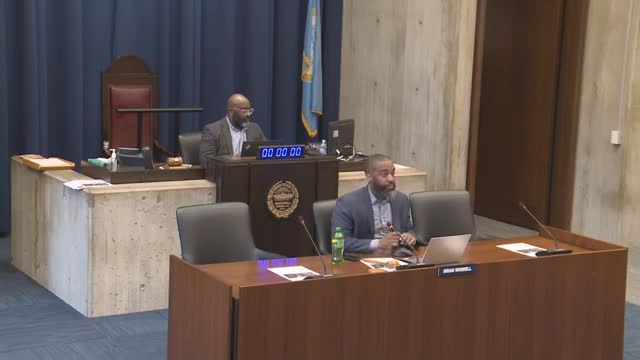
Boston officials presented the People Operations cabinet’s FY26 budget and described a series of administrative changes and pilot programs intended to improve hiring, training and pay equity for city employees.
Chief People and Administrative Officer Alex Lawrence told the Boston City Council Committee on Ways and Means on May 13 that the cabinet has centralized multiple human-capital and administrative functions under one umbrella and is pursuing technology, training and pay-policy changes to reduce vacancy-driven service gaps.
The presentation said the cabinet reduced steps in the hiring process and reported “18 different learning opportunities and about 700 participants” in its organizational-development training over the past year. Brenda Hernandez, executive director of People and Culture, described a newly established centralized organizational-development team and a “new city supervisor orientation” being scaled to reach existing and newly promoted managers.
Officials said the FY26 budget includes funding for a new applicant tracking system (to replace the current boston.gov/jobs platform) and that the city will use that procurement to standardize applicant and onboarding communications across departments. “We will be switching out that technology and also, sort of expanding some of the components that we currently use to make a better onboarding process,” Lawrence said.
City leaders described several personnel-focused policy pilots and program changes:
- A code-of-conduct policy is now part of the city’s annual compliance process for all employees; officials said collective-bargaining partners reviewed it and employees sign it at hire and annually.
- A bilingual-pay pilot will give nonunion employees a pay differential when they use one of the city’s designated threshold languages on the job; officials said a formal notice about the pilot was due to be issued to staff days after the hearing.
- A visa-sponsorship program for H-1B applicants has been established for current employees; officials said seven applicants received H‑1B approvals and 10 were pending at the time of the hearing.
- An ARPA-funded emergency housing program for employees ran during the prior year; officials said it helped staff but that housing services are best routed through the mayor’s Office of Housing for citywide delivery.
Lawrence and Hernandez emphasized that the city remains a decentralized HR environment — departments still hire locally — and that central staff’s role is to align departmental processes, provide training and scale promising pilots. They acknowledged continuing hiring challenges in certain categories (for example, Boston Center for Youth and Families positions and some specialized public-safety roles) while saying the city had success filling lifeguard, parking enforcement and crossing-guard vacancies.
Council members raised questions about retirement rules, health-benefit costs and transparency of workforce data. Officials said retirement eligibility and the underlying retirement formulas are statewide and tied to the statewide retirement board, not a city-only policy. Regarding health benefits, officials said the city works with a benefits consultant and union partners and that the benefits office would provide detailed drivers of year-to-year cost changes after the hearing.
Officials said they provide aggregated diversity and workforce information publicly through the city’s diversity dashboard and that some individual-level employee data are protected under employee-privacy considerations when responding to open-data requests. Lawrence cautioned that race/ethnicity categories in the current human-capital system are imperfect and that the applicant-tracking implementation should allow more nuanced collection.
Councilors asked about training and retention pathways and were told that supervisor training, mediation and de-escalation programs are in place and that departments are being asked to create pipelines for promotions and retention. Lawrence said the People Operations team will work with departments individually to address long hiring timelines and other operational bottlenecks.
Officials did not present or vote on any ordinance or budget amendment in the hearing itself; most items discussed were programmatic or procurement plans that staff said they would implement administratively or via future procurements.
Chief People and Administrative Officer Alex Lawrence told the Boston City Council Committee on Ways and Means on May 13 that the cabinet has centralized multiple human-capital and administrative functions under one umbrella and is pursuing technology, training and pay-policy changes to reduce vacancy-driven service gaps.
The presentation said the cabinet reduced steps in the hiring process and reported “18 different learning opportunities and about 700 participants” in its organizational-development training over the past year. Brenda Hernandez, executive director of People and Culture, described a newly established centralized organizational-development team and a “new city supervisor orientation” being scaled to reach existing and newly promoted managers.
Officials said the FY26 budget includes funding for a new applicant tracking system (to replace the current boston.gov/jobs platform) and that the city will use that procurement to standardize applicant and onboarding communications across departments. “We will be switching out that technology and also, sort of expanding some of the components that we currently use to make a better onboarding process,” Lawrence said.
City leaders described several personnel-focused policy pilots and program changes:
- A code-of-conduct policy is now part of the city’s annual compliance process for all employees; officials said collective-bargaining partners reviewed it and employees sign it at hire and annually.
- A bilingual-pay pilot will give nonunion employees a pay differential when they use one of the city’s designated threshold languages on the job; officials said a formal notice about the pilot was due to be issued to staff days after the hearing.
- A visa-sponsorship program for H-1B applicants has been established for current employees; officials said seven applicants received H‑1B approvals and 10 were pending at the time of the hearing.
- An ARPA-funded emergency housing program for employees ran during the prior year; officials said it helped staff but that housing services are best routed through the mayor’s Office of Housing for citywide delivery.
Lawrence and Hernandez emphasized that the city remains a decentralized HR environment — departments still hire locally — and that central staff’s role is to align departmental processes, provide training and scale promising pilots. They acknowledged continuing hiring challenges in certain categories (for example, Boston Center for Youth and Families positions and some specialized public-safety roles) while saying the city had success filling lifeguard, parking enforcement and crossing-guard vacancies.
Council members raised questions about retirement rules, health-benefit costs and transparency of workforce data. Officials said retirement eligibility and the underlying retirement formulas are statewide and tied to the statewide retirement board, not a city-only policy. Regarding health benefits, officials said the city works with a benefits consultant and union partners and that the benefits office would provide detailed drivers of year-to-year cost changes after the hearing.
Officials said they provide aggregated diversity and workforce information publicly through the city’s diversity dashboard and that some individual-level employee data are protected under employee-privacy considerations when responding to open-data requests. Lawrence cautioned that race/ethnicity categories in the current human-capital system are imperfect and that the applicant-tracking implementation should allow more nuanced collection.
Councilors asked about training and retention pathways and were told that supervisor training, mediation and de-escalation programs are in place and that departments are being asked to create pipelines for promotions and retention. Lawrence said the People Operations team will work with departments individually to address long hiring timelines and other operational bottlenecks.
Officials did not present or vote on any ordinance or budget amendment in the hearing itself; most items discussed were programmatic or procurement plans that staff said they would implement administratively or via future procurements.
Don't Miss a Word: See the Full Meeting!
Go beyond summaries. Unlock every video, transcript, and key insight with a Founder Membership.
✓
Get instant access to full meeting videos
✓
Search and clip any phrase from complete transcripts
✓
Receive AI-powered summaries & custom alerts
✓
Enjoy lifetime, unrestricted access to government data
30-day money-back guarantee
