Boston elections officials seek electronic poll books, more staff and equipment ahead of 2025 cycles
May 16, 2025 | Boston City, Suffolk County, Massachusetts
This article was created by AI summarizing key points discussed. AI makes mistakes, so for full details and context, please refer to the video of the full meeting. Please report any errors so we can fix them. Report an error »
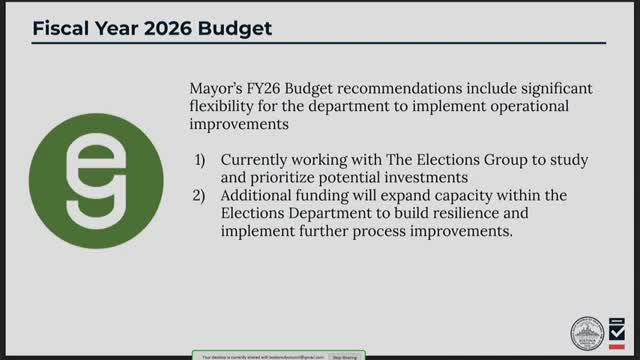
Boston elections officials told the City Council Committee on Ways and Means on May 13 that they have issued an invitation for bid (IFB) for electronic poll books and asked the council to consider funding and staffing changes to support upcoming election cycles and possible changes in ballot rules.
Commissioner of Elections (Commissioner Tavares) and supporting officials described how voting methods have shifted in recent years and said the department is processing more mailed and absentee ballots: “In 2024 we shifted from mostly in-person early voting to now, 30% absentee and vote by mail,” an elections official said.
Elections staff said the IFB seeks electronic poll books that would allow poll workers to access the citywide voter list at precincts, provide turn-by-turn directions to a voter who is at the wrong precinct and support real-time communications and broadcast messaging to poll workers across roughly 275 precincts. Officials said electronic poll books would also improve the department’s ability to track ballots and voter check-in activity in near real time. “The communication features on the poll books will solve for a number of things,” an elections official said.
Officials told councilors they expect to award a vendor and finalize procurement timelines in June, subject to coordination with the Secretary of the Commonwealth’s office. Commissioner Paul Truong said the administration used a FY25 mid-year transfer to fund the IFB. Councilors learned the mayor provided $750,000 mid-year to support the department’s procurement and operations related to the IFB.
Elections leaders emphasized that the department operates with a lean full-time staff and relies heavily on seasonal and temporary workers for ballot mailings, poll staffing and election-day logistics. The department reported record student participation in its poll-worker program — officials cited 90 student poll workers trained and recruited for the most recent election — and described expanding outreach and registration drives in Boston Public Schools.
Councilors and staff discussed operational gaps:
- Equipment and redundancy: Officials said that any electronic poll-book deployment would use paper backups; they also requested peripheral investments such as radios, backup batteries and additional vehicles to move materials to sites.
- Staffing: Officials said increasing permanent staff would reduce overtime; one official said they saw underspending on permanent employees and overspending on overtime in recent accounting through March 31, 2025.
- Ballot processing and ranked-choice voting: Elections staff warned that current ballot-processing machines can take 40–45 seconds per page and can jam; adding ranked-choice ballots (which may be multi-page) would increase processing time and risk delays. “With ranked choice voting…if we have a two-page ballot using the current machine that we have, it's going to take even longer to process those ballots,” a department official said.
Officials said training is required for every poll worker before each election and that the department has increased pay for training time and per-day poll-worker compensation (exact current rates will be provided to councilors on request). They also said the IFB and technology purchases are being coordinated with the Secretary of the Commonwealth to ensure compatibility with statewide rules and orders.
No formal vote or ordinance on ranked-choice voting occurred in this hearing; councilors noted the department’s requests and said additional budget or transfer authority would be needed to accelerate hiring, buy equipment or replace aging ballot-processing hardware.
Commissioner of Elections (Commissioner Tavares) and supporting officials described how voting methods have shifted in recent years and said the department is processing more mailed and absentee ballots: “In 2024 we shifted from mostly in-person early voting to now, 30% absentee and vote by mail,” an elections official said.
Elections staff said the IFB seeks electronic poll books that would allow poll workers to access the citywide voter list at precincts, provide turn-by-turn directions to a voter who is at the wrong precinct and support real-time communications and broadcast messaging to poll workers across roughly 275 precincts. Officials said electronic poll books would also improve the department’s ability to track ballots and voter check-in activity in near real time. “The communication features on the poll books will solve for a number of things,” an elections official said.
Officials told councilors they expect to award a vendor and finalize procurement timelines in June, subject to coordination with the Secretary of the Commonwealth’s office. Commissioner Paul Truong said the administration used a FY25 mid-year transfer to fund the IFB. Councilors learned the mayor provided $750,000 mid-year to support the department’s procurement and operations related to the IFB.
Elections leaders emphasized that the department operates with a lean full-time staff and relies heavily on seasonal and temporary workers for ballot mailings, poll staffing and election-day logistics. The department reported record student participation in its poll-worker program — officials cited 90 student poll workers trained and recruited for the most recent election — and described expanding outreach and registration drives in Boston Public Schools.
Councilors and staff discussed operational gaps:
- Equipment and redundancy: Officials said that any electronic poll-book deployment would use paper backups; they also requested peripheral investments such as radios, backup batteries and additional vehicles to move materials to sites.
- Staffing: Officials said increasing permanent staff would reduce overtime; one official said they saw underspending on permanent employees and overspending on overtime in recent accounting through March 31, 2025.
- Ballot processing and ranked-choice voting: Elections staff warned that current ballot-processing machines can take 40–45 seconds per page and can jam; adding ranked-choice ballots (which may be multi-page) would increase processing time and risk delays. “With ranked choice voting…if we have a two-page ballot using the current machine that we have, it's going to take even longer to process those ballots,” a department official said.
Officials said training is required for every poll worker before each election and that the department has increased pay for training time and per-day poll-worker compensation (exact current rates will be provided to councilors on request). They also said the IFB and technology purchases are being coordinated with the Secretary of the Commonwealth to ensure compatibility with statewide rules and orders.
No formal vote or ordinance on ranked-choice voting occurred in this hearing; councilors noted the department’s requests and said additional budget or transfer authority would be needed to accelerate hiring, buy equipment or replace aging ballot-processing hardware.
Don't Miss a Word: See the Full Meeting!
Go beyond summaries. Unlock every video, transcript, and key insight with a Founder Membership.
✓
Get instant access to full meeting videos
✓
Search and clip any phrase from complete transcripts
✓
Receive AI-powered summaries & custom alerts
✓
Enjoy lifetime, unrestricted access to government data
30-day money-back guarantee
