Prescott Valley consultants outline wildlife-corridor foundation guide, schedule public outreach and June work session
May 16, 2025 | Prescott Valley, Yavapai County, Arizona
This article was created by AI summarizing key points discussed. AI makes mistakes, so for full details and context, please refer to the video of the full meeting. Please report any errors so we can fix them. Report an error »
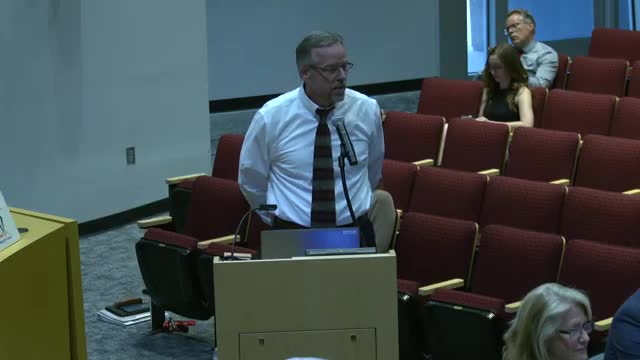
Consultants from Logan Simpson presented the Phase 1 "wildlife corridor foundation guide" to a joint meeting of the Prescott Valley Town Council and the Planning & Zoning Commission, describing the project's purpose, early findings and community outreach plans and asking residents to provide feedback at a public event on May 17.
The foundation guide, the consultants said, is meant to "set the stage" for a later, more detailed corridor plan. Sandra Hoffman, project manager and an AICP-certified planner with Logan Simpson, said the twofold purpose of Phase 1 is to report progress and continue data collection for a future plan. "Bridging habitats and building resilience," she said, is the project's tagline.
The guide will summarize existing conditions (land use, ownership, water flow and circulation), catalog best practices from case studies and present strategic options for the town to consider, the team said. "A wildlife corridor is a natural or planned habitat or crossing that connects animal populations to other suitable habitats," Michaela Dunphy, associate planner with Logan Simpson, said while presenting an introductory video used for public education.
Logan Simpson described a case-study inventory of 34 corridor efforts across the Western United States that the team narrowed to five for deeper analysis, including the Town of Marana (with zoning tools), Pima County's Sonoran Desert Conservation Plan, Yavapai County's Arizona Missing Linkages work, corridor work near Gallatin, Montana, and examples from Ventura County, California. The consultants said they will synthesize those examples into best practices the town could adapt.
Consultants said they have completed an existing-conditions analysis and about 15 listening sessions so far (the team had aimed for roughly 30). They reported three focus groups: town departments, wildlife interest groups (with Arizona Game and Fish Department participation), and landowners/developers (with Arizona State Land Department participation). A team biologist identified as Mary (listed as ‘‘Mary from Fort Collins’’ in the presentation) compiled a wildlife table the consultants will use for species- and habitat-level analysis.
"Not everything migrates," Bruce Bien, CEO of Logan Simpson, told the commissioners and council members when explaining that corridor design and width vary by species and behavior; he said corridor planning must account for multiple species and changing behaviors over time. The consultants emphasized that corridor widths are not "one size fits all" and that some species require larger linkages while others can use narrower passages.
Consultants and elected officials discussed private-property limits and tools for voluntary participation, including clustering development, land trades and potential acquisition of development rights. The team said Arizona State Trust lands can be part of negotiations and that land trades or other agreements may be possible in some cases, but emphasized there is no single solution: corridor systems evolve over time.
The project team invited public participation through an interactive Menti questionnaire and a pop-up event scheduled for May 17, 3:30 p.m. to 6 p.m., at Bronco Park at Granville. The consultants said they will assemble Saturday's feedback and present summary findings and recommended strategic options at a June work session for the council and commission; from that discussion the town will decide whether to pursue a Phase 2 corridor plan and what level of detail or enforceability it should include.
During discussion, an attendee summarized a common local concern about growth and education, saying, "If development stopped, everything would be perfect. And that's not the real world," and urged public outreach to explain corridor function and trade-offs. Council and commission members raised questions about species prioritization (for example pronghorn and other grassland species), native-plant restoration in corridors, and how agricultural uses and working landscapes could coexist with connected open space.
No formal motions or votes were taken at the meeting; the consultants characterized the document as a foundation guide and said formal recommendations will follow the June work session after the team compiles community input and completes analysis. The project team said it will return with a summary of best practices and three proposed strategic options for the town to consider.
Next steps: Logan Simpson will analyze outreach results from the May 17 event and the ongoing questionnaire, finalize findings for the existing-conditions report, and return in June with a work-session presentation of best practices and strategic options to guide any Phase 2 corridor planning.
The foundation guide, the consultants said, is meant to "set the stage" for a later, more detailed corridor plan. Sandra Hoffman, project manager and an AICP-certified planner with Logan Simpson, said the twofold purpose of Phase 1 is to report progress and continue data collection for a future plan. "Bridging habitats and building resilience," she said, is the project's tagline.
The guide will summarize existing conditions (land use, ownership, water flow and circulation), catalog best practices from case studies and present strategic options for the town to consider, the team said. "A wildlife corridor is a natural or planned habitat or crossing that connects animal populations to other suitable habitats," Michaela Dunphy, associate planner with Logan Simpson, said while presenting an introductory video used for public education.
Logan Simpson described a case-study inventory of 34 corridor efforts across the Western United States that the team narrowed to five for deeper analysis, including the Town of Marana (with zoning tools), Pima County's Sonoran Desert Conservation Plan, Yavapai County's Arizona Missing Linkages work, corridor work near Gallatin, Montana, and examples from Ventura County, California. The consultants said they will synthesize those examples into best practices the town could adapt.
Consultants said they have completed an existing-conditions analysis and about 15 listening sessions so far (the team had aimed for roughly 30). They reported three focus groups: town departments, wildlife interest groups (with Arizona Game and Fish Department participation), and landowners/developers (with Arizona State Land Department participation). A team biologist identified as Mary (listed as ‘‘Mary from Fort Collins’’ in the presentation) compiled a wildlife table the consultants will use for species- and habitat-level analysis.
"Not everything migrates," Bruce Bien, CEO of Logan Simpson, told the commissioners and council members when explaining that corridor design and width vary by species and behavior; he said corridor planning must account for multiple species and changing behaviors over time. The consultants emphasized that corridor widths are not "one size fits all" and that some species require larger linkages while others can use narrower passages.
Consultants and elected officials discussed private-property limits and tools for voluntary participation, including clustering development, land trades and potential acquisition of development rights. The team said Arizona State Trust lands can be part of negotiations and that land trades or other agreements may be possible in some cases, but emphasized there is no single solution: corridor systems evolve over time.
The project team invited public participation through an interactive Menti questionnaire and a pop-up event scheduled for May 17, 3:30 p.m. to 6 p.m., at Bronco Park at Granville. The consultants said they will assemble Saturday's feedback and present summary findings and recommended strategic options at a June work session for the council and commission; from that discussion the town will decide whether to pursue a Phase 2 corridor plan and what level of detail or enforceability it should include.
During discussion, an attendee summarized a common local concern about growth and education, saying, "If development stopped, everything would be perfect. And that's not the real world," and urged public outreach to explain corridor function and trade-offs. Council and commission members raised questions about species prioritization (for example pronghorn and other grassland species), native-plant restoration in corridors, and how agricultural uses and working landscapes could coexist with connected open space.
No formal motions or votes were taken at the meeting; the consultants characterized the document as a foundation guide and said formal recommendations will follow the June work session after the team compiles community input and completes analysis. The project team said it will return with a summary of best practices and three proposed strategic options for the town to consider.
Next steps: Logan Simpson will analyze outreach results from the May 17 event and the ongoing questionnaire, finalize findings for the existing-conditions report, and return in June with a work-session presentation of best practices and strategic options to guide any Phase 2 corridor planning.
Don't Miss a Word: See the Full Meeting!
Go beyond summaries. Unlock every video, transcript, and key insight with a Founder Membership.
✓
Get instant access to full meeting videos
✓
Search and clip any phrase from complete transcripts
✓
Receive AI-powered summaries & custom alerts
✓
Enjoy lifetime, unrestricted access to government data
30-day money-back guarantee
