Bremerton, Mason County continue talks on sewer extension to Puget Sound Industrial Center amid capacity, economic concerns
May 16, 2025 | Mason County, Washington
This article was created by AI summarizing key points discussed. AI makes mistakes, so for full details and context, please refer to the video of the full meeting. Please report any errors so we can fix them. Report an error »
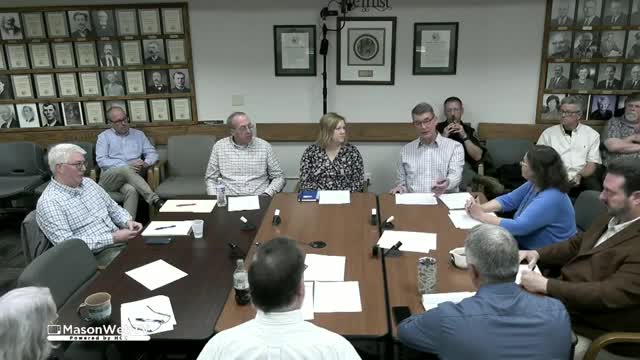
BREMERTON / BELFAIR, Wash. — City and county officials on Tuesday took another step toward exploring an extension of sewer service from Mason County into the southern Puget Sound Industrial Center, while identifying technical, financial and economic issues that must be resolved before either jurisdiction will commit to construction.
The meeting focused on a $3 million Washington State Department of Commerce appropriation that would fund design work for collection and treatment upgrades; the city would be the grant recipient and Mason County a subrecipient. Bremerton Mayor Greg Wheeler said the work ties to the city’s long-range plan for industrial jobs: “We envision in the entire industrial area up to 10,000 jobs.”
Why it matters: The PSIC is planned for industrial growth that municipal leaders say could bring regional jobs, but officials agree growth requires sewer, water and transportation upgrades. Mason County elected officials voiced concern that allowing retail or other destination sales on the PSIC could divert sales tax revenue and businesses away from the Belfair commercial area, harming county finances. Commissioners said they need clearer financial commitments and mitigation measures before signing any interlocal agreement.
City and county staff described the technical scope the design work would cover: improvements to collection-system choke points, pump stations and a forced main, plus a plant-side engineering study to rerate or expand capacity. County staff said the Belfair treatment plant currently operates within permit limits but that growth would require both additional membrane units and solids-handling upgrades.
Officials noted several numeric benchmarks discussed at the meeting. The city and county said existing ponds and the spray field are permitted each to receive up to 25,000 gallons per day; the current plant permit trigger discussed in the meeting referenced 6,250 gallons per day as an 85% trigger point for a 25,000-gpd component and a measurement defined by Ecology as average monthly flow over consecutive months. Staff described a range of capacity scenarios: a 20-year planning request on the table of roughly 60,000 gallons per day to be provided by Mason County, and an earlier full-build estimate for the south PSIC near 500,000 gallons per day.
Economics and equity drove the most pointed questions from county commissioners. Commissioner Ryan said: “I lose, 1 or 2 big businesses down there. I lose community members. I lose tax. I lose jobs. I lose everything for creating a competition for myself, for my own community.” County leaders pressed Bremerton for options to mitigate sales-tax loss, including possible restrictions on retail development near the highway or revenue-sharing mechanisms if destination retail locates on PSIC land.
Bremerton leaders and staff said the city’s intent is regional economic growth, not to harm Belfair. The city noted precedent for charging premiums to customers outside city limits and said hookup and general facilities charges (GFCs) are typically used to allocate infrastructure costs to new customers; Bremerton staff said their current surcharge for outside customers is 50 percent on top of base rates (the city noted it would check whether that surcharge applies to GFCs).
On grant timing and next steps, Mara (the county’s grant administrator, referenced in the meeting) notified officials that if the governor signs the budget, the Commerce appropriation’s deadline would move from June 2025 to June 2027. Bremerton staff emphasized they do not want to spend grant funds on detailed design until both jurisdictions reach a clear, mutual commitment to serve, and Mason County asked that any engineering work include a financial analysis (rates, GFCs, and likely impacts) alongside technical designs.
Environmental and regulatory constraints also surfaced: staff said the county holds an Ecology permit for a spray field that has been largely unused because the plant has not produced enough Class A reclaimed water, and that any rerating or expansion would require an engineering report and approval from the Washington State Department of Ecology under applicable WAC rules. Tribal and port stakeholders were flagged as necessary participants; Commissioner Ryan asked Bremerton to meet with the Suquamish Tribe and recommended a larger stakeholder meeting with the Port of Bremerton and other affected parties.
No binding decisions were made. Instead the parties agreed to continue drafting an interlocal agreement, to add finance and mitigation language to the study scope, and to schedule follow-up government-to-government and stakeholder meetings. Bremerton staff said they would circulate edits and clarify conditional language so the agreement reads as a conditional commitment to jointly study service and not an unconditional promise to deliver sewer service.
What’s next: Officials said they will refine the draft interlocal agreement to make expectations explicit — including triggers for when design work proceeds, whether grant funds are spent before commitments are finalized, and how financial burdens and benefits would be shared — then return to their elected bodies for policy decisions.
Context: The subject has a history in local planning documents and prior county-state discussions going back more than a decade; participants referred to planning work from 2008–2012 and to previous periods when the county’s wastewater utility faced serious capacity and fiscal issues. The group agreed to move with more frequent coordination if they are to complete the Commerce-funded design work in the budget window.
The meeting focused on a $3 million Washington State Department of Commerce appropriation that would fund design work for collection and treatment upgrades; the city would be the grant recipient and Mason County a subrecipient. Bremerton Mayor Greg Wheeler said the work ties to the city’s long-range plan for industrial jobs: “We envision in the entire industrial area up to 10,000 jobs.”
Why it matters: The PSIC is planned for industrial growth that municipal leaders say could bring regional jobs, but officials agree growth requires sewer, water and transportation upgrades. Mason County elected officials voiced concern that allowing retail or other destination sales on the PSIC could divert sales tax revenue and businesses away from the Belfair commercial area, harming county finances. Commissioners said they need clearer financial commitments and mitigation measures before signing any interlocal agreement.
City and county staff described the technical scope the design work would cover: improvements to collection-system choke points, pump stations and a forced main, plus a plant-side engineering study to rerate or expand capacity. County staff said the Belfair treatment plant currently operates within permit limits but that growth would require both additional membrane units and solids-handling upgrades.
Officials noted several numeric benchmarks discussed at the meeting. The city and county said existing ponds and the spray field are permitted each to receive up to 25,000 gallons per day; the current plant permit trigger discussed in the meeting referenced 6,250 gallons per day as an 85% trigger point for a 25,000-gpd component and a measurement defined by Ecology as average monthly flow over consecutive months. Staff described a range of capacity scenarios: a 20-year planning request on the table of roughly 60,000 gallons per day to be provided by Mason County, and an earlier full-build estimate for the south PSIC near 500,000 gallons per day.
Economics and equity drove the most pointed questions from county commissioners. Commissioner Ryan said: “I lose, 1 or 2 big businesses down there. I lose community members. I lose tax. I lose jobs. I lose everything for creating a competition for myself, for my own community.” County leaders pressed Bremerton for options to mitigate sales-tax loss, including possible restrictions on retail development near the highway or revenue-sharing mechanisms if destination retail locates on PSIC land.
Bremerton leaders and staff said the city’s intent is regional economic growth, not to harm Belfair. The city noted precedent for charging premiums to customers outside city limits and said hookup and general facilities charges (GFCs) are typically used to allocate infrastructure costs to new customers; Bremerton staff said their current surcharge for outside customers is 50 percent on top of base rates (the city noted it would check whether that surcharge applies to GFCs).
On grant timing and next steps, Mara (the county’s grant administrator, referenced in the meeting) notified officials that if the governor signs the budget, the Commerce appropriation’s deadline would move from June 2025 to June 2027. Bremerton staff emphasized they do not want to spend grant funds on detailed design until both jurisdictions reach a clear, mutual commitment to serve, and Mason County asked that any engineering work include a financial analysis (rates, GFCs, and likely impacts) alongside technical designs.
Environmental and regulatory constraints also surfaced: staff said the county holds an Ecology permit for a spray field that has been largely unused because the plant has not produced enough Class A reclaimed water, and that any rerating or expansion would require an engineering report and approval from the Washington State Department of Ecology under applicable WAC rules. Tribal and port stakeholders were flagged as necessary participants; Commissioner Ryan asked Bremerton to meet with the Suquamish Tribe and recommended a larger stakeholder meeting with the Port of Bremerton and other affected parties.
No binding decisions were made. Instead the parties agreed to continue drafting an interlocal agreement, to add finance and mitigation language to the study scope, and to schedule follow-up government-to-government and stakeholder meetings. Bremerton staff said they would circulate edits and clarify conditional language so the agreement reads as a conditional commitment to jointly study service and not an unconditional promise to deliver sewer service.
What’s next: Officials said they will refine the draft interlocal agreement to make expectations explicit — including triggers for when design work proceeds, whether grant funds are spent before commitments are finalized, and how financial burdens and benefits would be shared — then return to their elected bodies for policy decisions.
Context: The subject has a history in local planning documents and prior county-state discussions going back more than a decade; participants referred to planning work from 2008–2012 and to previous periods when the county’s wastewater utility faced serious capacity and fiscal issues. The group agreed to move with more frequent coordination if they are to complete the Commerce-funded design work in the budget window.
View the Full Meeting & All Its Details
This article offers just a summary. Unlock complete video, transcripts, and insights as a Founder Member.
✓
Watch full, unedited meeting videos
✓
Search every word spoken in unlimited transcripts
✓
AI summaries & real-time alerts (all government levels)
✓
Permanent access to expanding government content
30-day money-back guarantee
