DRB continues Desert Summit Lot 34 building-envelope request amid drainage, open-space and privacy concerns
May 16, 2025 | Scottsdale, Maricopa County, Arizona
This article was created by AI summarizing key points discussed. AI makes mistakes, so for full details and context, please refer to the video of the full meeting. Please report any errors so we can fix them. Report an error »
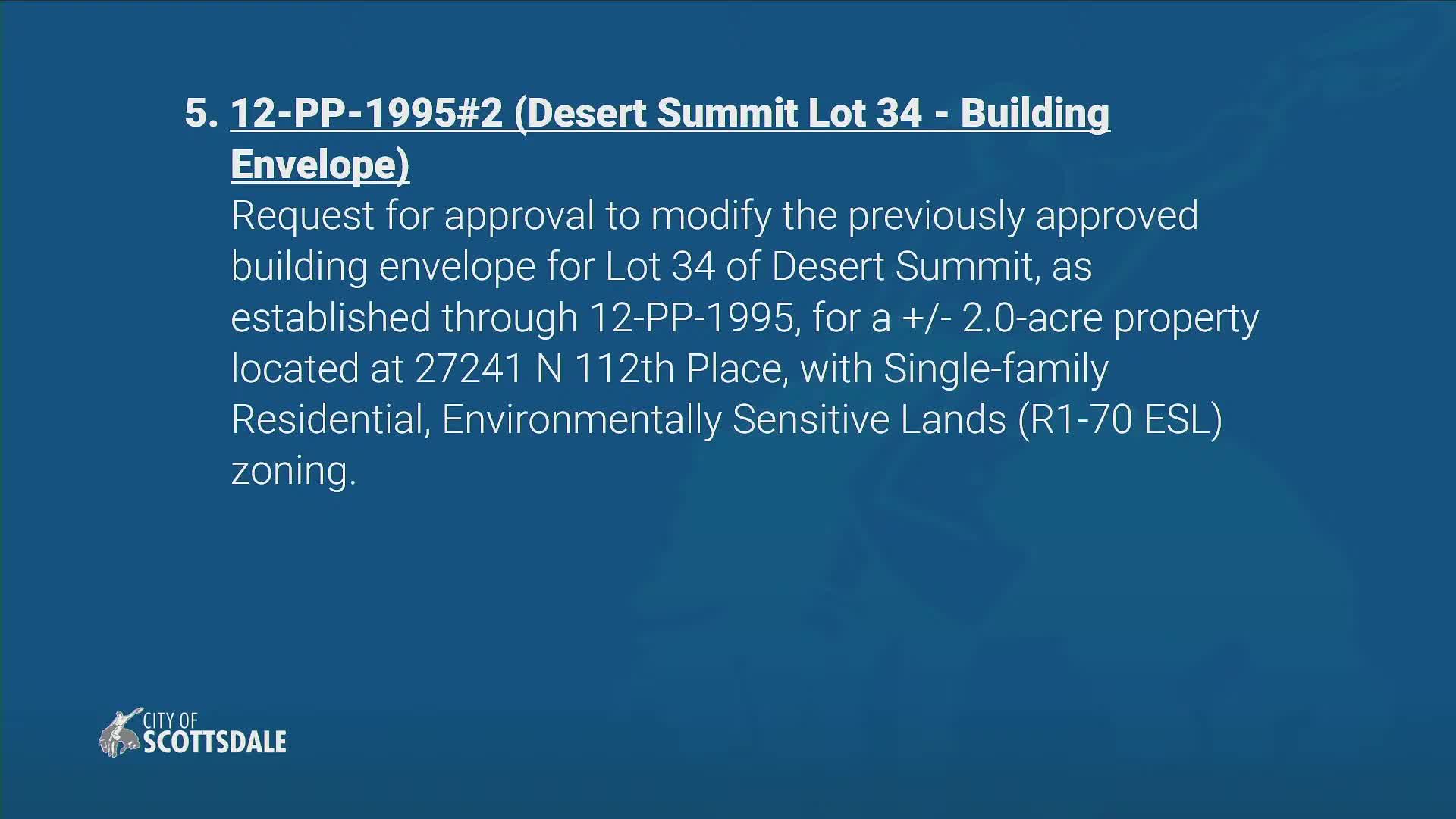
The Scottsdale Development Review Board on May 1, 2025 continued a request by the owners of Lot 34 in the Desert Summit subdivision to relocate a previously approved conceptual building envelope to a higher elevation on the lot, after staff flagged potential conflicts with prior zoning and preliminary-plat stipulations and multiple neighbors raised concerns about drainage, privacy and hillside impacts.
Staff said the proposed shift would move the envelope from its street-front location up the hillside into an area identified as the hillside landform and questioned whether the change would undermine the original NAOS (Natural Area Open Space) separations established by the zoning and preliminary-plat approvals. "The request before you today, is a request by the owner, to modify a previously approved building envelope for Lot 34 within the Desert Summit subdivision," Jeff Barnes, a planner with the city's planning department, told the board.
The board heard detailed staff history noting the zoning action (76 ZN 1992), a 1995 amendment and the preliminary plat approval (12 PP 1995) that carried building-envelope locations forward. Staff highlighted three specific concerns: consistency with prior stipulations, conformance with the ESL purpose and potential loss of the intended NAOS separation, including the ordinance requirement that NAOS between envelopes not be less than 60 feet. Barnes said staff also received public input opposing the proposal and recommended continuance "to allow the applicant to explore alternative locations that may align better with the criteria with the ESL design guidelines."
Tom Galvin, an attorney with Rose Law Group representing the Angeloni family, argued the existing envelope is now effectively unbuildable because stormwater from adjacent Lot 33 has been routed into the lower area and filled the envelope with standing water. "It is impossible for the Angeloni family to build in the current building envelope," Galvin said, adding the family sought the change to find the least-disturbing and most buildable location on the lot. Architect Andrew Grambling said the saddle area proposed by the applicant would allow a low-profile, minimally graded house and a driveway that follows the topography. "If we can nestle this in a flat spot tucked up in the hill, do a one-story house with a walkout basement, it's gonna be barely visible from everybody else," Grambling said.
Several neighbors urged caution. Kelly Claire Clark, owner of Lot 35 immediately adjacent to the proposed envelope, said a relocated building at the top of the lot would look down into her living room and a child's bedroom and sharply reduce privacy. "If the building envelope was changed to the top where that is, the new owner would be looking directly into our living room," Clark said. Lot 33 owner Mark Fisher described existing drainage features and said the current configuration was not a problem for his yard but that any change must preserve neighborhood privacy and character.
Board members pressed staff and the applicant on technical details the record lacks, including a documented drainage easement for the lower area, engineering analysis of hydrology and cut-and-fill estimates, and whether prior approvals implicitly allowed other lots to be built outside their conceptual envelopes. Barnes said staff had not located a recorded drainage easement for the specific low area and recommended further civil engineering analysis to confirm flow patterns. He also cautioned that while other neighboring homes have been constructed in places that differ from the 1992 sketch, staff found no clear record that Lot 35's apparent encroachment had formal approval through the envelope-modification process.
Members also discussed the ESL goals of preserving natural terrain, protecting NAOS and minimizing development impacts. Barnes read ESL purpose elements into the record, including protecting visible natural resources, guiding location and distribution of meaningful on-lot open space, and minimizing impacts by controlling location and construction techniques.
After public comment and discussion, the board voted to continue the case and directed the applicant to work with staff to identify alternative envelope locations that better align with the subdivision's prior stipulations and the ESL/NAOS intent. The motion to continue passed with the following roll-call votes: Councilwoman Kathleen Littlefield (chair) — yes; Vice Chair Brand — yes; Commissioner Ertel — no; Board member Peazer — yes; Board member Mason — no; Board member Robinson — yes. The board recorded the action as a continuance; the continuance date was set to be determined and staff was instructed to facilitate the applicant's exploration of alternatives.
The item generated extensive discussion and public comment and the board requested additional technical evidence before acting on any envelope modification: documented drainage analysis, civil-engineering grading and cut-fill estimates, more precise plans showing NAOS separations, and mapping of sensitive features (vegetation, rock outcrops and possible wildlife corridors). The applicant said it has spent more than a year working with staff and is willing to revise its proposed envelope and work with staff beyond the "hinge" of the lot's narrow "bow tie" midsection.
The board's continuance leaves the existing envelope unchanged for now; any change would require the board to determine whether the proposal meets DRB criteria and the ESL and to document that impacts to NAOS and visual character have been minimized.
The board did not set a new hearing date at the meeting and asked staff and the applicant to return with the requested technical analyses and alternative envelope configurations for further consideration.
Staff said the proposed shift would move the envelope from its street-front location up the hillside into an area identified as the hillside landform and questioned whether the change would undermine the original NAOS (Natural Area Open Space) separations established by the zoning and preliminary-plat approvals. "The request before you today, is a request by the owner, to modify a previously approved building envelope for Lot 34 within the Desert Summit subdivision," Jeff Barnes, a planner with the city's planning department, told the board.
The board heard detailed staff history noting the zoning action (76 ZN 1992), a 1995 amendment and the preliminary plat approval (12 PP 1995) that carried building-envelope locations forward. Staff highlighted three specific concerns: consistency with prior stipulations, conformance with the ESL purpose and potential loss of the intended NAOS separation, including the ordinance requirement that NAOS between envelopes not be less than 60 feet. Barnes said staff also received public input opposing the proposal and recommended continuance "to allow the applicant to explore alternative locations that may align better with the criteria with the ESL design guidelines."
Tom Galvin, an attorney with Rose Law Group representing the Angeloni family, argued the existing envelope is now effectively unbuildable because stormwater from adjacent Lot 33 has been routed into the lower area and filled the envelope with standing water. "It is impossible for the Angeloni family to build in the current building envelope," Galvin said, adding the family sought the change to find the least-disturbing and most buildable location on the lot. Architect Andrew Grambling said the saddle area proposed by the applicant would allow a low-profile, minimally graded house and a driveway that follows the topography. "If we can nestle this in a flat spot tucked up in the hill, do a one-story house with a walkout basement, it's gonna be barely visible from everybody else," Grambling said.
Several neighbors urged caution. Kelly Claire Clark, owner of Lot 35 immediately adjacent to the proposed envelope, said a relocated building at the top of the lot would look down into her living room and a child's bedroom and sharply reduce privacy. "If the building envelope was changed to the top where that is, the new owner would be looking directly into our living room," Clark said. Lot 33 owner Mark Fisher described existing drainage features and said the current configuration was not a problem for his yard but that any change must preserve neighborhood privacy and character.
Board members pressed staff and the applicant on technical details the record lacks, including a documented drainage easement for the lower area, engineering analysis of hydrology and cut-and-fill estimates, and whether prior approvals implicitly allowed other lots to be built outside their conceptual envelopes. Barnes said staff had not located a recorded drainage easement for the specific low area and recommended further civil engineering analysis to confirm flow patterns. He also cautioned that while other neighboring homes have been constructed in places that differ from the 1992 sketch, staff found no clear record that Lot 35's apparent encroachment had formal approval through the envelope-modification process.
Members also discussed the ESL goals of preserving natural terrain, protecting NAOS and minimizing development impacts. Barnes read ESL purpose elements into the record, including protecting visible natural resources, guiding location and distribution of meaningful on-lot open space, and minimizing impacts by controlling location and construction techniques.
After public comment and discussion, the board voted to continue the case and directed the applicant to work with staff to identify alternative envelope locations that better align with the subdivision's prior stipulations and the ESL/NAOS intent. The motion to continue passed with the following roll-call votes: Councilwoman Kathleen Littlefield (chair) — yes; Vice Chair Brand — yes; Commissioner Ertel — no; Board member Peazer — yes; Board member Mason — no; Board member Robinson — yes. The board recorded the action as a continuance; the continuance date was set to be determined and staff was instructed to facilitate the applicant's exploration of alternatives.
The item generated extensive discussion and public comment and the board requested additional technical evidence before acting on any envelope modification: documented drainage analysis, civil-engineering grading and cut-fill estimates, more precise plans showing NAOS separations, and mapping of sensitive features (vegetation, rock outcrops and possible wildlife corridors). The applicant said it has spent more than a year working with staff and is willing to revise its proposed envelope and work with staff beyond the "hinge" of the lot's narrow "bow tie" midsection.
The board's continuance leaves the existing envelope unchanged for now; any change would require the board to determine whether the proposal meets DRB criteria and the ESL and to document that impacts to NAOS and visual character have been minimized.
The board did not set a new hearing date at the meeting and asked staff and the applicant to return with the requested technical analyses and alternative envelope configurations for further consideration.
View the Full Meeting & All Its Details
This article offers just a summary. Unlock complete video, transcripts, and insights as a Founder Member.
✓
Watch full, unedited meeting videos
✓
Search every word spoken in unlimited transcripts
✓
AI summaries & real-time alerts (all government levels)
✓
Permanent access to expanding government content
30-day money-back guarantee
