Planning commission continues noise-ordinance hearing after questions about enforcement, measurement
May 16, 2025 | Sierra Madre City, Los Angeles County, California
This article was created by AI summarizing key points discussed. AI makes mistakes, so for full details and context, please refer to the video of the full meeting. Please report any errors so we can fix them. Report an error »
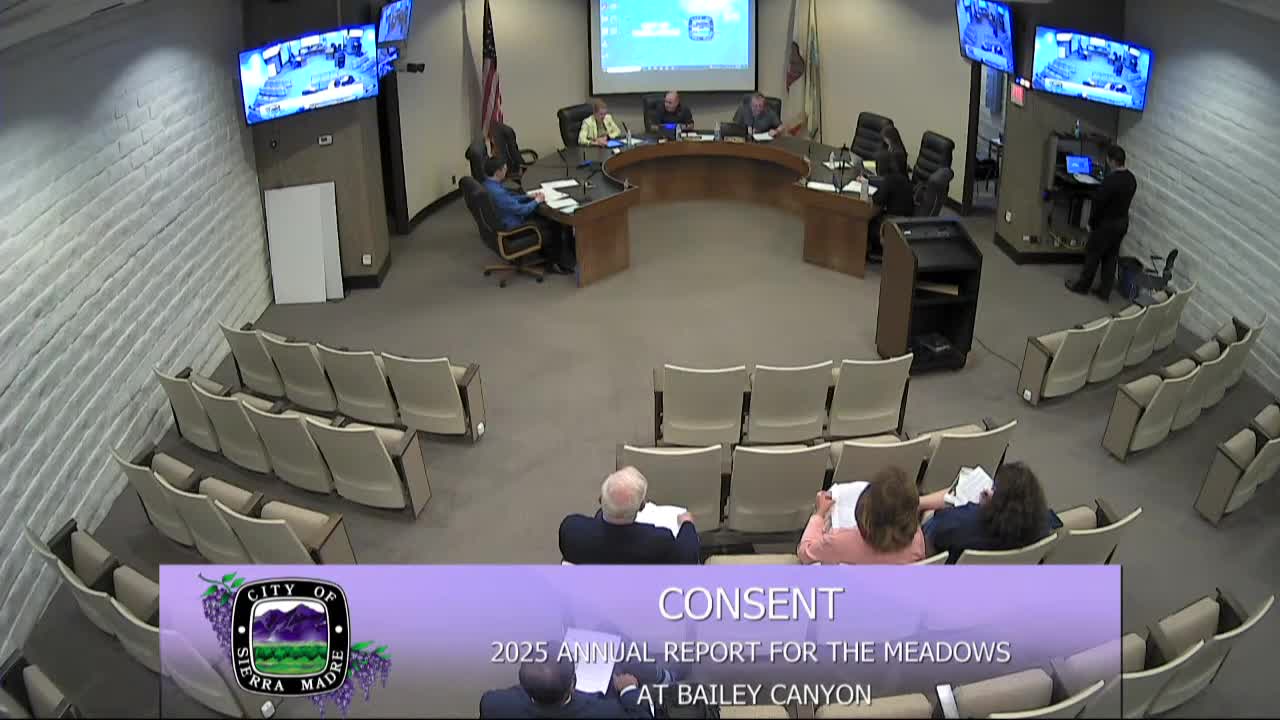
Sierra Madre City Planning Commission on May 15 continued a public hearing on a proposed municipal code text amendment (MCTA 25‑01) that would set numeric noise limits, add C‑weighted measurements for low‑frequency noise, shorten measurement duration to 10 minutes and remove a separate vibration standard.
The hearing matters because the ordinance would replace a largely qualitative noise code with measurable decibel thresholds and enforcement procedures that the police department says could require on‑site measurements before a citation is issued.
System Planner Huang, the staff presenter, summarized the key technical elements: "the allowable equivalent continuous sound sound levels, measured in 10 minutes is 60 dBA in the daytime and 50 dBA in the evening time with maximum noise levels of 80 and 70 dBA," and said consultants from Rincon recommended adding C‑weighted (dBC) measurements to capture low‑frequency bass. Huang also said staff and Rincon recommended deleting the separate vibration section because of measurement complexity.
Commissioners and members of the public pressed for clearer enforcement procedures and definitions. "We enforce the code is first, warning. Second, it would be a citation," Police Chief (name not given) told the commission when asked how officers would use the numeric standard. He added that while warnings are commonly used, a citation under the proposed ordinance would require an on‑site measurement: "With this code? Yes. Absolutely. We would have to stand there for 10 minutes to record the yes." He also said the department is discussing with the city attorney what level of on‑site measurement is reasonable for routine calls.
Alverno Heights representatives and their acoustical consultant asked for clarity about how the ordinance would treat schools and private event venues. "We appreciate the city's effort to simplify and update the noise standards," said Ken Farsing, representing Alverno's board of trustees, and consultant Indi Savitalla asked specifically for "clarity as to the maximum noise levels" and how ambient noise that already exceeds proposed limits would be handled.
Community services supervisor Ted Heggert explained the commission's proposed carve‑out for "city‑sponsored or city‑affiliated events," listing examples: "those city events would be July 4. We have concerts in the park. We have our concerts in the summer. Movies." Commissioners asked staff to define "city‑sponsored" and to clarify what the ordinance would treat as a special event conducted by schools.
On specific code language, commissioners discussed striking a provision that limited daytime standards to "active outdoor use areas," because as written it could make evening standards the default in most of the city. Commissioners also agreed to recommend removing the vibration section and to pursue harmonizing construction and powered‑equipment hours across city codes so that homeowners and permitted construction would not be subject to conflicting hours. Several commissioners said the apparent current effect — that landscaping power equipment is not allowed on Sundays while construction can proceed — seemed unintended and should be fixed.
The commission asked staff to: consult with Rincon on the origin and purpose of language that singled out certain land‑use types; coordinate with the City Attorney on enforceability and with the Police Department on what measurement procedures are practical in the field; define "city‑sponsored" and "special events" in the draft code; and return with redline language. Planning staff noted the draft memo from Rincon on recommended enforcement methods is available to the dais.
After deliberation, a commissioner moved to continue the public hearing to allow staff to prepare revisions and answer the enforcement questions; the motion carried unanimously.
Next steps: staff will return with clarified definitions, proposed edits to harmonize construction/powered‑equipment hours, Rincon follow‑up on dBA/dBC measurement guidance, and a recommended enforcement protocol discussed with the city attorney and police department.
The hearing matters because the ordinance would replace a largely qualitative noise code with measurable decibel thresholds and enforcement procedures that the police department says could require on‑site measurements before a citation is issued.
System Planner Huang, the staff presenter, summarized the key technical elements: "the allowable equivalent continuous sound sound levels, measured in 10 minutes is 60 dBA in the daytime and 50 dBA in the evening time with maximum noise levels of 80 and 70 dBA," and said consultants from Rincon recommended adding C‑weighted (dBC) measurements to capture low‑frequency bass. Huang also said staff and Rincon recommended deleting the separate vibration section because of measurement complexity.
Commissioners and members of the public pressed for clearer enforcement procedures and definitions. "We enforce the code is first, warning. Second, it would be a citation," Police Chief (name not given) told the commission when asked how officers would use the numeric standard. He added that while warnings are commonly used, a citation under the proposed ordinance would require an on‑site measurement: "With this code? Yes. Absolutely. We would have to stand there for 10 minutes to record the yes." He also said the department is discussing with the city attorney what level of on‑site measurement is reasonable for routine calls.
Alverno Heights representatives and their acoustical consultant asked for clarity about how the ordinance would treat schools and private event venues. "We appreciate the city's effort to simplify and update the noise standards," said Ken Farsing, representing Alverno's board of trustees, and consultant Indi Savitalla asked specifically for "clarity as to the maximum noise levels" and how ambient noise that already exceeds proposed limits would be handled.
Community services supervisor Ted Heggert explained the commission's proposed carve‑out for "city‑sponsored or city‑affiliated events," listing examples: "those city events would be July 4. We have concerts in the park. We have our concerts in the summer. Movies." Commissioners asked staff to define "city‑sponsored" and to clarify what the ordinance would treat as a special event conducted by schools.
On specific code language, commissioners discussed striking a provision that limited daytime standards to "active outdoor use areas," because as written it could make evening standards the default in most of the city. Commissioners also agreed to recommend removing the vibration section and to pursue harmonizing construction and powered‑equipment hours across city codes so that homeowners and permitted construction would not be subject to conflicting hours. Several commissioners said the apparent current effect — that landscaping power equipment is not allowed on Sundays while construction can proceed — seemed unintended and should be fixed.
The commission asked staff to: consult with Rincon on the origin and purpose of language that singled out certain land‑use types; coordinate with the City Attorney on enforceability and with the Police Department on what measurement procedures are practical in the field; define "city‑sponsored" and "special events" in the draft code; and return with redline language. Planning staff noted the draft memo from Rincon on recommended enforcement methods is available to the dais.
After deliberation, a commissioner moved to continue the public hearing to allow staff to prepare revisions and answer the enforcement questions; the motion carried unanimously.
Next steps: staff will return with clarified definitions, proposed edits to harmonize construction/powered‑equipment hours, Rincon follow‑up on dBA/dBC measurement guidance, and a recommended enforcement protocol discussed with the city attorney and police department.
Don't Miss a Word: See the Full Meeting!
Go beyond summaries. Unlock every video, transcript, and key insight with a Founder Membership.
✓
Get instant access to full meeting videos
✓
Search and clip any phrase from complete transcripts
✓
Receive AI-powered summaries & custom alerts
✓
Enjoy lifetime, unrestricted access to government data
30-day money-back guarantee
