Planning Commission begins review of small‑scale solar rules; staff to draft ordinance language
May 16, 2025 | Lancaster County, Virginia
This article was created by AI summarizing key points discussed. AI makes mistakes, so for full details and context, please refer to the video of the full meeting. Please report any errors so we can fix them. Report an error »
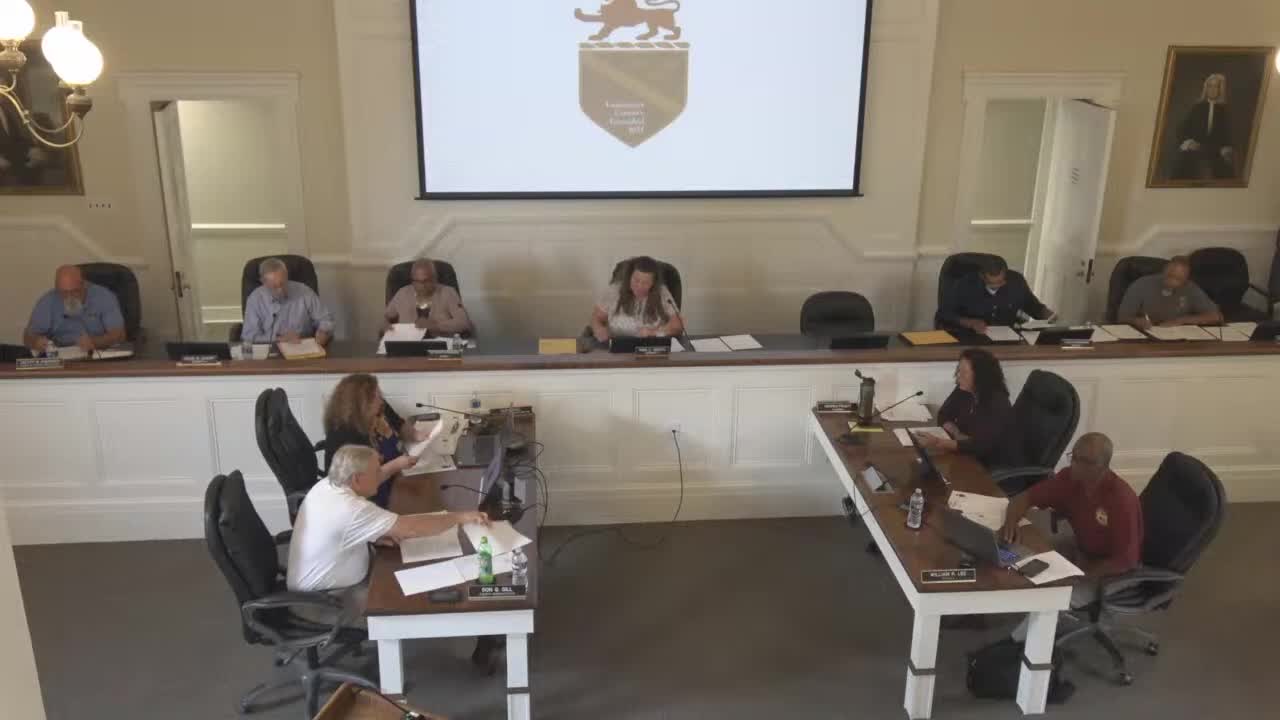
The Lancaster County Planning Commission on May 15 held a work session to review proposed updates to Article 28 of the county zoning ordinance addressing utility‑scale and small‑scale solar energy facilities. Commissioners directed staff to draft ordinance language and to obtain an attorney opinion for the next meeting, with the intention of returning the revised language for consideration and possible public hearing.
Planning staff member Andrea Pruitt presented research and a comparison table of neighboring localities’ ordinances and recommended defining a small‑scale solar facility as a system with a maximum capacity of 25 kilowatts. Pruitt said the 25‑kilowatt limit is grounded in Virginia code limits for residential systems and that, by current panel efficiencies, a 25‑kilowatt residential system would generally occupy on the order of a few thousand square feet rather than the 10,000 square feet currently in the Lancaster ordinance. She summarized: “you can't go above 25 k.”
Staff recommended also including a surface‑area limit and commissioners discussed a 2,500‑square‑foot cap as a likely upper bound for ground‑mounted residential systems. Commissioners and staff noted that technology efficiency and panel choice affect required surface area; staff offered both a capacity‑based limit (25 kW) and an optional square‑foot cap so the ordinance would remain effective as technology evolves.
Other discussion items included whether to rename the category from “small‑scale residential solar” to simply “small scale solar” so the definition would apply consistently across zoning districts; setbacks; carports; height; screening; decommissioning; noise; and resource protection area restrictions. On setbacks, staff noted current county rules treat ground‑mounted solar as subject to the primary‑structure setback (typically 25 feet in some districts) while accessory structures such as carports typically have a 5‑foot setback. Commissioners debated whether solar carports should meet the primary‑structure setback or the accessory setback; several commissioners expressed that a 5‑foot accessory setback is too short for solar carports and preferred retaining the 25‑foot standard for ground‑mounted systems. One commissioner said, “I think 5 feet is too short,” and the group reached consensus to leave the ordinance’s default 25‑foot setback in place and include language allowing special‑exception or variance processes where warranted.
On height limits for ground‑mounted systems, commissioners and staff reviewed nearby local ordinances and observed that a 15‑foot maximum is commonly used; one commissioner said, “I think 15 is a good number.” The commission agreed to add a 15‑foot limit for ground‑mounted panels. Commissioners also discussed approaches that specify maximum heights at the panels’ highest and lowest tilt to ensure systems remain close to the ground.
Staff reminded the commission that solar panels are treated as impervious surface for stormwater and resource‑protection purposes and therefore are generally not allowed in resource protection area buffers unless placed on existing impervious cover (for example, roof‑mounted systems that do not increase impervious area).
The commission asked staff to draft ordinance language incorporating the agreed parameters (25 kW capacity cap for small scale; suggested 2,500 square feet surface area limit; rename to “small scale solar”; 15‑foot ground‑mounted height limit; retain 25‑foot primary setbacks with clarification on carports; and include a mechanism for special exceptions or variances) and to obtain county attorney feedback. Staff said it would return the draft as a consideration item at the next meeting for commissioners to decide whether to send the changes to public hearing.
Planning staff member Andrea Pruitt presented research and a comparison table of neighboring localities’ ordinances and recommended defining a small‑scale solar facility as a system with a maximum capacity of 25 kilowatts. Pruitt said the 25‑kilowatt limit is grounded in Virginia code limits for residential systems and that, by current panel efficiencies, a 25‑kilowatt residential system would generally occupy on the order of a few thousand square feet rather than the 10,000 square feet currently in the Lancaster ordinance. She summarized: “you can't go above 25 k.”
Staff recommended also including a surface‑area limit and commissioners discussed a 2,500‑square‑foot cap as a likely upper bound for ground‑mounted residential systems. Commissioners and staff noted that technology efficiency and panel choice affect required surface area; staff offered both a capacity‑based limit (25 kW) and an optional square‑foot cap so the ordinance would remain effective as technology evolves.
Other discussion items included whether to rename the category from “small‑scale residential solar” to simply “small scale solar” so the definition would apply consistently across zoning districts; setbacks; carports; height; screening; decommissioning; noise; and resource protection area restrictions. On setbacks, staff noted current county rules treat ground‑mounted solar as subject to the primary‑structure setback (typically 25 feet in some districts) while accessory structures such as carports typically have a 5‑foot setback. Commissioners debated whether solar carports should meet the primary‑structure setback or the accessory setback; several commissioners expressed that a 5‑foot accessory setback is too short for solar carports and preferred retaining the 25‑foot standard for ground‑mounted systems. One commissioner said, “I think 5 feet is too short,” and the group reached consensus to leave the ordinance’s default 25‑foot setback in place and include language allowing special‑exception or variance processes where warranted.
On height limits for ground‑mounted systems, commissioners and staff reviewed nearby local ordinances and observed that a 15‑foot maximum is commonly used; one commissioner said, “I think 15 is a good number.” The commission agreed to add a 15‑foot limit for ground‑mounted panels. Commissioners also discussed approaches that specify maximum heights at the panels’ highest and lowest tilt to ensure systems remain close to the ground.
Staff reminded the commission that solar panels are treated as impervious surface for stormwater and resource‑protection purposes and therefore are generally not allowed in resource protection area buffers unless placed on existing impervious cover (for example, roof‑mounted systems that do not increase impervious area).
The commission asked staff to draft ordinance language incorporating the agreed parameters (25 kW capacity cap for small scale; suggested 2,500 square feet surface area limit; rename to “small scale solar”; 15‑foot ground‑mounted height limit; retain 25‑foot primary setbacks with clarification on carports; and include a mechanism for special exceptions or variances) and to obtain county attorney feedback. Staff said it would return the draft as a consideration item at the next meeting for commissioners to decide whether to send the changes to public hearing.
View the Full Meeting & All Its Details
This article offers just a summary. Unlock complete video, transcripts, and insights as a Founder Member.
✓
Watch full, unedited meeting videos
✓
Search every word spoken in unlimited transcripts
✓
AI summaries & real-time alerts (all government levels)
✓
Permanent access to expanding government content
30-day money-back guarantee
