Mayors urge Dearborn County to address perceived 9-1-1 funding imbalance
May 16, 2025 | Dearborn County, Indiana
This article was created by AI summarizing key points discussed. AI makes mistakes, so for full details and context, please refer to the video of the full meeting. Please report any errors so we can fix them. Report an error »
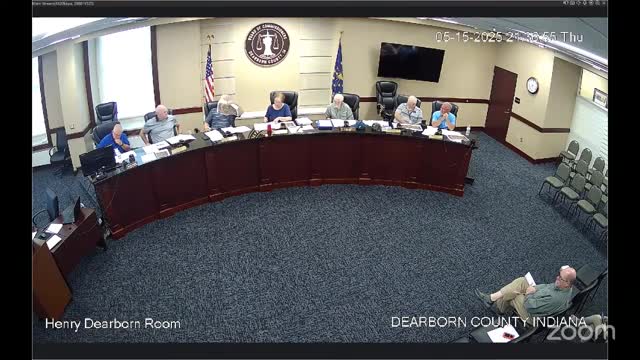
Mayors from the county’s three cities told the Dearborn County Council that their residents are paying disproportionately high shares of 9-1-1 costs and asked the council to pursue a more equitable cost-sharing arrangement.
The presenters said the three cities account for about 26% of the county population but generate roughly 55% of 9-1-1 call volume, in part because of tourist traffic, Highway 50, and large local employers. They argued that city residents appear to be “double charged” because local property taxpayers already contribute county property tax revenues while the county general fund is covering an 9-1-1 shortfall that disproportionately benefits the whole county.
The mayors suggested options for addressing the disparity: the county could cover the shortfall out of county general; the public safety local income tax (described in the meeting as the public safety “LIT”) could be increased slightly (an example cited was an increase of 0.06 percentage points to close the gap); or the parties could renegotiate a cost-sharing arrangement among the cities and county. Presenters noted state-level changes being discussed — including Senate Bill 1 and other proposals affecting 9-1-1 funding — and said state action could change the local funding picture by 2028.
Council members and staff responded that some fixes would require broader approval (for example, changes to the public safety local income tax would involve local income-tax authorities and the mayors) and that statutory and administrative constraints limit what the county can unilaterally change. The county’s finance staff explained that the shortfall is currently borne largely by county general funds and noted the mechanics of how local public safety allocations are distributed among municipalities. Several council members invited the mayors to meet with commissioners and county staff to pursue options.
No formal council appropriation or new policy was adopted at the meeting; the discussion ended with an agreement to continue talks and for mayors to pursue information-sharing with county officials and state legislators.
The presenters said the three cities account for about 26% of the county population but generate roughly 55% of 9-1-1 call volume, in part because of tourist traffic, Highway 50, and large local employers. They argued that city residents appear to be “double charged” because local property taxpayers already contribute county property tax revenues while the county general fund is covering an 9-1-1 shortfall that disproportionately benefits the whole county.
The mayors suggested options for addressing the disparity: the county could cover the shortfall out of county general; the public safety local income tax (described in the meeting as the public safety “LIT”) could be increased slightly (an example cited was an increase of 0.06 percentage points to close the gap); or the parties could renegotiate a cost-sharing arrangement among the cities and county. Presenters noted state-level changes being discussed — including Senate Bill 1 and other proposals affecting 9-1-1 funding — and said state action could change the local funding picture by 2028.
Council members and staff responded that some fixes would require broader approval (for example, changes to the public safety local income tax would involve local income-tax authorities and the mayors) and that statutory and administrative constraints limit what the county can unilaterally change. The county’s finance staff explained that the shortfall is currently borne largely by county general funds and noted the mechanics of how local public safety allocations are distributed among municipalities. Several council members invited the mayors to meet with commissioners and county staff to pursue options.
No formal council appropriation or new policy was adopted at the meeting; the discussion ended with an agreement to continue talks and for mayors to pursue information-sharing with county officials and state legislators.
View the Full Meeting & All Its Details
This article offers just a summary. Unlock complete video, transcripts, and insights as a Founder Member.
✓
Watch full, unedited meeting videos
✓
Search every word spoken in unlimited transcripts
✓
AI summaries & real-time alerts (all government levels)
✓
Permanent access to expanding government content
30-day money-back guarantee
