NVTA technical advisory committee endorses regional approach to fund Northern Virginia bike‑ped network
October 15, 2025 | Northern Virginia Transportation Authority, Boards and Commissions, Executive, Virginia
This article was created by AI summarizing key points discussed. AI makes mistakes, so for full details and context, please refer to the video of the full meeting. Please report any errors so we can fix them. Report an error »
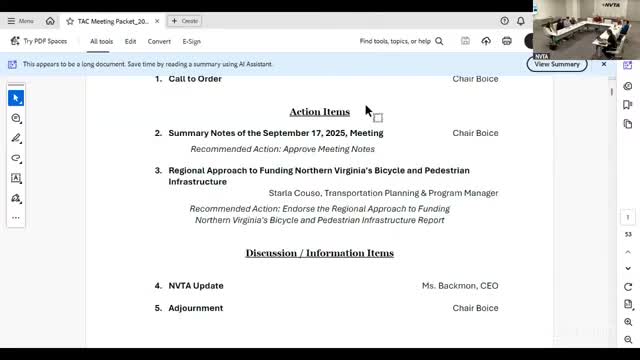
The Northern Virginia Transportation Authority (NVTA) Technical Advisory Committee on Oct. 15 endorsed a regional approach to funding bicycle and pedestrian infrastructure identified in the 2024 VDOT Northern Virginia Bicycle and Pedestrian Network.
Starla Cuso, transportation planning and programming manager at the Northern Virginia Transportation Authority and project manager for the initiative, told the committee the effort reviewed existing funding sources and evaluated future funding strategies to implement and maintain roughly 4,000 miles of bicycle and pedestrian infrastructure the VDOT study identified. “We really looked at those 7 metrics and understanding how the different strategies or fees would be assessed against them so we can understand a holistic picture of the different tax and fees that we were looking at,” Cuso said.
The initiative examined local, regional, state and federal pots of money currently used to implement projects and screened 45 potential future funding strategies against seven qualitative metrics, Cuso said. The project team narrowed its recommendations to 14 strategies that scored highly on multiple metrics; two of those also scored highly for revenue potential and an existing pathway for regional implementation. The consultants noted the effort did not include financial modeling and recommended further analysis of revenue estimates, legal feasibility and regional impacts before implementation.
Kate Widnes, consultant project manager at Kimley‑Horn, said the team also consulted related efforts, including ongoing policy items and regional coordination meetings. The presenters told the committee that several otherwise promising strategies were not recommended to move forward because a regional implementation pathway did not exist or because it would be difficult to dedicate proceeds specifically to bicycle and pedestrian infrastructure.
Committee members asked questions about scope and implementation. One committee member noted that the report’s recommended sources were state or local and asked whether the project assumed federal funding availability; the presenters said the focus was finding funding that could be implemented within the region. Another committee member asked whether the study considered streamlining project delivery and operations and maintenance; Cuso said that was outside the initiative’s scope but could be a logical next step.
The committee voted to endorse the report by voice vote. No opposing votes were recorded; one member, Armand, was asked to sit out the vote. The meeting also approved the summary minutes from Sept. 17 by voice vote.
Separately, NVTA staff provided an update on the region’s long‑range plan process and near‑term programing. Ms. Beckman (NVTA staff) said the TransAction long‑range plan update is in its early stage, the request for proposals is open and the RFP closes next week. She reported that NVTA has received 26 projects requesting a combined $1,300,000,000 and reminded jurisdictions that resolutions of support are due Oct. 31 at 5 p.m. She also said NVTA will host its second annual State of the Region’s Transportation event next week, with panelists including Aaliyah Gaskins, mayor of the City of Alexandria; Clark Mercer, executive director of the Metropolitan Washington Council of Governments; and Nuria Fernández, former administrator of the Federal Transit Administration.
What the committee endorsed is a regional funding approach, not an adoption of any specific new tax or fee. The presenters recommended follow‑up work, including financial modeling and legal review, before any individual funding strategy would move to implementation.
Votes at a glance: The committee approved acceptance of the Sept. 17 meeting minutes (motion and second not specified; voice vote, approved) and endorsed the regional approach to funding Northern Virginia bicycle and pedestrian infrastructure (motion and second not specified; voice vote, approved; one member asked to sit out the vote).
Starla Cuso, transportation planning and programming manager at the Northern Virginia Transportation Authority and project manager for the initiative, told the committee the effort reviewed existing funding sources and evaluated future funding strategies to implement and maintain roughly 4,000 miles of bicycle and pedestrian infrastructure the VDOT study identified. “We really looked at those 7 metrics and understanding how the different strategies or fees would be assessed against them so we can understand a holistic picture of the different tax and fees that we were looking at,” Cuso said.
The initiative examined local, regional, state and federal pots of money currently used to implement projects and screened 45 potential future funding strategies against seven qualitative metrics, Cuso said. The project team narrowed its recommendations to 14 strategies that scored highly on multiple metrics; two of those also scored highly for revenue potential and an existing pathway for regional implementation. The consultants noted the effort did not include financial modeling and recommended further analysis of revenue estimates, legal feasibility and regional impacts before implementation.
Kate Widnes, consultant project manager at Kimley‑Horn, said the team also consulted related efforts, including ongoing policy items and regional coordination meetings. The presenters told the committee that several otherwise promising strategies were not recommended to move forward because a regional implementation pathway did not exist or because it would be difficult to dedicate proceeds specifically to bicycle and pedestrian infrastructure.
Committee members asked questions about scope and implementation. One committee member noted that the report’s recommended sources were state or local and asked whether the project assumed federal funding availability; the presenters said the focus was finding funding that could be implemented within the region. Another committee member asked whether the study considered streamlining project delivery and operations and maintenance; Cuso said that was outside the initiative’s scope but could be a logical next step.
The committee voted to endorse the report by voice vote. No opposing votes were recorded; one member, Armand, was asked to sit out the vote. The meeting also approved the summary minutes from Sept. 17 by voice vote.
Separately, NVTA staff provided an update on the region’s long‑range plan process and near‑term programing. Ms. Beckman (NVTA staff) said the TransAction long‑range plan update is in its early stage, the request for proposals is open and the RFP closes next week. She reported that NVTA has received 26 projects requesting a combined $1,300,000,000 and reminded jurisdictions that resolutions of support are due Oct. 31 at 5 p.m. She also said NVTA will host its second annual State of the Region’s Transportation event next week, with panelists including Aaliyah Gaskins, mayor of the City of Alexandria; Clark Mercer, executive director of the Metropolitan Washington Council of Governments; and Nuria Fernández, former administrator of the Federal Transit Administration.
What the committee endorsed is a regional funding approach, not an adoption of any specific new tax or fee. The presenters recommended follow‑up work, including financial modeling and legal review, before any individual funding strategy would move to implementation.
Votes at a glance: The committee approved acceptance of the Sept. 17 meeting minutes (motion and second not specified; voice vote, approved) and endorsed the regional approach to funding Northern Virginia bicycle and pedestrian infrastructure (motion and second not specified; voice vote, approved; one member asked to sit out the vote).
View the Full Meeting & All Its Details
This article offers just a summary. Unlock complete video, transcripts, and insights as a Founder Member.
✓
Watch full, unedited meeting videos
✓
Search every word spoken in unlimited transcripts
✓
AI summaries & real-time alerts (all government levels)
✓
Permanent access to expanding government content
30-day money-back guarantee
