Notre Dame Healthcare seeks permission to remove undermining trees along Coal Mine Brook; commission requests site visit
September 30, 2025 | Worcester City, Worcester County, Massachusetts
This article was created by AI summarizing key points discussed. AI makes mistakes, so for full details and context, please refer to the video of the full meeting. Please report any errors so we can fix them. Report an error »
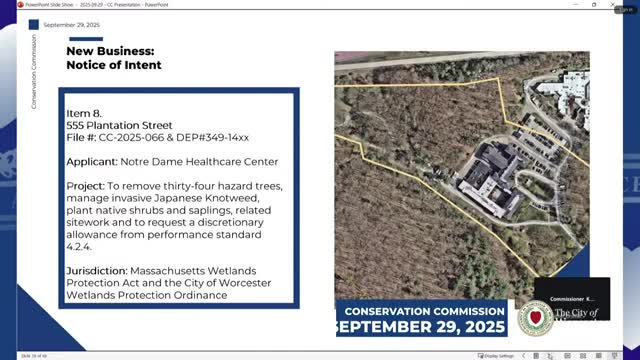
WORCESTER — Representatives for Notre Dame Healthcare presented a notice of intent Sept. 29 seeking permission to remove dozens of trees and two debris dams along Coal Mine Brook where erosion has undermined the south bank, and they proposed native sapling plantings as compensation.
Project wetland scientist Arthur Allen of EcoTech said the brook’s south bank has been badly undercut and that at least four large trees had already fallen; he reported the arborist recommended removal of 28 live trees plus four standing dead trees and two fallen trees that have created debris dams impeding flow. Allen said equipment would be staged on the facility driveway and that crews would cut and remove trees while leaving root masses in place to help stabilize the bank. He proposed planting 28 native saplings and shrubs, placed by the wetland scientist to take advantage of canopy openings created by removals.
Andrew Dube, grounds superintendent for Notre Dame Healthcare, told commissioners the work responds to safety concerns: fallen limbs and trees have impinged on the power feed and could threaten the facility and residents using nearby walking paths.
Staff raised concerns about the overall scale of removals and about preserving stream shading because Coal Mine Brook is a cold‑water fishery. Eric Flint of the Division of Planning and Regulatory Services recommended a joint site walk with staff and the applicant to identify trees that could be saved and to calibrate planting locations and species. Commissioners asked whether the underlying cause — increased flashy flows and bank erosion from urbanization — had been analyzed and noted that small saplings will not immediately replace the shade lost with mature canopy removals.
Because the project lacks a DEP file number and staff comments remain outstanding, the commission continued the hearing to Oct. 20 and agreed to arrange a site visit. Commission staff will circulate possible morning times and coordinate the joint site walk.
Project wetland scientist Arthur Allen of EcoTech said the brook’s south bank has been badly undercut and that at least four large trees had already fallen; he reported the arborist recommended removal of 28 live trees plus four standing dead trees and two fallen trees that have created debris dams impeding flow. Allen said equipment would be staged on the facility driveway and that crews would cut and remove trees while leaving root masses in place to help stabilize the bank. He proposed planting 28 native saplings and shrubs, placed by the wetland scientist to take advantage of canopy openings created by removals.
Andrew Dube, grounds superintendent for Notre Dame Healthcare, told commissioners the work responds to safety concerns: fallen limbs and trees have impinged on the power feed and could threaten the facility and residents using nearby walking paths.
Staff raised concerns about the overall scale of removals and about preserving stream shading because Coal Mine Brook is a cold‑water fishery. Eric Flint of the Division of Planning and Regulatory Services recommended a joint site walk with staff and the applicant to identify trees that could be saved and to calibrate planting locations and species. Commissioners asked whether the underlying cause — increased flashy flows and bank erosion from urbanization — had been analyzed and noted that small saplings will not immediately replace the shade lost with mature canopy removals.
Because the project lacks a DEP file number and staff comments remain outstanding, the commission continued the hearing to Oct. 20 and agreed to arrange a site visit. Commission staff will circulate possible morning times and coordinate the joint site walk.
View the Full Meeting & All Its Details
This article offers just a summary. Unlock complete video, transcripts, and insights as a Founder Member.
✓
Watch full, unedited meeting videos
✓
Search every word spoken in unlimited transcripts
✓
AI summaries & real-time alerts (all government levels)
✓
Permanent access to expanding government content
30-day money-back guarantee
