Beaufort County: Recycling running in the red as officials plan composting, new containers and pilots
May 23, 2025 | Beaufort County, South Carolina
This article was created by AI summarizing key points discussed. AI makes mistakes, so for full details and context, please refer to the video of the full meeting. Please report any errors so we can fix them. Report an error »
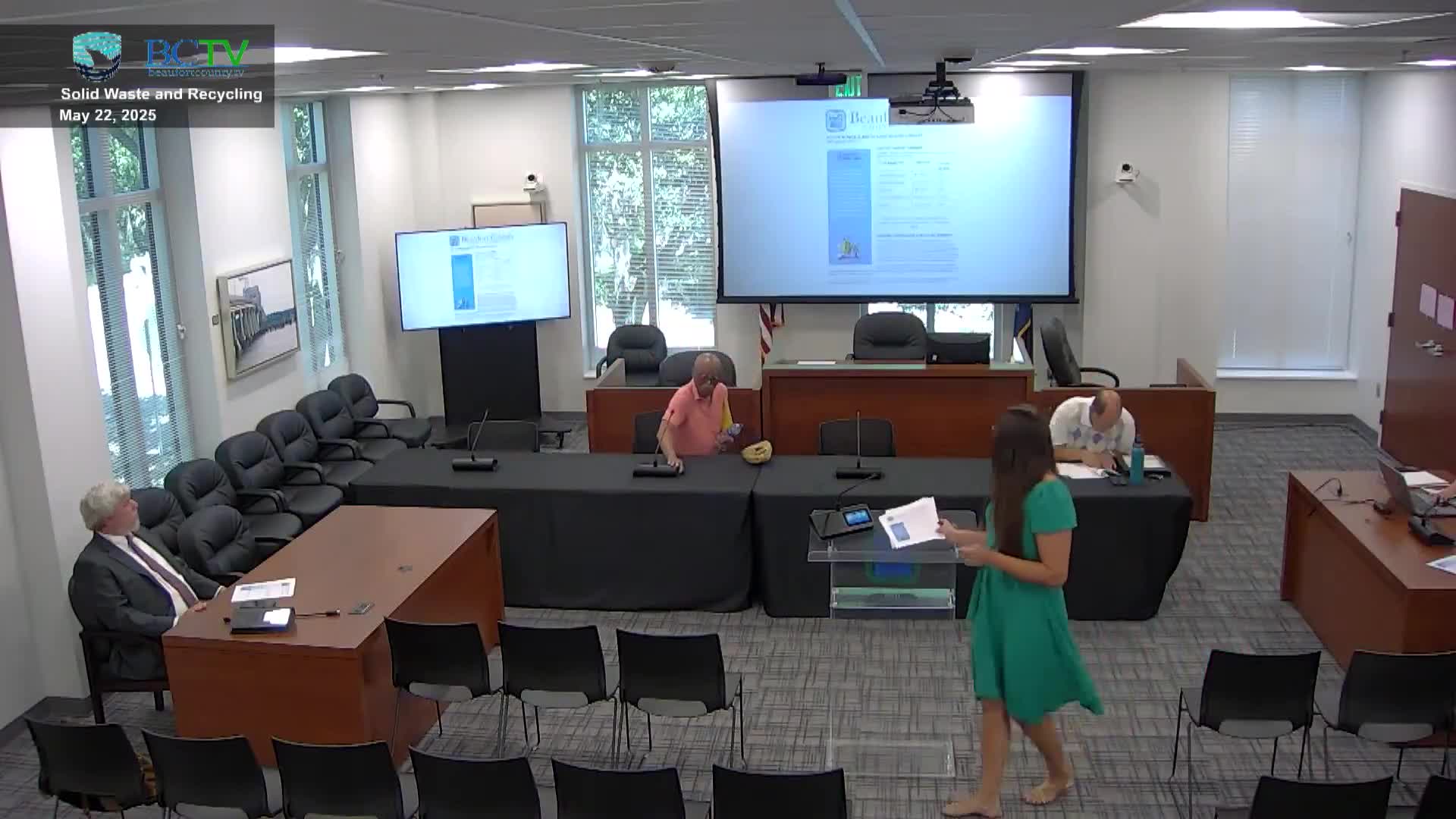
Beaufort County Solid Waste and Recycling staff reported growing recycling and disposal costs and outlined several pilot programs and investments aimed at diverting waste and standardizing recycling across the county.
Victoria Hoffman, speaking for Solid Waste and Recycling, told the committee that recycling is currently operating at a net cost. "We're not in the green for recycling. It's in the red," she said, adding that the county had spent "368,000 and change to recycle" to date and that the county's net cost with one vendor (referred to in the meeting as I2) was reported as $620,000.
The financial picture matters because of landfill expenses: Hoffman said, "It cost us $4,000,000 to dispose of MSW at the landfill last year." She noted those landfill disposal costs and recycling expenses are rising as county population and tonnage increase.
To address diversion and operations, Hoffman described several programs and purchases planned for fiscal year 2026 if the budget is approved. She said the county has procured an in-vessel composting unit and will hold a kickoff meeting with the vendor in the coming weeks; the vendor contract includes installation, training and two years of support. Hoffman said the county will pilot a compartmentalized 40-yard roll-off container with separate sections for plastic, cans, paper and other materials to bring recycling to more rural convenience centers that previously lacked on-site recycling.
Hoffman also said the IT department has installed security cameras at some convenience centers and is working on live feeds for remaining centers for safety and risk management purposes. For customer access and throughput, she described a proposed FY26 capital pilot at the Shanklin Convenience Center to test an automated arm scanner for residential hauler decals; if approved, that pilot would free attendant time to support resident education in recycling areas.
The county is planning outreach and cultural review for some public-facing materials; Hoffman said the department has worked with Gullah/Geechee leader Queen Quet to review a compost program mascot and that the county purchased compost storage sheds using state grant funds, with one already installed at the Shanklin center. She also said staff will continue outreach on Daufuskie Island, where recycling is complicated and costly by barge transport.
On vendor pricing and rebates, Hoffman said previous vendors' fees and hauling arrangements differed from current contracts; the committee was shown that monthly recycling processing and hauling costs exceed rebates but that the county will continue recycling as a policy choice despite net costs.
Hoffman said the department's FY26 budget request has completed one reading at county council and must complete two more readings; she said the full budget will be known after council approval. "We requested money just like every other department and they allotted us," she said.
Discussion included questions about the tradeoffs between curbside service and convenience centers, the cost to residents in unincorporated areas if curbside fees are assessed, and how standardizing county oversight of recycling hauling and processing could change hauler incentives. Hoffman framed the policy choices as financial versus environmental priorities: "It's financial versus an environmental—exactly what's more important."
Victoria Hoffman, speaking for Solid Waste and Recycling, told the committee that recycling is currently operating at a net cost. "We're not in the green for recycling. It's in the red," she said, adding that the county had spent "368,000 and change to recycle" to date and that the county's net cost with one vendor (referred to in the meeting as I2) was reported as $620,000.
The financial picture matters because of landfill expenses: Hoffman said, "It cost us $4,000,000 to dispose of MSW at the landfill last year." She noted those landfill disposal costs and recycling expenses are rising as county population and tonnage increase.
To address diversion and operations, Hoffman described several programs and purchases planned for fiscal year 2026 if the budget is approved. She said the county has procured an in-vessel composting unit and will hold a kickoff meeting with the vendor in the coming weeks; the vendor contract includes installation, training and two years of support. Hoffman said the county will pilot a compartmentalized 40-yard roll-off container with separate sections for plastic, cans, paper and other materials to bring recycling to more rural convenience centers that previously lacked on-site recycling.
Hoffman also said the IT department has installed security cameras at some convenience centers and is working on live feeds for remaining centers for safety and risk management purposes. For customer access and throughput, she described a proposed FY26 capital pilot at the Shanklin Convenience Center to test an automated arm scanner for residential hauler decals; if approved, that pilot would free attendant time to support resident education in recycling areas.
The county is planning outreach and cultural review for some public-facing materials; Hoffman said the department has worked with Gullah/Geechee leader Queen Quet to review a compost program mascot and that the county purchased compost storage sheds using state grant funds, with one already installed at the Shanklin center. She also said staff will continue outreach on Daufuskie Island, where recycling is complicated and costly by barge transport.
On vendor pricing and rebates, Hoffman said previous vendors' fees and hauling arrangements differed from current contracts; the committee was shown that monthly recycling processing and hauling costs exceed rebates but that the county will continue recycling as a policy choice despite net costs.
Hoffman said the department's FY26 budget request has completed one reading at county council and must complete two more readings; she said the full budget will be known after council approval. "We requested money just like every other department and they allotted us," she said.
Discussion included questions about the tradeoffs between curbside service and convenience centers, the cost to residents in unincorporated areas if curbside fees are assessed, and how standardizing county oversight of recycling hauling and processing could change hauler incentives. Hoffman framed the policy choices as financial versus environmental priorities: "It's financial versus an environmental—exactly what's more important."
Don't Miss a Word: See the Full Meeting!
Go beyond summaries. Unlock every video, transcript, and key insight with a Founder Membership.
✓
Get instant access to full meeting videos
✓
Search and clip any phrase from complete transcripts
✓
Receive AI-powered summaries & custom alerts
✓
Enjoy lifetime, unrestricted access to government data
30-day money-back guarantee
