House subcommittee presses Navy on late budget, weakened shipbuilding demand signal
June 05, 2025 | Armed Services: House Committee, Standing Committees - House & Senate, Congressional Hearings Compilation, Legislative, Federal
This article was created by AI summarizing key points discussed. AI makes mistakes, so for full details and context, please refer to the video of the full meeting. Please report any errors so we can fix them. Report an error »
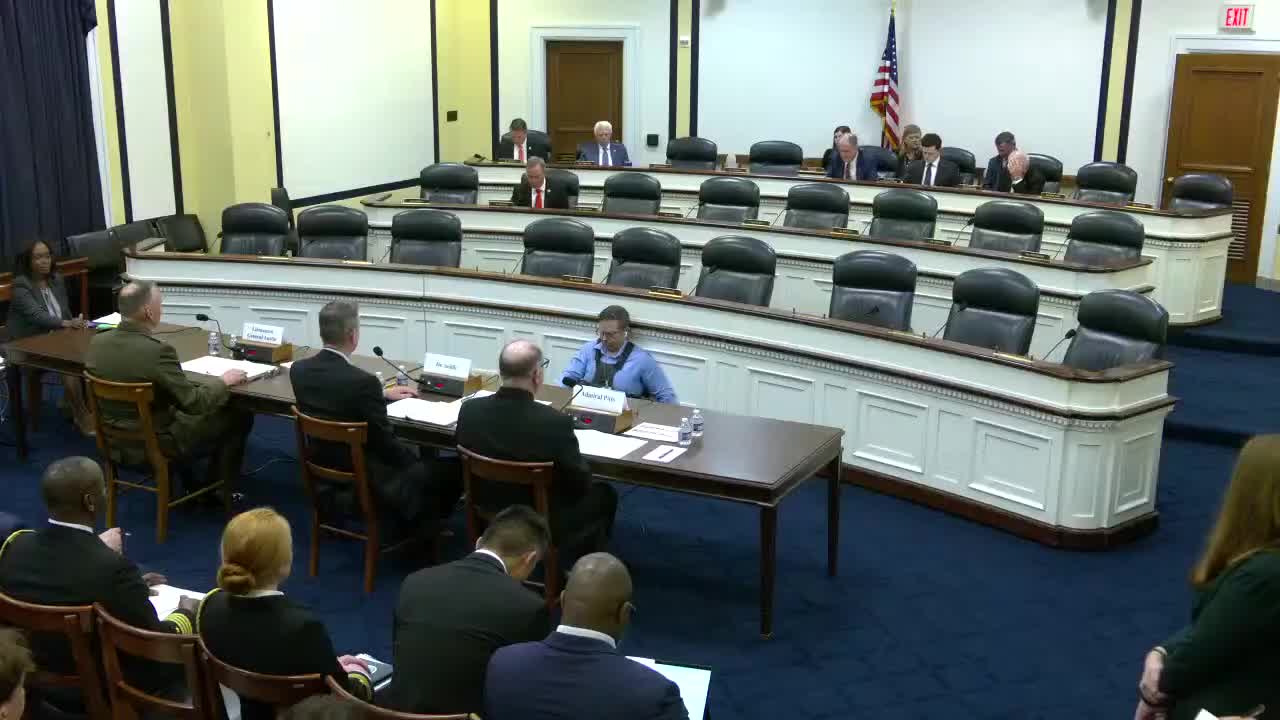
Members of the House Armed Services Subcommittee said on June 4 that delays and top-line reductions in the Department of the Navy’s fiscal 2026 budget are creating uncertainty that could harm shipbuilding capacity and workforce recovery.
The subcommittee’s chair, Chairman Kelly, opened the hearing by saying lawmakers expect additional budget details in coming weeks and that the panel “looks forward to seeing how the budget decisions for fiscal year 2026 measure up to our current threat environment.” The ranking member, Representative Joe Courtney, told the panel the administration had not yet delivered a complete budget and that an appendix released with topline numbers lacked account-level breakdowns.
Why it matters: Committee members and witnesses repeatedly said the industrial base needs a consistent, multiyear procurement signal so primes and yards can hire, retain and invest. Representative Courtney said the appendix posted last Friday “provided only top lines for accounts with no funding line breakdown.” He noted the appendix included a request of $20,800,000,000 for the Navy’s Shipbuilding and Conversion (SCN) account, which he said is roughly $15.7 billion less than the $36.6 billion that became law in the last appropriation cycle.
Witnesses echoed the need for a steady demand signal. Dr. Seidel, a Department of the Navy witness, said the Navy is “working hard…how to be more directive about holistic governance of our acquisition so that we can send that demand signal in a healthy way.” Admiral Pitts, the Navy’s deputy chief of naval operations for warfighting requirements and capabilities, emphasized procurement stability as a priority and the services’ desire to “deliver more readiness in both the near and long term.”
Members pressed how the budget and reconciliation process interact. Courtney and others noted the pending reconciliation legislation contains shipbuilding funds (he referenced a $33 billion figure included in previous drafts) but said reconciliation text varies between chambers and that funds in reconciliation can be obligated over multiple years through Sept. 30, 2029, which complicates assumptions about what is available for FY26 procurement.
Committee and witnesses cited mechanisms they believe can improve industrial-base certainty, including multiyear contracts, robust and timely funding, advanced procurement for long-lead material, and clearer program stability. Dr. Seidel told members the Navy and Congress have previously used these tools to create procurement stability and that the department is trying to improve governance to avoid “cyclical problems” that disrupt yards and workforce.
The subcommittee sought commitments that planned advanced procurement — particularly for carrier and ship programs — remain aligned with schedules that keep production lines active and prevent workforce attrition. Members warned that moving advanced procurements between fiscal years or failing to provide account-level detail would undercut those goals and result in higher costs and slower build rates.
The hearing did not produce binding decisions on account allocations; witnesses repeatedly said final budgets and reconciliation language would determine what funds are available and that some questions would need to be taken for the record. Several members said they expect follow-up work with witnesses and staff to ensure that account-level plans match the industrial-base objectives the committee cited.
The hearing moved on to program- and platform-level topics after this discussion; members directed several follow-up questions to witnesses for the record.
The subcommittee’s chair, Chairman Kelly, opened the hearing by saying lawmakers expect additional budget details in coming weeks and that the panel “looks forward to seeing how the budget decisions for fiscal year 2026 measure up to our current threat environment.” The ranking member, Representative Joe Courtney, told the panel the administration had not yet delivered a complete budget and that an appendix released with topline numbers lacked account-level breakdowns.
Why it matters: Committee members and witnesses repeatedly said the industrial base needs a consistent, multiyear procurement signal so primes and yards can hire, retain and invest. Representative Courtney said the appendix posted last Friday “provided only top lines for accounts with no funding line breakdown.” He noted the appendix included a request of $20,800,000,000 for the Navy’s Shipbuilding and Conversion (SCN) account, which he said is roughly $15.7 billion less than the $36.6 billion that became law in the last appropriation cycle.
Witnesses echoed the need for a steady demand signal. Dr. Seidel, a Department of the Navy witness, said the Navy is “working hard…how to be more directive about holistic governance of our acquisition so that we can send that demand signal in a healthy way.” Admiral Pitts, the Navy’s deputy chief of naval operations for warfighting requirements and capabilities, emphasized procurement stability as a priority and the services’ desire to “deliver more readiness in both the near and long term.”
Members pressed how the budget and reconciliation process interact. Courtney and others noted the pending reconciliation legislation contains shipbuilding funds (he referenced a $33 billion figure included in previous drafts) but said reconciliation text varies between chambers and that funds in reconciliation can be obligated over multiple years through Sept. 30, 2029, which complicates assumptions about what is available for FY26 procurement.
Committee and witnesses cited mechanisms they believe can improve industrial-base certainty, including multiyear contracts, robust and timely funding, advanced procurement for long-lead material, and clearer program stability. Dr. Seidel told members the Navy and Congress have previously used these tools to create procurement stability and that the department is trying to improve governance to avoid “cyclical problems” that disrupt yards and workforce.
The subcommittee sought commitments that planned advanced procurement — particularly for carrier and ship programs — remain aligned with schedules that keep production lines active and prevent workforce attrition. Members warned that moving advanced procurements between fiscal years or failing to provide account-level detail would undercut those goals and result in higher costs and slower build rates.
The hearing did not produce binding decisions on account allocations; witnesses repeatedly said final budgets and reconciliation language would determine what funds are available and that some questions would need to be taken for the record. Several members said they expect follow-up work with witnesses and staff to ensure that account-level plans match the industrial-base objectives the committee cited.
The hearing moved on to program- and platform-level topics after this discussion; members directed several follow-up questions to witnesses for the record.
Don't Miss a Word: See the Full Meeting!
Go beyond summaries. Unlock every video, transcript, and key insight with a Founder Membership.
✓
Get instant access to full meeting videos
✓
Search and clip any phrase from complete transcripts
✓
Receive AI-powered summaries & custom alerts
✓
Enjoy lifetime, unrestricted access to government data
30-day money-back guarantee
