Cabarrus County managers present balanced FY26 general fund budget, five-year plan shows growing deficits
June 05, 2025 | Cabarrus County, North Carolina
This article was created by AI summarizing key points discussed. AI makes mistakes, so for full details and context, please refer to the video of the full meeting. Please report any errors so we can fix them. Report an error »
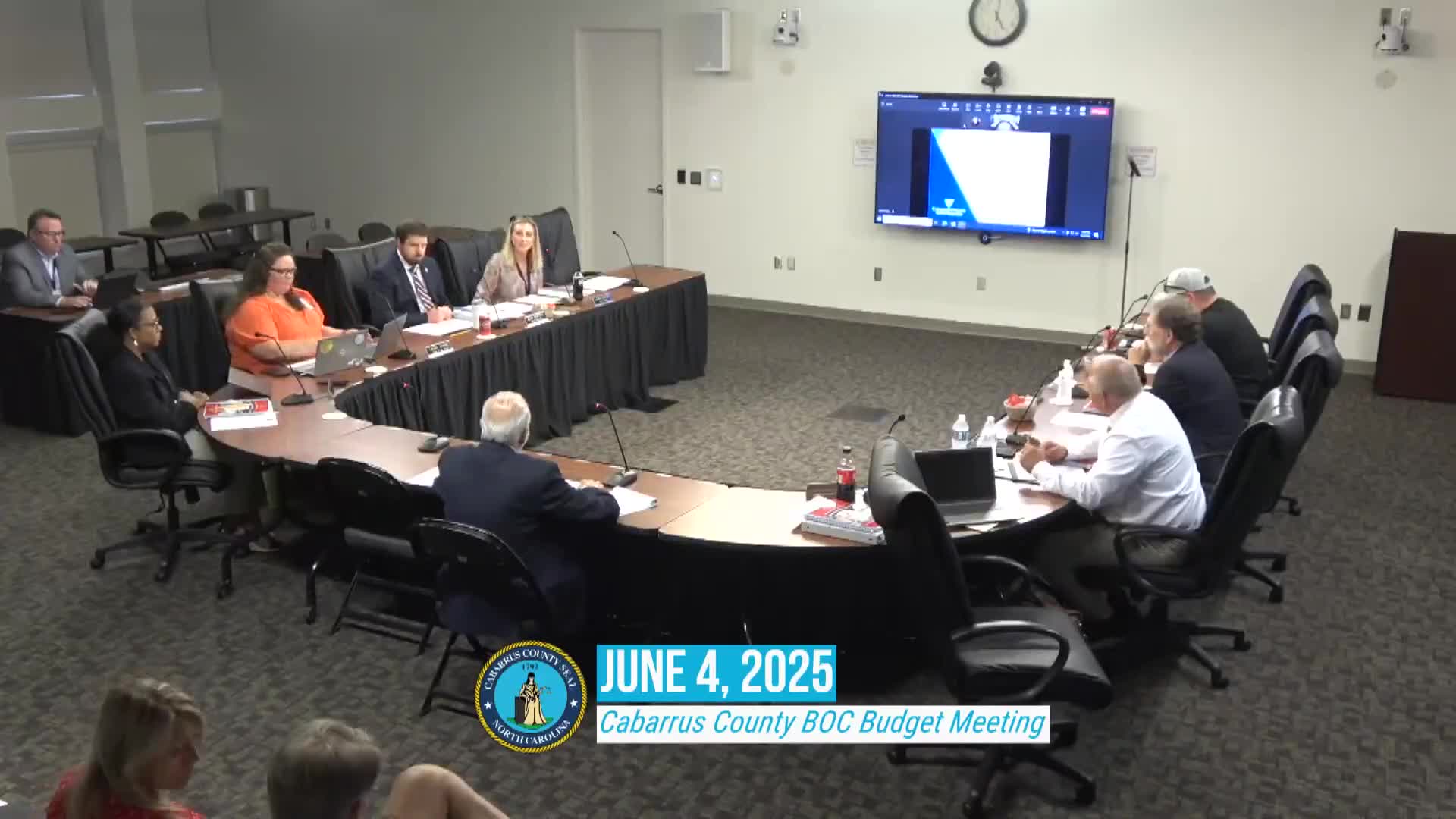
Cabarrus County staff presented a recommended FY26 general fund budget at the June 4 budget workshop, showing a balanced budget for next year while forecasting rising deficits in subsequent years.
The recommended budget includes $280,000,000 in property tax revenue, up from $269,000,000 in the prior year, and relies in part on one-time transfers that include $2,400,000 from internal service fund balances and $2,300,000 from an economic incentive grants fund balance, County staff said. "Just a disclaimer, all the figures here could change, depends on what you guys decide," the budget presenter said as he outlined revenue and expenditure assumptions.
County finance staff said the recommended budget balances revenues and expenses for FY26 by a combination of higher property valuations adjusted in April and May, conservative revenue projections in other categories and one-time fund balance transfers. On the expenditure side, personnel costs drove much of the increase, with salary and benefit items — including a budgeted lapse and anticipated health insurance and retirement increases — accounting for the largest shares.
Staff reviewed the county's five-year plan and the assumptions behind it, including a 2 percent annual property tax base growth assumption and a 4.5 percent annual increase for education in the plan. The five-year projection shows a $10,800,000 deficit in year two, growing to about $47,000,000 in year five under the current assumptions. Staff cautioned those projections are sensitive to assumptions about education growth, personnel costs and revenue trends.
Commissioners asked how the recommended numbers compared with prior planning steps. The presenter said property valuations adjustments in April and May added about $4,900,000 to revenues and that budget conferences and leadership reviews produced department reductions and reclassifications. He said the recommended budget already includes a $1,250,000 budgeted lapse and $242,000 in net position reclassifications identified during department reviews.
Several commissioners stressed the desire to avoid raising the property tax rate and pressed staff for options to reduce recurring costs without eroding services. Staff said some monies in the recommended budget are one-time, including a $2,400,000 transfer from a self-insurance fund to the Community Investment Fund for deferred maintenance and capital one-time needs. The presenter also noted capital outlay requests, principally vehicle replacements, were substantially reduced this cycle.
The workshop did not include a formal vote on the budget; staff said adjustments made by the board between now and adoption would be shown as technical changes to the final budget ordinance. Commissioners directed staff to continue analysis and to bring detailed debt-capacity information and options back to the board ahead of the formal adoption process.
The recommended budget includes $280,000,000 in property tax revenue, up from $269,000,000 in the prior year, and relies in part on one-time transfers that include $2,400,000 from internal service fund balances and $2,300,000 from an economic incentive grants fund balance, County staff said. "Just a disclaimer, all the figures here could change, depends on what you guys decide," the budget presenter said as he outlined revenue and expenditure assumptions.
County finance staff said the recommended budget balances revenues and expenses for FY26 by a combination of higher property valuations adjusted in April and May, conservative revenue projections in other categories and one-time fund balance transfers. On the expenditure side, personnel costs drove much of the increase, with salary and benefit items — including a budgeted lapse and anticipated health insurance and retirement increases — accounting for the largest shares.
Staff reviewed the county's five-year plan and the assumptions behind it, including a 2 percent annual property tax base growth assumption and a 4.5 percent annual increase for education in the plan. The five-year projection shows a $10,800,000 deficit in year two, growing to about $47,000,000 in year five under the current assumptions. Staff cautioned those projections are sensitive to assumptions about education growth, personnel costs and revenue trends.
Commissioners asked how the recommended numbers compared with prior planning steps. The presenter said property valuations adjustments in April and May added about $4,900,000 to revenues and that budget conferences and leadership reviews produced department reductions and reclassifications. He said the recommended budget already includes a $1,250,000 budgeted lapse and $242,000 in net position reclassifications identified during department reviews.
Several commissioners stressed the desire to avoid raising the property tax rate and pressed staff for options to reduce recurring costs without eroding services. Staff said some monies in the recommended budget are one-time, including a $2,400,000 transfer from a self-insurance fund to the Community Investment Fund for deferred maintenance and capital one-time needs. The presenter also noted capital outlay requests, principally vehicle replacements, were substantially reduced this cycle.
The workshop did not include a formal vote on the budget; staff said adjustments made by the board between now and adoption would be shown as technical changes to the final budget ordinance. Commissioners directed staff to continue analysis and to bring detailed debt-capacity information and options back to the board ahead of the formal adoption process.
Don't Miss a Word: See the Full Meeting!
Go beyond summaries. Unlock every video, transcript, and key insight with a Founder Membership.
✓
Get instant access to full meeting videos
✓
Search and clip any phrase from complete transcripts
✓
Receive AI-powered summaries & custom alerts
✓
Enjoy lifetime, unrestricted access to government data
30-day money-back guarantee
