Decatur County BZA pauses decision on 7,000‑acre Cobia/GNEX solar project after new agreements and studies presented
June 05, 2025 | Decatur County, Indiana
This article was created by AI summarizing key points discussed. AI makes mistakes, so for full details and context, please refer to the video of the full meeting. Please report any errors so we can fix them. Report an error »
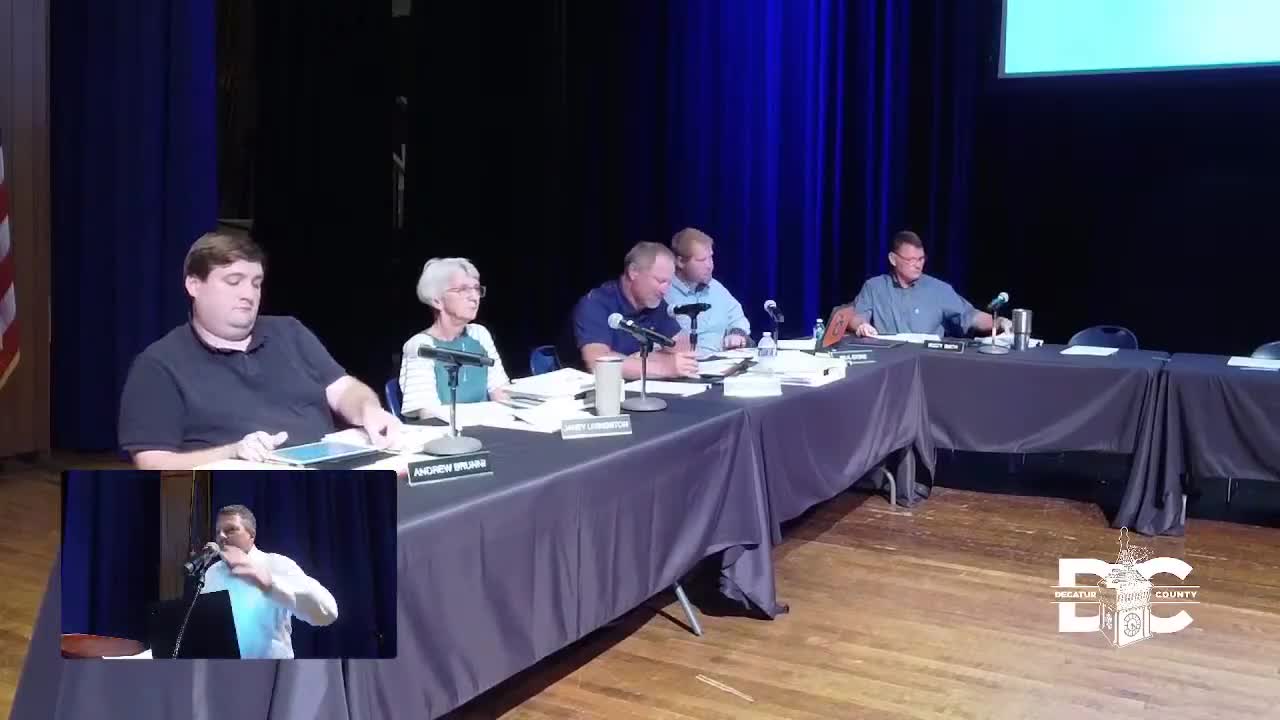
The Decatur County Board of Zoning Appeals on June 4 agreed to continue consideration of the Cobia (GNX) commercial solar special-exception request until Aug. 6 after the developer presented new agreements and technical studies and answered questions from board members and residents.
The continuation gives the county, the board, and nearby landowners time to review an economic development terms sheet, decommissioning and road-use plans, a fire‑safety and emergency‑response agreement, and an expanded “master agricultural preservation” package the petitioner delivered at the meeting.
GNX Solar project representative Wayne DeLong summarized the proposal as a multi‑phase project across Adams and Clay townships he described as roughly 7,049 acres with about 5,363 acres located behind perimeter fencing; he said construction for both phases would take about 24 to 36 months once it begins. Donnie DeCastro, GNX vice president of development, said the company would place sufficient surety for decommissioning and commit to water and soil monitoring, and that the project would include agrivoltaic uses such as sheep grazing.
“We are not consuming farmland. We are preserving farmland,” DeCastro told the board, summarizing the company’s pitch that the proposed covenants and operational commitments would protect soil health and allow ranching or other agricultural activities beneath and between panels.
The project team also submitted a draft economic development agreement (EDA) described in the meeting as a terms sheet that, in the developer’s initial presentation, would deliver about $16.5 million in payments over time; GNX and project counsel said that figure is the starting point for negotiation with county officials and the county council. Attorneys for GNX and consultants on the record said GNX would meet or exceed Decatur County’s zoning requirements (including a 150% surety for decommissioning required by county ordinance) and that the company would accept many TAC (technical advisory committee) recommendations on buffering, water testing and monitoring, and road‑use repair obligations.
The petitioner introduced several outside experts at the hearing: a sheep‑grazing consultant and operators proposing rotational grazing, a fire‑safety specialist who said he trains first responders on solar incidents, an appraiser to discuss property‑value impacts, and attorneys who said the developer will execute written covenants as zoning commitments under Indiana law. Landowners who have signed leases for the project also spoke in support, and an attorney representing opposing landowners requested more time to review the new documents.
BZA members said the volume of new, technical material and the number of nearby residents who wanted to comment made a continuance sensible. Attorney Brianna Schroeder, representing project landowners, urged the board to apply the county’s solar ordinance and to respect private property rights, saying the agreement framework preserves farmland while providing stable income for farm families. Landowner Gordon Smiley told the board the project would protect farm ownership and provide predictable revenue to keep farms in family hands.
Board members voted to table further action and resume the public‑comment and rebuttal process at the BZA’s Aug. 6 meeting; the board did not take a final vote on the special exception. Several petition materials and technical attachments were submitted to the county clerk and to county counsel the night of the meeting for further review.
What was said and what happens next: GNX asked to present and then asked the board to postpone final action so county staff, elected officials and members of the public could consider the EDA and the agricultural and emergency‑response commitments. The board accepted that request and set the continued hearing date. The developer and county staff indicated additional negotiation and documentation of the EDA and related agreements were likely to continue between the developer and county council offices before the Aug. 6 hearing.
Documents submitted with the developer’s rebuttal packet and TAC recommendations include: a draft master agricultural preservation agreement with subagreements on construction standards, drainage and erosion controls, soil conservation, agrivoltaics (dual use), vegetative management, visual screening, crop‑damage restoration and environmental monitoring; a decommissioning plan and a road‑use agreement that includes pre‑ and post‑construction road surveys and repair obligations; and a draft fire‑safety and emergency‑response plan that commits to training and equipment support for local responders.
The board indicated it will reopen public comment at the Aug. 6 meeting and hear a rebuttal from the petitioner at that time. No substantive county action was adopted at the June 4 session.
The continuation gives the county, the board, and nearby landowners time to review an economic development terms sheet, decommissioning and road-use plans, a fire‑safety and emergency‑response agreement, and an expanded “master agricultural preservation” package the petitioner delivered at the meeting.
GNX Solar project representative Wayne DeLong summarized the proposal as a multi‑phase project across Adams and Clay townships he described as roughly 7,049 acres with about 5,363 acres located behind perimeter fencing; he said construction for both phases would take about 24 to 36 months once it begins. Donnie DeCastro, GNX vice president of development, said the company would place sufficient surety for decommissioning and commit to water and soil monitoring, and that the project would include agrivoltaic uses such as sheep grazing.
“We are not consuming farmland. We are preserving farmland,” DeCastro told the board, summarizing the company’s pitch that the proposed covenants and operational commitments would protect soil health and allow ranching or other agricultural activities beneath and between panels.
The project team also submitted a draft economic development agreement (EDA) described in the meeting as a terms sheet that, in the developer’s initial presentation, would deliver about $16.5 million in payments over time; GNX and project counsel said that figure is the starting point for negotiation with county officials and the county council. Attorneys for GNX and consultants on the record said GNX would meet or exceed Decatur County’s zoning requirements (including a 150% surety for decommissioning required by county ordinance) and that the company would accept many TAC (technical advisory committee) recommendations on buffering, water testing and monitoring, and road‑use repair obligations.
The petitioner introduced several outside experts at the hearing: a sheep‑grazing consultant and operators proposing rotational grazing, a fire‑safety specialist who said he trains first responders on solar incidents, an appraiser to discuss property‑value impacts, and attorneys who said the developer will execute written covenants as zoning commitments under Indiana law. Landowners who have signed leases for the project also spoke in support, and an attorney representing opposing landowners requested more time to review the new documents.
BZA members said the volume of new, technical material and the number of nearby residents who wanted to comment made a continuance sensible. Attorney Brianna Schroeder, representing project landowners, urged the board to apply the county’s solar ordinance and to respect private property rights, saying the agreement framework preserves farmland while providing stable income for farm families. Landowner Gordon Smiley told the board the project would protect farm ownership and provide predictable revenue to keep farms in family hands.
Board members voted to table further action and resume the public‑comment and rebuttal process at the BZA’s Aug. 6 meeting; the board did not take a final vote on the special exception. Several petition materials and technical attachments were submitted to the county clerk and to county counsel the night of the meeting for further review.
What was said and what happens next: GNX asked to present and then asked the board to postpone final action so county staff, elected officials and members of the public could consider the EDA and the agricultural and emergency‑response commitments. The board accepted that request and set the continued hearing date. The developer and county staff indicated additional negotiation and documentation of the EDA and related agreements were likely to continue between the developer and county council offices before the Aug. 6 hearing.
Documents submitted with the developer’s rebuttal packet and TAC recommendations include: a draft master agricultural preservation agreement with subagreements on construction standards, drainage and erosion controls, soil conservation, agrivoltaics (dual use), vegetative management, visual screening, crop‑damage restoration and environmental monitoring; a decommissioning plan and a road‑use agreement that includes pre‑ and post‑construction road surveys and repair obligations; and a draft fire‑safety and emergency‑response plan that commits to training and equipment support for local responders.
The board indicated it will reopen public comment at the Aug. 6 meeting and hear a rebuttal from the petitioner at that time. No substantive county action was adopted at the June 4 session.
View the Full Meeting & All Its Details
This article offers just a summary. Unlock complete video, transcripts, and insights as a Founder Member.
✓
Watch full, unedited meeting videos
✓
Search every word spoken in unlimited transcripts
✓
AI summaries & real-time alerts (all government levels)
✓
Permanent access to expanding government content
30-day money-back guarantee
