Parents, PTSA leaders urge Seattle School District to revise 2025–26 recommended budget, cite special education and enrollment concerns
June 05, 2025 | Seattle School District No. 1, School Districts, Washington
This article was created by AI summarizing key points discussed. AI makes mistakes, so for full details and context, please refer to the video of the full meeting. Please report any errors so we can fix them. Report an error »
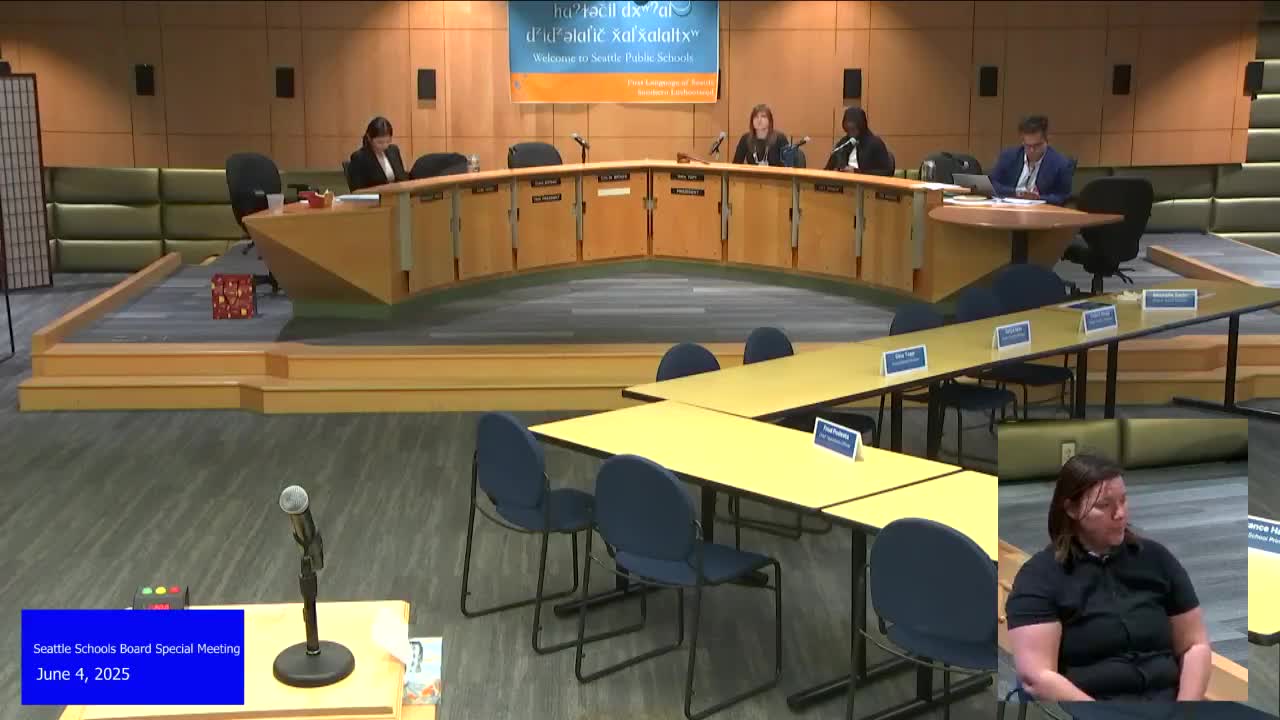
Seattle School district officials heard more than an hour of public testimony Tuesday night during a special budget hearing focused on the district’s 2025–26 recommended budget, with parents and PTSA leaders urging changes to staffing, enrollment projections and program accounting before the board votes on next year’s plan.
Speakers said the recommended budget does not reflect students’ needs and called on the board to pause approval and investigate inconsistencies. “Is anyone actually considering students’ needs or is staffing treated as a math problem and a budget exercise?” asked Yana Parker, president of the Seattle Special Education PTSA, during the hearing.
Public testimony focused on several recurring concerns: reductions to administrators who serve as 504 coordinators and other special-education supports; the handling of enrollment and school-closure plans; accounting and projection methods for programs that share buildings; impacts on individual schools such as Olympic Hills and Cleveland High School; and apparent data discrepancies in the budget book and presentations.
Yana Parker told the board that the district has assigned many school administrators the role of 504 coordinator and that the recommended budget would reduce those positions. “How can schools with only 1 or 1.5 FTE administrators meet those demands?” Parker asked, adding that legally mandated meetings for students with disabilities require time and staffing. Parker referenced both the Individuals with Disabilities Education Act (IDEA) and Section 504 of the Rehabilitation Act while urging the board to ensure legal entitlements are considered in staffing decisions.
Jess Bertrand, a parent at Olympic Hills Elementary, described her school’s student composition and said the budget continues “the same failing policies and priorities as last year.” Bertrand gave enrollment and demographic figures for her school — 486 students, roughly 55% low-income, more than 60% students of color, 22% students with disabilities, 8% houseless and 27% multilingual — and warned that closure and boundary proposals have been rushed and lack clear transition plans for students and staff.
Speakers from districtwide PTSA groups and individual school communities pressed for budget alignment with student outcomes and weighted staffing standards. “We are once again not seeing changes to the weighted staffing standard. We’re not seeing alignment of the budget to student outcome,” said Samantha Fogg, co-president of Seattle Council PTSA, urging an audit that would examine whether the budget reflects district values and goals.
Parents from alternative or choice programs raised separate concerns about how the budget treats multi-model schools. Kristen Ecken Turnbull Conte, a parent and building-leadership member at Cascade Current Partnership, said Cascade operates three complementary program models and that accounting decisions were forcing programs to compete against each other. She said the district’s “purple book” projects 392 students for Cascade next year while the May 1 FTE count was 530; she described the difference as a shortfall the budget does not plan for and said the site’s top priority on its budget committee was to retain current staff.
At Cleveland High School, parent Katie Kennedy said the district placed an enrollment cap on the incoming freshman class and warned the school could lose teaching positions if budgeted staffing is not adjusted to updated enrollment. Kennedy said the school’s anticipated enrollment is within about 20 students of last year’s incoming class and said the school faces a shortfall of multiple teachers unless projections are updated now.
Beyond staffing and enrollment, commenter Chris Jackins raised broader budget questions: he noted a reported $4,000,000 change between budget postings, cited a mismatch between the superintendent’s cover letter (which he said listed federal funding at 6.5% of the general fund) and the budget book (which he said lists it at 5.3%), and urged caution on capital projects including Memorial Stadium and the district’s planned use of artificial turf, which he urged the district not to use if it contains “forever chemicals.” Jackins also said Associated Student Body athletic revenues were budgeted up by 46% in the draft materials.
Several speakers asked the board to delay final action and to open a forensic review. “I urge the board not to pass the budget as is,” Michelle Campbell, co-secretary of Seattle Council PTSA, said near the end of public testimony. Campbell cited board resolution No. 2420 (adopted Dec. 18, 2024) directing budget proposals to align with board goals and a district financial planning policy (SPS policy 0060, adopted Nov. 15, 2023), and argued the recommended budget does not appear to meet those directives.
No vote on the budget took place at the special meeting. President Topp opened the hearing at 8:05 p.m., and after accepting public testimony the board adjourned at 8:27 p.m.; the board announced it will continue budget discussions at its scheduled retreat.
The public testimony at the hearing touched on legal protections for students with disabilities, specific staffing risks at individual schools, and requests that the board either revise the recommended budget to reflect updated enrollments and program structures or call for an independent review. The district has accepted written testimony through its agenda process, and speakers were told they had two minutes each for oral remarks during the hearing.
Speakers said the recommended budget does not reflect students’ needs and called on the board to pause approval and investigate inconsistencies. “Is anyone actually considering students’ needs or is staffing treated as a math problem and a budget exercise?” asked Yana Parker, president of the Seattle Special Education PTSA, during the hearing.
Public testimony focused on several recurring concerns: reductions to administrators who serve as 504 coordinators and other special-education supports; the handling of enrollment and school-closure plans; accounting and projection methods for programs that share buildings; impacts on individual schools such as Olympic Hills and Cleveland High School; and apparent data discrepancies in the budget book and presentations.
Yana Parker told the board that the district has assigned many school administrators the role of 504 coordinator and that the recommended budget would reduce those positions. “How can schools with only 1 or 1.5 FTE administrators meet those demands?” Parker asked, adding that legally mandated meetings for students with disabilities require time and staffing. Parker referenced both the Individuals with Disabilities Education Act (IDEA) and Section 504 of the Rehabilitation Act while urging the board to ensure legal entitlements are considered in staffing decisions.
Jess Bertrand, a parent at Olympic Hills Elementary, described her school’s student composition and said the budget continues “the same failing policies and priorities as last year.” Bertrand gave enrollment and demographic figures for her school — 486 students, roughly 55% low-income, more than 60% students of color, 22% students with disabilities, 8% houseless and 27% multilingual — and warned that closure and boundary proposals have been rushed and lack clear transition plans for students and staff.
Speakers from districtwide PTSA groups and individual school communities pressed for budget alignment with student outcomes and weighted staffing standards. “We are once again not seeing changes to the weighted staffing standard. We’re not seeing alignment of the budget to student outcome,” said Samantha Fogg, co-president of Seattle Council PTSA, urging an audit that would examine whether the budget reflects district values and goals.
Parents from alternative or choice programs raised separate concerns about how the budget treats multi-model schools. Kristen Ecken Turnbull Conte, a parent and building-leadership member at Cascade Current Partnership, said Cascade operates three complementary program models and that accounting decisions were forcing programs to compete against each other. She said the district’s “purple book” projects 392 students for Cascade next year while the May 1 FTE count was 530; she described the difference as a shortfall the budget does not plan for and said the site’s top priority on its budget committee was to retain current staff.
At Cleveland High School, parent Katie Kennedy said the district placed an enrollment cap on the incoming freshman class and warned the school could lose teaching positions if budgeted staffing is not adjusted to updated enrollment. Kennedy said the school’s anticipated enrollment is within about 20 students of last year’s incoming class and said the school faces a shortfall of multiple teachers unless projections are updated now.
Beyond staffing and enrollment, commenter Chris Jackins raised broader budget questions: he noted a reported $4,000,000 change between budget postings, cited a mismatch between the superintendent’s cover letter (which he said listed federal funding at 6.5% of the general fund) and the budget book (which he said lists it at 5.3%), and urged caution on capital projects including Memorial Stadium and the district’s planned use of artificial turf, which he urged the district not to use if it contains “forever chemicals.” Jackins also said Associated Student Body athletic revenues were budgeted up by 46% in the draft materials.
Several speakers asked the board to delay final action and to open a forensic review. “I urge the board not to pass the budget as is,” Michelle Campbell, co-secretary of Seattle Council PTSA, said near the end of public testimony. Campbell cited board resolution No. 2420 (adopted Dec. 18, 2024) directing budget proposals to align with board goals and a district financial planning policy (SPS policy 0060, adopted Nov. 15, 2023), and argued the recommended budget does not appear to meet those directives.
No vote on the budget took place at the special meeting. President Topp opened the hearing at 8:05 p.m., and after accepting public testimony the board adjourned at 8:27 p.m.; the board announced it will continue budget discussions at its scheduled retreat.
The public testimony at the hearing touched on legal protections for students with disabilities, specific staffing risks at individual schools, and requests that the board either revise the recommended budget to reflect updated enrollments and program structures or call for an independent review. The district has accepted written testimony through its agenda process, and speakers were told they had two minutes each for oral remarks during the hearing.
Don't Miss a Word: See the Full Meeting!
Go beyond summaries. Unlock every video, transcript, and key insight with a Founder Membership.
✓
Get instant access to full meeting videos
✓
Search and clip any phrase from complete transcripts
✓
Receive AI-powered summaries & custom alerts
✓
Enjoy lifetime, unrestricted access to government data
30-day money-back guarantee
