Everett photo‑enforcement update: school‑zone crashes and speeds fell after camera launch, staff say
June 05, 2025 | Everett, Snohomish County, Washington
This article was created by AI summarizing key points discussed. AI makes mistakes, so for full details and context, please refer to the video of the full meeting. Please report any errors so we can fix them. Report an error »
Corey Hertz, Everett city traffic engineer, told the Community Health and Safety Committee on June 4, 2025, that the city's photo‑enforcement program has been associated with lower crash counts and reduced speeds at the Horizon Elementary school zone and has produced higher‑than‑expected citations while remaining on track to be revenue neutral.
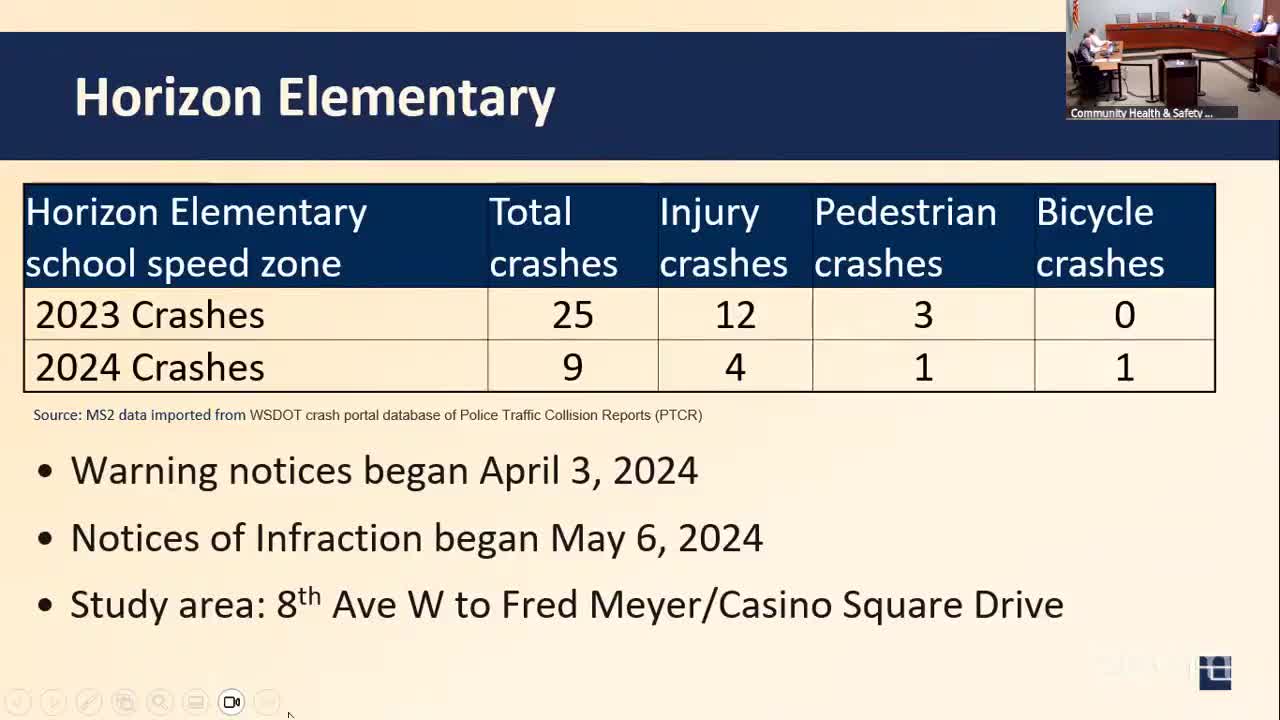
Hertz said the city installed nine cameras at six intersections for red‑light enforcement and two cameras at the Horizon Elementary school zone on Casino Road as part of a safety program guided by Everett's Vision Zero planning. Warnings were mailed beginning April 3, 2024, and notices of infraction began May 6, 2024. "Photo enforcement program is a a safety program," Hertz said, framing the update as a crash‑reduction effort.
Horizon Elementary's school zone showed 25 crashes in 2023 with 12 injury crashes — including three pedestrian crashes — and dropped to nine total crashes in 2024 with four injuries (one pedestrian and one bicycle crash), Hertz reported. Speed measurements while the school beacons were flashing fell from 70.2% of vehicles traveling 30 mph or greater before public outreach to about 42.9% most recently. "For that month, the percentage of vehicles traveling over 30 miles an hour dropped to 45.3. And then continuing to this day in May to, 42.9% of the traffic," Hertz said.
Hertz told the committee the city expected a longer‑term decline in citations after systems began, projecting about 915 citations per month; actual counts were higher in early months and as of April were about 1,340 citations per month. He reported a sequence of monthly violation counts — 2,977 when the Horizon system first activated in May 2024, about 2,200 in September 2024, and more recently roughly 1,300 — and said that pattern indicates the systems are having an effect in reducing high‑risk behavior over time.
Crash data at red‑light camera sites varied by location. At 16th and Broadway, Hertz said there were 14 total crashes with seven injuries in 2023 and 12 crashes with four injuries in 2024; through June 1, 2025, the intersection had four recorded crashes and zero injuries.
On finance, Hertz reported 2024 program revenues of about $817,000 and expenses around $564,500, leaving an ending fund balance of approximately $2,252,700. The program funds eight city positions (fully or partially), and Hertz said court administration proved more labor intensive than expected, leading to an added position in budget amendment 1. He characterized the program as on track to remain revenue neutral and attributed short‑term revenue lags to school breaks that affect issuance and payment timing.
Council members asked follow‑up questions. One asked whether extreme high speeds (40–50 mph) had declined; Hertz said the high‑end speeds have decreased and that prior single vehicles with dozens of citations in a year were less common in the most recent data. Council members requested resident vs. nonresident breakdowns for citations; Hertz said he would ask the vendor to provide ZIP‑code resolution for the upcoming annual report and noted prior vendor data showed most violations were by drivers from outside the city.
Hertz also reviewed operational status: several red‑light locations are active (north/south Broadway at 16th, Rucker Avenue at 40th, eastbound 112th at Evergreen Way), others are awaiting power meters from the PUD or final calibration and will be activated within days. He said the vendor posts an annual collision and citation report and that staff will produce the first public report in the coming month.
No policy vote was taken in committee; the presentation functioned as an informational update and staff committed to provide zip‑code breakdowns and additional reporting in the city’s forthcoming annual camera program report.
Hertz said the city installed nine cameras at six intersections for red‑light enforcement and two cameras at the Horizon Elementary school zone on Casino Road as part of a safety program guided by Everett's Vision Zero planning. Warnings were mailed beginning April 3, 2024, and notices of infraction began May 6, 2024. "Photo enforcement program is a a safety program," Hertz said, framing the update as a crash‑reduction effort.
Horizon Elementary's school zone showed 25 crashes in 2023 with 12 injury crashes — including three pedestrian crashes — and dropped to nine total crashes in 2024 with four injuries (one pedestrian and one bicycle crash), Hertz reported. Speed measurements while the school beacons were flashing fell from 70.2% of vehicles traveling 30 mph or greater before public outreach to about 42.9% most recently. "For that month, the percentage of vehicles traveling over 30 miles an hour dropped to 45.3. And then continuing to this day in May to, 42.9% of the traffic," Hertz said.
Hertz told the committee the city expected a longer‑term decline in citations after systems began, projecting about 915 citations per month; actual counts were higher in early months and as of April were about 1,340 citations per month. He reported a sequence of monthly violation counts — 2,977 when the Horizon system first activated in May 2024, about 2,200 in September 2024, and more recently roughly 1,300 — and said that pattern indicates the systems are having an effect in reducing high‑risk behavior over time.
Crash data at red‑light camera sites varied by location. At 16th and Broadway, Hertz said there were 14 total crashes with seven injuries in 2023 and 12 crashes with four injuries in 2024; through June 1, 2025, the intersection had four recorded crashes and zero injuries.
On finance, Hertz reported 2024 program revenues of about $817,000 and expenses around $564,500, leaving an ending fund balance of approximately $2,252,700. The program funds eight city positions (fully or partially), and Hertz said court administration proved more labor intensive than expected, leading to an added position in budget amendment 1. He characterized the program as on track to remain revenue neutral and attributed short‑term revenue lags to school breaks that affect issuance and payment timing.
Council members asked follow‑up questions. One asked whether extreme high speeds (40–50 mph) had declined; Hertz said the high‑end speeds have decreased and that prior single vehicles with dozens of citations in a year were less common in the most recent data. Council members requested resident vs. nonresident breakdowns for citations; Hertz said he would ask the vendor to provide ZIP‑code resolution for the upcoming annual report and noted prior vendor data showed most violations were by drivers from outside the city.
Hertz also reviewed operational status: several red‑light locations are active (north/south Broadway at 16th, Rucker Avenue at 40th, eastbound 112th at Evergreen Way), others are awaiting power meters from the PUD or final calibration and will be activated within days. He said the vendor posts an annual collision and citation report and that staff will produce the first public report in the coming month.
No policy vote was taken in committee; the presentation functioned as an informational update and staff committed to provide zip‑code breakdowns and additional reporting in the city’s forthcoming annual camera program report.
View the Full Meeting & All Its Details
This article offers just a summary. Unlock complete video, transcripts, and insights as a Founder Member.
✓
Watch full, unedited meeting videos
✓
Search every word spoken in unlimited transcripts
✓
AI summaries & real-time alerts (all government levels)
✓
Permanent access to expanding government content
30-day money-back guarantee
