Council Hears Tight Limits on Media Access to Police Radio; FBI CJIS Cited as Major Constraint
June 05, 2025 | Honolulu City, Honolulu County, Hawaii
This article was created by AI summarizing key points discussed. AI makes mistakes, so for full details and context, please refer to the video of the full meeting. Please report any errors so we can fix them. Report an error »
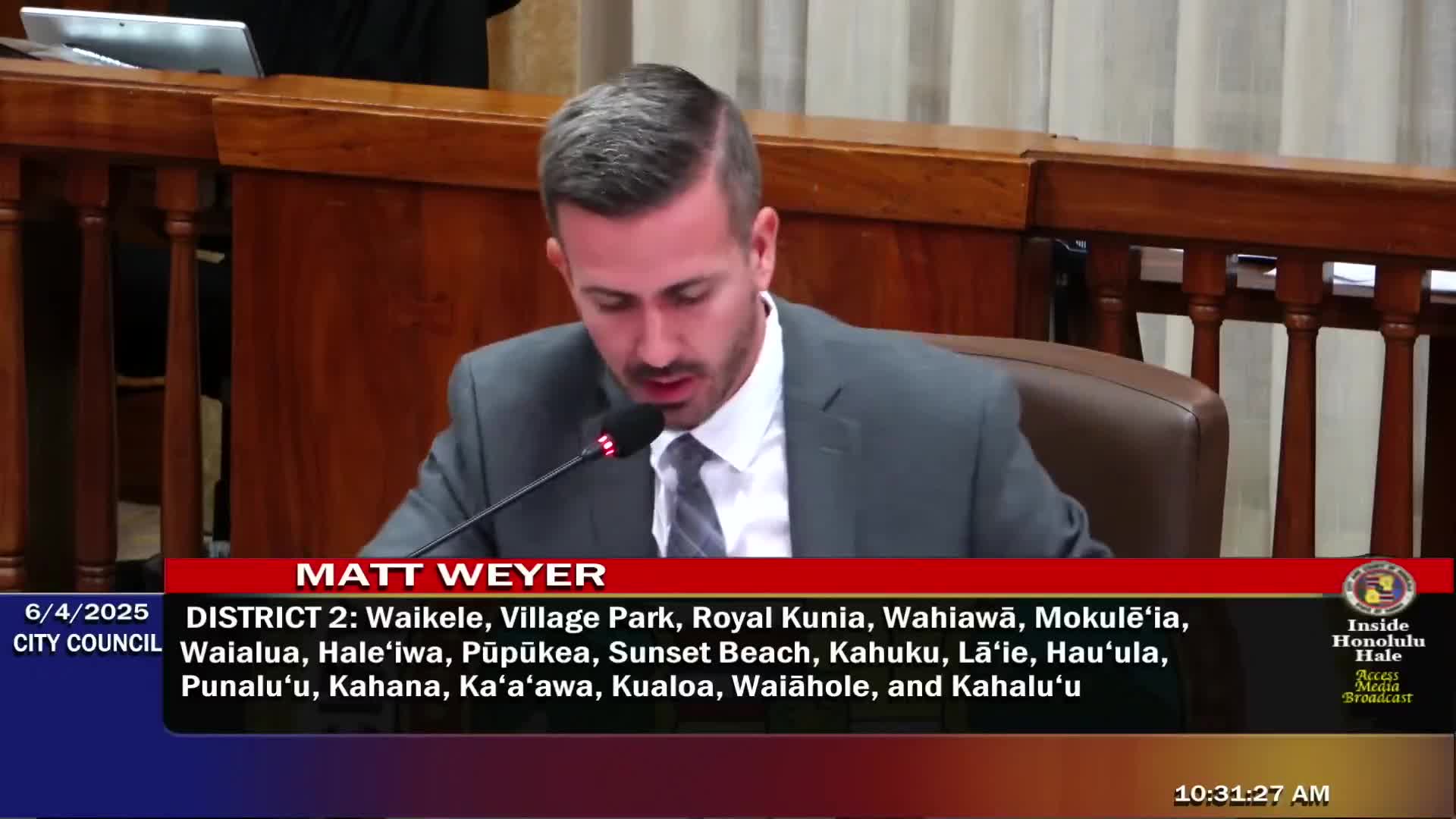
The Honolulu City Council heard competing views Friday on a proposal to give media outlets access to Honolulu Police Department radio communications, with civil‑liberties advocates and reporters pushing for transparency and HPD and its telecommunications staff warning that federal criminal‑justice rules and privacy laws restrict what can be broadcast.
Supporters said public access to radio traffic would help keep residents informed during fast‑moving incidents. Opponents, including a telecommunications specialist for HPD, told the council that the FBI’s Criminal Justice Information Services, or CJIS, sets binding limits on sharing material that may include names, dates of birth, juvenile information and other personally identifying details.
The dispute centered on whether audio could be released live, or on delay, without violating federal rules and exposing victims, witnesses and ongoing investigations. Roy Kuroda, who identified himself as working “in telecommunications with the Honolulu Police Department,” told the council that the CJIS security policy constrains any public distribution of dispatch audio.
“These protections apply whether the audio is live or delayed,” Kuroda said. “Delaying a broadcast is not the same as redacted. If the audio contains CGI, even if delayed, it remains non compliant under CJIS.”
HPD leadership said it shares the council’s desire for more public information but must balance transparency with officer safety and investigative integrity. Assistant Chief Rodney Vannick acknowledged the department’s duty to protect communications and offered to meet with council members and media representatives to seek options.
“I think gone are the days where we can just rest on our laurels and say, ‘hey ... no,’” Vannick said. “So I think we need to at least make a commitment to bring the right people to the table, figure out what we can do.”
Members of the public described experiences in which records and video were difficult to obtain. Joseph Ocana said he filed a Uniform Information Practices Act request and was told evidence would be preserved but later was denied access.
“We have had an incident where we requested the information … and we basically been blocked from seeing anything, from getting any information pertinent to the case to include the case report itself,” Ocana told the council. “They agreed to preserve the information, but they said we’re not giving you any of that.”
Nonprofit and community advocates urged care in drafting any requirement that would leave a single official making release decisions. Angela Melody Young, testifying for CARES, said asking HPD to classify incidents and then publish them places an extraordinary burden on the chief.
“I have to wonder what is the vision of this measure if the mandate seeks to ask HPD to assess imminent harm versus exigent circumstances and then to publish it in the media,” Young said.
Council members acknowledged the tension. Council member Tupelo told HPD leadership she expected a middle ground to be possible; Council member Tullibaugh said the bill would signal the public’s desire for more communication under new leadership.
Procedural status: the measure was on the agenda as one of the first‑reading items (pages 7–8). The council took public testimony and recorded reservations from several members; the item remains under the council’s usual ordinance and committee process for revision.
What’s next: HPD said it will meet with council staff, the bill’s introducer and stakeholders to identify options that balance CJIS and HIPAA constraints with the public’s need for timely information. The council did not adopt a final amendment or immediate action in the session.
Authorities cited in testimony included the FBI Criminal Justice Information Services (CJIS) security policy and federal privacy law references such as HIPAA, both raised by HPD witnesses and outside testifiers.
Supporters said public access to radio traffic would help keep residents informed during fast‑moving incidents. Opponents, including a telecommunications specialist for HPD, told the council that the FBI’s Criminal Justice Information Services, or CJIS, sets binding limits on sharing material that may include names, dates of birth, juvenile information and other personally identifying details.
The dispute centered on whether audio could be released live, or on delay, without violating federal rules and exposing victims, witnesses and ongoing investigations. Roy Kuroda, who identified himself as working “in telecommunications with the Honolulu Police Department,” told the council that the CJIS security policy constrains any public distribution of dispatch audio.
“These protections apply whether the audio is live or delayed,” Kuroda said. “Delaying a broadcast is not the same as redacted. If the audio contains CGI, even if delayed, it remains non compliant under CJIS.”
HPD leadership said it shares the council’s desire for more public information but must balance transparency with officer safety and investigative integrity. Assistant Chief Rodney Vannick acknowledged the department’s duty to protect communications and offered to meet with council members and media representatives to seek options.
“I think gone are the days where we can just rest on our laurels and say, ‘hey ... no,’” Vannick said. “So I think we need to at least make a commitment to bring the right people to the table, figure out what we can do.”
Members of the public described experiences in which records and video were difficult to obtain. Joseph Ocana said he filed a Uniform Information Practices Act request and was told evidence would be preserved but later was denied access.
“We have had an incident where we requested the information … and we basically been blocked from seeing anything, from getting any information pertinent to the case to include the case report itself,” Ocana told the council. “They agreed to preserve the information, but they said we’re not giving you any of that.”
Nonprofit and community advocates urged care in drafting any requirement that would leave a single official making release decisions. Angela Melody Young, testifying for CARES, said asking HPD to classify incidents and then publish them places an extraordinary burden on the chief.
“I have to wonder what is the vision of this measure if the mandate seeks to ask HPD to assess imminent harm versus exigent circumstances and then to publish it in the media,” Young said.
Council members acknowledged the tension. Council member Tupelo told HPD leadership she expected a middle ground to be possible; Council member Tullibaugh said the bill would signal the public’s desire for more communication under new leadership.
Procedural status: the measure was on the agenda as one of the first‑reading items (pages 7–8). The council took public testimony and recorded reservations from several members; the item remains under the council’s usual ordinance and committee process for revision.
What’s next: HPD said it will meet with council staff, the bill’s introducer and stakeholders to identify options that balance CJIS and HIPAA constraints with the public’s need for timely information. The council did not adopt a final amendment or immediate action in the session.
Authorities cited in testimony included the FBI Criminal Justice Information Services (CJIS) security policy and federal privacy law references such as HIPAA, both raised by HPD witnesses and outside testifiers.
View the Full Meeting & All Its Details
This article offers just a summary. Unlock complete video, transcripts, and insights as a Founder Member.
✓
Watch full, unedited meeting videos
✓
Search every word spoken in unlimited transcripts
✓
AI summaries & real-time alerts (all government levels)
✓
Permanent access to expanding government content
30-day money-back guarantee
