Trophy Club patrol board approves FY2026 budget; chiefs outline drones, cameras, vehicles and training
June 05, 2025 | Trophy Club, Denton County, Texas
This article was created by AI summarizing key points discussed. AI makes mistakes, so for full details and context, please refer to the video of the full meeting. Please report any errors so we can fix them. Report an error »
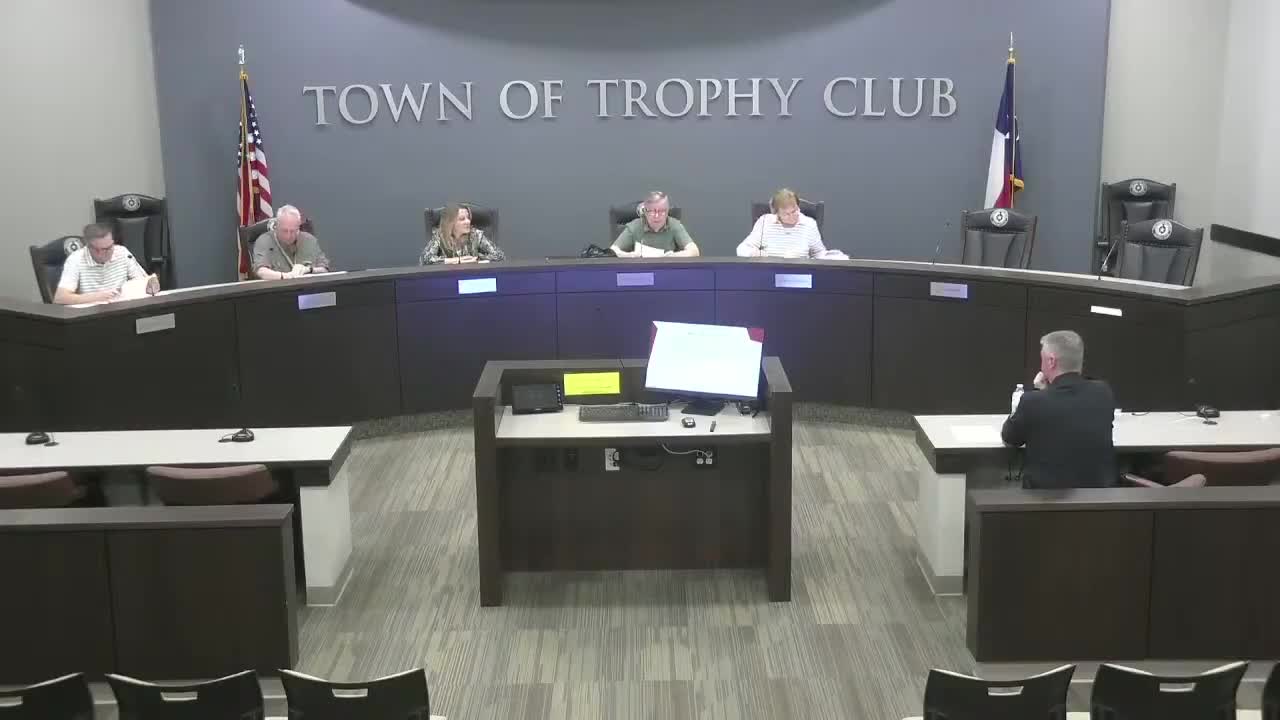
The Trophy Club Scribe Patrol and Prevention District Board voted 5-0 to approve the district’s proposed fiscal year 2026 budget following a public hearing at its June 2025 meeting, and heard a presentation from Chief Arata on how new sales-tax revenue would cover planned equipment and program additions.
Chief Arata told the board the district’s share of local sales tax has been revised upward to $430,181 for the coming year, a change he said will allow the department to fund planned purchases without tapping reserves. “We have $430,181 this year to spend,” Chief Arata said, summarizing the revenue picture and its effect on the draft budget.
The budget presentation focused on a package of public-safety investments. The department plans to add a second drone to its aviation program (the presentation identified the model as the EVO Max 4 n), expand use of the Flock license-plate camera system, buy two vehicles and proceed with scheduled taser replacements. Chief Arata described the drone’s features — day and low-light cameras, thermal imaging, automated search and tracking functions, obstacle-avoidance and an estimated 45-minute flight time — and said adding a second aircraft will allow continuous coverage while batteries are changed. “This will give us that ability to keep Odin in operation when his truck is down,” Chief Arata said, referring to the department’s K‑9 operations and the planned K‑9-capable vehicle.
On the Flock camera system Chief Arata reported operational results for the most recent six-month period: the system generated more than 600 alerts, 65 of which were judged actionable, and those actionable leads contributed to nine arrests. The board discussed a future recommendation to add two outward-facing cameras (at Trophy Lake Drive and at Bobcat) to capture outbound traffic and better support an ongoing traffic study done to meet town-council requirements.
Planned capital purchases discussed included two patrol vehicles (the town will pay for one vehicle from the general fund), plus outfitting and equipment. The packet referenced a capital line of about $180,000 for vehicle purchases and equipment, but board members pressed for clarification of individual line items; at the meeting Chief Arata explained one vehicle will be outfitted as a K‑9 unit, which increases its cost relative to a standard patrol vehicle. The board also discussed smaller equipment and software purchases: the budget’s small-equipment line covers the Flock payment, weapons sighting systems, the drone and other items.
The board heard about community-facing programs supported in the budget. The department said it expanded a training and community-education program that previously focused on elderly fraud awareness to cover identity theft and internet fraud; the first session at the town’s new activity center had 17 attendees. School-safety work remains a priority, with officers continuing drug-interdiction efforts at local schools; Chief Arata said vaping devices (often containing THC) were a top reported issue this year.
Board members also asked about replacement schedules and training for less-visible items. Chief Arata said the department is in year six of its current Axon taser lifecycle and plans to transition to the Taser 7 model as part of a multi-year replacement plan; taser training is provided annually and additional transition training will occur when new devices arrive.
Board discussion reflected attention to the district’s fund balance. Chief Arata noted the fund-balance figures discussed in the presentation (an example cited in the packet: if the district holds $460,000 in revenues, a $308,000 fund balance was shown), and said the board should consider deliberate use of reserves for near-term purchases so the fund balance does not grow indefinitely. He described options such as accelerating specific equipment purchases by a year to manage the balance.
The board closed the public hearing and approved the budget by voice vote, 5 in favor, 0 opposed. Chief Arata and board members noted that, following board approval, the district’s budget will be forwarded to the town council; if the council accepts the district budget it will take effect October 1, the start of the district’s October 1–September 30 fiscal year. If the council rejects the district’s budget, a joint meeting would be required to resolve changes. The board also approved the minutes from its April 23 meeting by voice vote, 5-0.
The board did not take separate action on procurement at the June meeting; the presentation and packet were framed as budget authorizations and program direction, with details and vendor contracts to follow in subsequent procurement steps.
Chief Arata told the board the district’s share of local sales tax has been revised upward to $430,181 for the coming year, a change he said will allow the department to fund planned purchases without tapping reserves. “We have $430,181 this year to spend,” Chief Arata said, summarizing the revenue picture and its effect on the draft budget.
The budget presentation focused on a package of public-safety investments. The department plans to add a second drone to its aviation program (the presentation identified the model as the EVO Max 4 n), expand use of the Flock license-plate camera system, buy two vehicles and proceed with scheduled taser replacements. Chief Arata described the drone’s features — day and low-light cameras, thermal imaging, automated search and tracking functions, obstacle-avoidance and an estimated 45-minute flight time — and said adding a second aircraft will allow continuous coverage while batteries are changed. “This will give us that ability to keep Odin in operation when his truck is down,” Chief Arata said, referring to the department’s K‑9 operations and the planned K‑9-capable vehicle.
On the Flock camera system Chief Arata reported operational results for the most recent six-month period: the system generated more than 600 alerts, 65 of which were judged actionable, and those actionable leads contributed to nine arrests. The board discussed a future recommendation to add two outward-facing cameras (at Trophy Lake Drive and at Bobcat) to capture outbound traffic and better support an ongoing traffic study done to meet town-council requirements.
Planned capital purchases discussed included two patrol vehicles (the town will pay for one vehicle from the general fund), plus outfitting and equipment. The packet referenced a capital line of about $180,000 for vehicle purchases and equipment, but board members pressed for clarification of individual line items; at the meeting Chief Arata explained one vehicle will be outfitted as a K‑9 unit, which increases its cost relative to a standard patrol vehicle. The board also discussed smaller equipment and software purchases: the budget’s small-equipment line covers the Flock payment, weapons sighting systems, the drone and other items.
The board heard about community-facing programs supported in the budget. The department said it expanded a training and community-education program that previously focused on elderly fraud awareness to cover identity theft and internet fraud; the first session at the town’s new activity center had 17 attendees. School-safety work remains a priority, with officers continuing drug-interdiction efforts at local schools; Chief Arata said vaping devices (often containing THC) were a top reported issue this year.
Board members also asked about replacement schedules and training for less-visible items. Chief Arata said the department is in year six of its current Axon taser lifecycle and plans to transition to the Taser 7 model as part of a multi-year replacement plan; taser training is provided annually and additional transition training will occur when new devices arrive.
Board discussion reflected attention to the district’s fund balance. Chief Arata noted the fund-balance figures discussed in the presentation (an example cited in the packet: if the district holds $460,000 in revenues, a $308,000 fund balance was shown), and said the board should consider deliberate use of reserves for near-term purchases so the fund balance does not grow indefinitely. He described options such as accelerating specific equipment purchases by a year to manage the balance.
The board closed the public hearing and approved the budget by voice vote, 5 in favor, 0 opposed. Chief Arata and board members noted that, following board approval, the district’s budget will be forwarded to the town council; if the council accepts the district budget it will take effect October 1, the start of the district’s October 1–September 30 fiscal year. If the council rejects the district’s budget, a joint meeting would be required to resolve changes. The board also approved the minutes from its April 23 meeting by voice vote, 5-0.
The board did not take separate action on procurement at the June meeting; the presentation and packet were framed as budget authorizations and program direction, with details and vendor contracts to follow in subsequent procurement steps.
View the Full Meeting & All Its Details
This article offers just a summary. Unlock complete video, transcripts, and insights as a Founder Member.
✓
Watch full, unedited meeting videos
✓
Search every word spoken in unlimited transcripts
✓
AI summaries & real-time alerts (all government levels)
✓
Permanent access to expanding government content
30-day money-back guarantee
