Buncombe launches door‑to‑door CASPER survey and Envision Buncombe steering committee for Swannanoa planning
June 04, 2025 | Buncombe County, North Carolina
This article was created by AI summarizing key points discussed. AI makes mistakes, so for full details and context, please refer to the video of the full meeting. Please report any errors so we can fix them. Report an error »
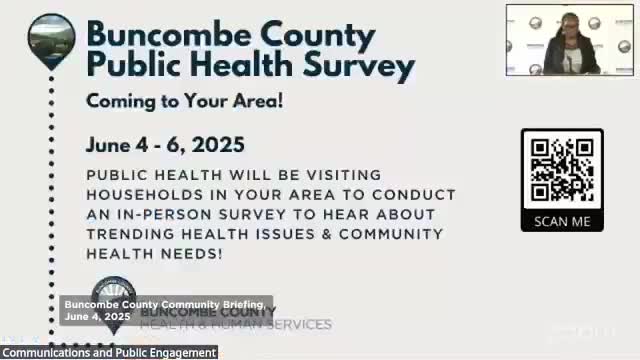
Buncombe County staff said county and state teams are conducting a Community Assessment for Public Health Emergency Response (CASPER) door‑to‑door survey across the county to collect household data on demographics, emergency preparedness and health needs.
County Manager Avril Pinter explained the CASPER survey’s purpose: staff will wear high‑visibility vests and name badges, approach randomly selected households primarily in afternoons and early evenings, and provide resources directly during face‑to‑face interviews. Pinter said the door‑to‑door method is used by the CDC and local health departments because it improves data accuracy, builds trust and allows staff to observe conditions that may not appear on written surveys.
Angelica Tyler, who presented the Envision Buncombe results, said more than 2,600 residents completed a four‑question Envision Buncombe survey and that staff engaged at 16 community events countywide; more than 3,000 views of the survey in Spanish were recorded and over 300 paper surveys were collected. County staff will analyze the results and plan to present findings to the Board of County Commissioners in the fall; staff said findings will inform the county’s 2030 strategic plan and a long‑term recovery plan.
Pinter also announced an application process for the Swannanoa Small Area and Resiliency Plan steering committee. The committee will include 11–13 Swannanoa residents and collaborators to provide guidance to county planning staff, review data and public input, and recommend goals, policies and actions for housing, transportation, health, recreation and disaster mitigation. The county said the application deadline is June 20 and the Board of County Commissioners will appoint the committee in August.
Participation in the CASPER survey is voluntary, and the county encouraged residents who prefer not to open their door to ask for ID. The county provided resource contacts and directed residents to buncombready.org and engage.buncombecounty.org/envisionbuncombe for more information.
County Manager Avril Pinter explained the CASPER survey’s purpose: staff will wear high‑visibility vests and name badges, approach randomly selected households primarily in afternoons and early evenings, and provide resources directly during face‑to‑face interviews. Pinter said the door‑to‑door method is used by the CDC and local health departments because it improves data accuracy, builds trust and allows staff to observe conditions that may not appear on written surveys.
Angelica Tyler, who presented the Envision Buncombe results, said more than 2,600 residents completed a four‑question Envision Buncombe survey and that staff engaged at 16 community events countywide; more than 3,000 views of the survey in Spanish were recorded and over 300 paper surveys were collected. County staff will analyze the results and plan to present findings to the Board of County Commissioners in the fall; staff said findings will inform the county’s 2030 strategic plan and a long‑term recovery plan.
Pinter also announced an application process for the Swannanoa Small Area and Resiliency Plan steering committee. The committee will include 11–13 Swannanoa residents and collaborators to provide guidance to county planning staff, review data and public input, and recommend goals, policies and actions for housing, transportation, health, recreation and disaster mitigation. The county said the application deadline is June 20 and the Board of County Commissioners will appoint the committee in August.
Participation in the CASPER survey is voluntary, and the county encouraged residents who prefer not to open their door to ask for ID. The county provided resource contacts and directed residents to buncombready.org and engage.buncombecounty.org/envisionbuncombe for more information.
Don't Miss a Word: See the Full Meeting!
Go beyond summaries. Unlock every video, transcript, and key insight with a Founder Membership.
✓
Get instant access to full meeting videos
✓
Search and clip any phrase from complete transcripts
✓
Receive AI-powered summaries & custom alerts
✓
Enjoy lifetime, unrestricted access to government data
30-day money-back guarantee
