Franklin council weighs real-estate tax hike, 1% meals tax and cuts to school funding
June 02, 2025 | Franklin City, Franklin County, Virginia
This article was created by AI summarizing key points discussed. AI makes mistakes, so for full details and context, please refer to the video of the full meeting. Please report any errors so we can fix them. Report an error »
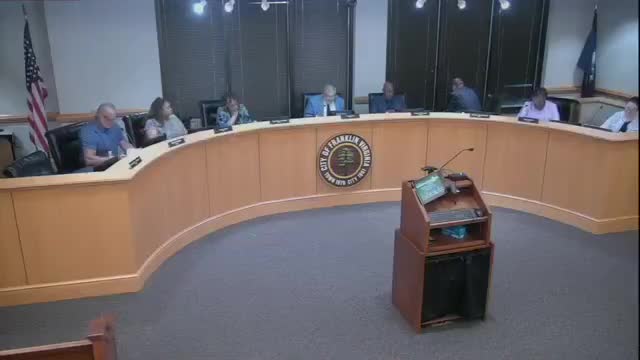
At a Franklin City Council meeting, staff presented examples showing how proposed increments to the real-estate tax would affect property owners and councilmembers discussed pairing a meals-tax increase with cuts to the school appropriation to close a budget gap.
Finance staff showed that a property appraised at $150,000 would pay about $15 more per year for each penny added to the tax rate and that an assessed downtown property at $253,100 would pay about $25.31 more per penny. “When you go up a penny, it increases what they would pay annually by $15,” the staff member said during the presentation.
The discussion centered on three revenue options: raising the real-estate tax (up to a total of four cents as earlier proposed in the draft budget), adding 1% to the meals tax, or recovering funds from the city’s allocation to the Franklin City School system. Councilmembers discussed a mixed option — raising the meals tax by 1% while taking $400,000 from the schools — as a way to meet projected revenue needs without adopting the full four‑cent real‑estate increase.
Several councilmembers said they opposed raising taxes on residents. “I don’t want a tax increase on the citizens,” one councilmember said. Others argued the city should seek recurring revenue and fix internal budget processes instead of relying on one‑time or ad hoc transfers from the school system. “If we correct the system and bring in revenue, we don’t need to raise taxes,” a councilmember said.
Councilmembers also reviewed a revenue-sharing repayment item in the budget. Staff said the city’s budget had estimated $1,050,000 from a revenue-sharing partner, but the partner adopted a projection of $1,020,000; of that amount, staff said roughly $239,000 must be repaid under the agreement, reducing net funds available to the city.
There was no motion or formal vote on tax rates or school allocations that night. Council members repeatedly characterized the discussion as guidance for budget work rather than a final decision. Multiple members expressed a preference for the combined approach of a 1% meals-tax increase plus $400,000 from the schools if budget shortfalls remain, but they emphasized that any reduction to the school appropriation would affect the FY 2026 budget and would not change FY 2025 appropriations already made.
Councilmembers also asked staff to continue exploring revenue and savings options, including hiring a grant writer and other cost‑saving measures, and cautioned that any formal change to school funding or tax rates would follow the formal budget process and public notice requirements.
The council did not adopt any ordinance or formal budget amendment during the meeting; the discussion was recorded as direction to staff and an informal council consensus that will be reflected in further budget deliberations.
Finance staff showed that a property appraised at $150,000 would pay about $15 more per year for each penny added to the tax rate and that an assessed downtown property at $253,100 would pay about $25.31 more per penny. “When you go up a penny, it increases what they would pay annually by $15,” the staff member said during the presentation.
The discussion centered on three revenue options: raising the real-estate tax (up to a total of four cents as earlier proposed in the draft budget), adding 1% to the meals tax, or recovering funds from the city’s allocation to the Franklin City School system. Councilmembers discussed a mixed option — raising the meals tax by 1% while taking $400,000 from the schools — as a way to meet projected revenue needs without adopting the full four‑cent real‑estate increase.
Several councilmembers said they opposed raising taxes on residents. “I don’t want a tax increase on the citizens,” one councilmember said. Others argued the city should seek recurring revenue and fix internal budget processes instead of relying on one‑time or ad hoc transfers from the school system. “If we correct the system and bring in revenue, we don’t need to raise taxes,” a councilmember said.
Councilmembers also reviewed a revenue-sharing repayment item in the budget. Staff said the city’s budget had estimated $1,050,000 from a revenue-sharing partner, but the partner adopted a projection of $1,020,000; of that amount, staff said roughly $239,000 must be repaid under the agreement, reducing net funds available to the city.
There was no motion or formal vote on tax rates or school allocations that night. Council members repeatedly characterized the discussion as guidance for budget work rather than a final decision. Multiple members expressed a preference for the combined approach of a 1% meals-tax increase plus $400,000 from the schools if budget shortfalls remain, but they emphasized that any reduction to the school appropriation would affect the FY 2026 budget and would not change FY 2025 appropriations already made.
Councilmembers also asked staff to continue exploring revenue and savings options, including hiring a grant writer and other cost‑saving measures, and cautioned that any formal change to school funding or tax rates would follow the formal budget process and public notice requirements.
The council did not adopt any ordinance or formal budget amendment during the meeting; the discussion was recorded as direction to staff and an informal council consensus that will be reflected in further budget deliberations.
Don't Miss a Word: See the Full Meeting!
Go beyond summaries. Unlock every video, transcript, and key insight with a Founder Membership.
✓
Get instant access to full meeting videos
✓
Search and clip any phrase from complete transcripts
✓
Receive AI-powered summaries & custom alerts
✓
Enjoy lifetime, unrestricted access to government data
30-day money-back guarantee
