Experts disagree over wetland extent at Silverview site after county-ordered peer review
June 04, 2025 | Kitsap County, Washington
This article was created by AI summarizing key points discussed. AI makes mistakes, so for full details and context, please refer to the video of the full meeting. Please report any errors so we can fix them. Report an error »
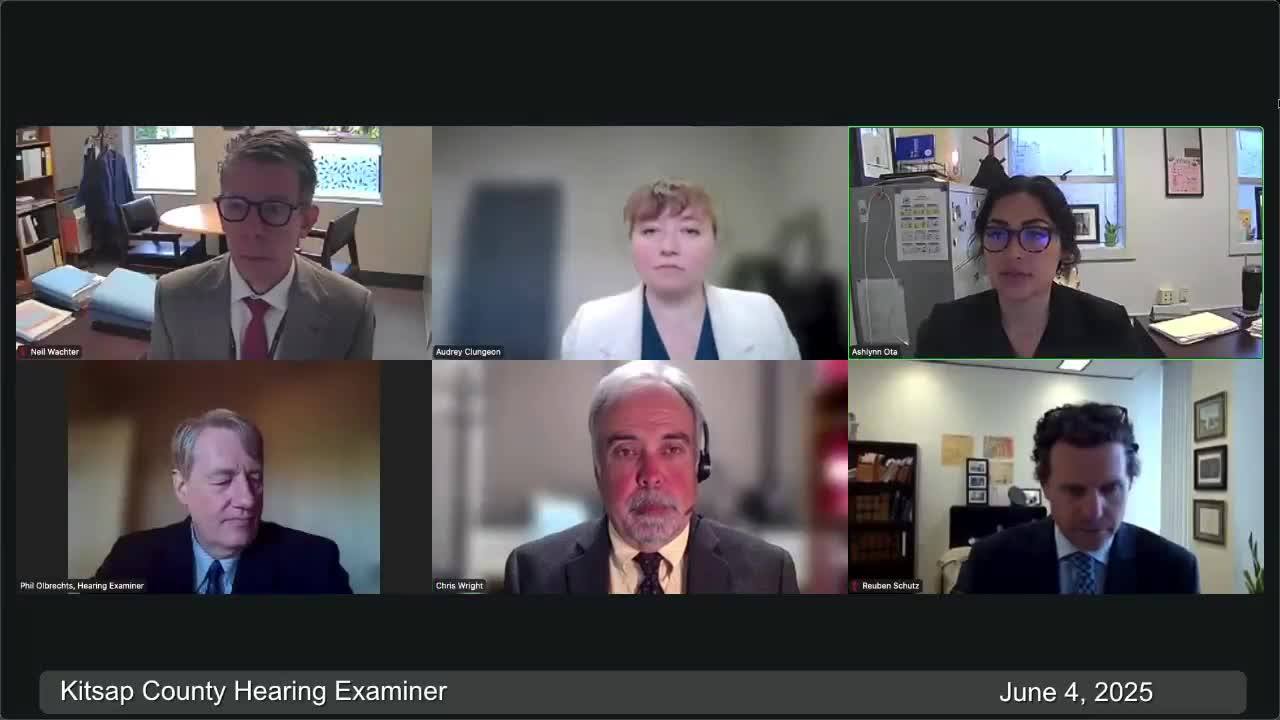
Experts who visited the Silverview property in Silverdale gave sharply different accounts this week of whether meadow areas meet the three legal parameters for wetlands — hydrology, hydrophytic vegetation and hydric soil — and how large any regulatory wetland is.
A peer reviewer retained by Kitsap County, Christopher Wright of Radke Associates, testified that his team opened six test pits and found hydric soil meeting the A-11 indicator at one location (their Sample Plot 2) but not at five others. Wright said some pits were dug during a dry period and that the agency with jurisdiction, the Washington Department of Ecology, had earlier accepted a smaller mapped wetland for the site.
The split matters because the Hearing Examiner ordered a remand limited in part to a focused review of soil indicators. Why it matters: wetland boundaries determine which areas are subject to county code controls and whether the project would require mitigation or avoidance.
Wright described standard field practice: when a prior pit is obvious or disturbed, a reviewer opens a new, undisturbed hole “in close proximity” (he said often 5–8 feet away) and compares results. He told the examiner that three of four holes near Wetland A did not meet hydric-soil criteria, while one pit did and also showed hydrophytic vegetation and secondary hydrology indicators (drainage patterns). Wright emphasized he followed the Corps/NRCS checklists and the 1987 Corps manual as updated by later field indicators when assessing soils.
Appellant consultant Dr. Sarah Cook and Soundview Consultants’ Rachel Hyland testified that their earlier delineations show a larger wetland. Cook said she identified a meadow wetland dominated in places by reed canarygrass and that her mapping, and a later field letter by tribal and state technical staff, supported substantially more than the 355 square feet Ecology had referenced earlier. Hyland said Soundview collected additional plots on remand (the parties’ materials show ~20 data plots were collected across the site on remand) and reported multiple locations that meet wetland parameters; she and other witnesses said many of the post-remand plots lie between the parties’ mapped lines.
Experts debated which field standards control. The hearing record includes repeated references to: the 1987 Corps of Engineers Wetland Delineation Manual, the Western Mountains/Valleys/Coast regional supplement, and the current Field Indicators of Hydric Soils (v. 8.2). Radke and Soundview witnesses told the examiner they relied on the updated field indicators (v.8.2), which set practical thresholds for visually detecting redoximorphic features (for example, the F6 indicator requires a dark surface and 2% redox concentrations within the upper rooting zone, or an alternate threshold for chroma 2 soils of 5% redox). Appellant’s witness Dr. Cook cited published literature and professional debate over visual thresholds for identifying faint redox features; she argued several Soundview plots contained hydric-soil features that should have been classified wet.
County staff senior planner Jeff Smith testified the county had requested a party review and that the remand scope focused on specific soil indicators called out in the Hearing Examiner’s order. He said staff considers the applicant’s feasibility and design arguments separately from technical wetland jurisdiction. Wright and Radke noted a prior Ecology review and a letter of concurrence with the applicant’s mapped wetland boundary; Cook and Hyland said Ecology’s internal technical staff had disagreed in the field with that head-office letter and the county should weigh that technical disagreement.
What was decided here: the hearing so far has produced conflicting technical findings, but not a final change in the county’s regulatory position. No formal vote or binding county action on jurisdiction occurred during the session. The Hearing Examiner retained the record for further consideration.
Ending
The disagreement centers on interpretation of in-field evidence and which soil-indicator thresholds to apply. The record contains detailed data forms from multiple consultants, a county-ordered peer review, and references to Ecology and Corps guidance. The Examiner will weigh those conflicting technical reports and agency guidance before issuing a written ruling that will determine which areas of the site are regulated wetland and what mitigation or avoidance measures — if any — the county will require.
A peer reviewer retained by Kitsap County, Christopher Wright of Radke Associates, testified that his team opened six test pits and found hydric soil meeting the A-11 indicator at one location (their Sample Plot 2) but not at five others. Wright said some pits were dug during a dry period and that the agency with jurisdiction, the Washington Department of Ecology, had earlier accepted a smaller mapped wetland for the site.
The split matters because the Hearing Examiner ordered a remand limited in part to a focused review of soil indicators. Why it matters: wetland boundaries determine which areas are subject to county code controls and whether the project would require mitigation or avoidance.
Wright described standard field practice: when a prior pit is obvious or disturbed, a reviewer opens a new, undisturbed hole “in close proximity” (he said often 5–8 feet away) and compares results. He told the examiner that three of four holes near Wetland A did not meet hydric-soil criteria, while one pit did and also showed hydrophytic vegetation and secondary hydrology indicators (drainage patterns). Wright emphasized he followed the Corps/NRCS checklists and the 1987 Corps manual as updated by later field indicators when assessing soils.
Appellant consultant Dr. Sarah Cook and Soundview Consultants’ Rachel Hyland testified that their earlier delineations show a larger wetland. Cook said she identified a meadow wetland dominated in places by reed canarygrass and that her mapping, and a later field letter by tribal and state technical staff, supported substantially more than the 355 square feet Ecology had referenced earlier. Hyland said Soundview collected additional plots on remand (the parties’ materials show ~20 data plots were collected across the site on remand) and reported multiple locations that meet wetland parameters; she and other witnesses said many of the post-remand plots lie between the parties’ mapped lines.
Experts debated which field standards control. The hearing record includes repeated references to: the 1987 Corps of Engineers Wetland Delineation Manual, the Western Mountains/Valleys/Coast regional supplement, and the current Field Indicators of Hydric Soils (v. 8.2). Radke and Soundview witnesses told the examiner they relied on the updated field indicators (v.8.2), which set practical thresholds for visually detecting redoximorphic features (for example, the F6 indicator requires a dark surface and 2% redox concentrations within the upper rooting zone, or an alternate threshold for chroma 2 soils of 5% redox). Appellant’s witness Dr. Cook cited published literature and professional debate over visual thresholds for identifying faint redox features; she argued several Soundview plots contained hydric-soil features that should have been classified wet.
County staff senior planner Jeff Smith testified the county had requested a party review and that the remand scope focused on specific soil indicators called out in the Hearing Examiner’s order. He said staff considers the applicant’s feasibility and design arguments separately from technical wetland jurisdiction. Wright and Radke noted a prior Ecology review and a letter of concurrence with the applicant’s mapped wetland boundary; Cook and Hyland said Ecology’s internal technical staff had disagreed in the field with that head-office letter and the county should weigh that technical disagreement.
What was decided here: the hearing so far has produced conflicting technical findings, but not a final change in the county’s regulatory position. No formal vote or binding county action on jurisdiction occurred during the session. The Hearing Examiner retained the record for further consideration.
Ending
The disagreement centers on interpretation of in-field evidence and which soil-indicator thresholds to apply. The record contains detailed data forms from multiple consultants, a county-ordered peer review, and references to Ecology and Corps guidance. The Examiner will weigh those conflicting technical reports and agency guidance before issuing a written ruling that will determine which areas of the site are regulated wetland and what mitigation or avoidance measures — if any — the county will require.
Don't Miss a Word: See the Full Meeting!
Go beyond summaries. Unlock every video, transcript, and key insight with a Founder Membership.
✓
Get instant access to full meeting videos
✓
Search and clip any phrase from complete transcripts
✓
Receive AI-powered summaries & custom alerts
✓
Enjoy lifetime, unrestricted access to government data
30-day money-back guarantee
