Remand fieldwork finds no hydric soils at most test pits; county consultant flags one disputed spot, applicant offers alternative wetland boundary
June 02, 2025 | Kitsap County, Washington
This article was created by AI summarizing key points discussed. AI makes mistakes, so for full details and context, please refer to the video of the full meeting. Please report any errors so we can fix them. Report an error »
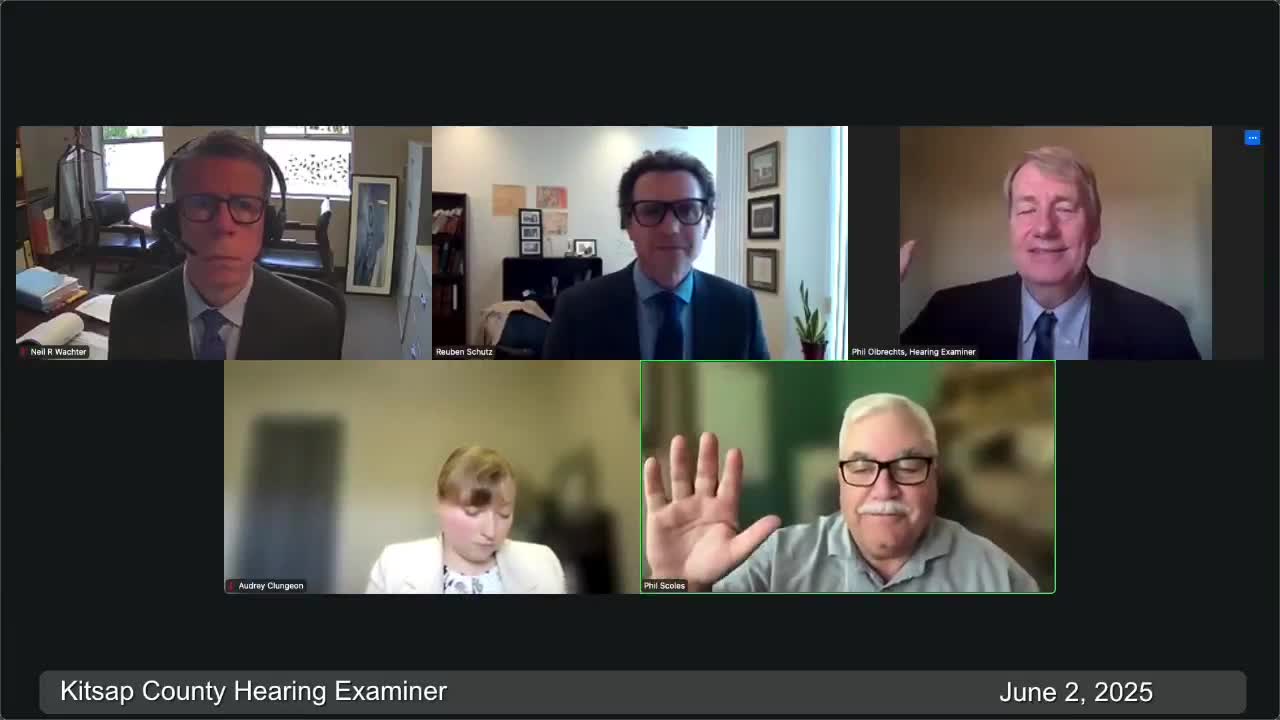
Kitsap County’s hearing examiner took testimony June 2 on technical work performed to resolve a remand about wetlands at the Silverview site in Silverdale. Phil Scholes, the applicant’s consulting soil scientist, said additional test pits dug on remand failed to show hydric soils at the disputed locations. The county’s peer reviewer, Radke Associates, generally agreed with the applicant’s findings but identified one location (DP16) where their field review reported a hydric‑soil indicator. The applicant offered an alternative, conservative wetland boundary that would include the disputed spot and expand the wetland footprint to roughly 570 square feet.
Why it matters: the presence and boundary of wetlands affect development layout and mitigation requirements. The examiner remanded the case to clarify whether prior wetland findings were supported by additional field data and to remove uncertainty around a single disputed area in the southwest portion of the site.
Most important facts
- Remand fieldwork: Applicant soil scientist Phil Scholes said his team went to the site on three field dates after the remand (May 20, 2024; Aug. 21, 2024; Oct. 28, 2024) and dug multiple test pits. The work included pits adjacent to the spots Dr. Sarah Cook of Cook Scientific had previously sampled (Cook’s sample plots were labeled SP1–SP5).
- Results: Scholes testified that the remand pits adjacent to Cook Scientific’s plots met the vegetation and hydrology indicators in some places but did not show hydric soils (the soil parameter required to classify an area as wetland) at seven of the eight verification pits. In short, the applicant’s team said most locations did not meet the full three‑parameter test for wetlands (vegetation, hydrology, soils).
- Peer review: Kitsap County retained Radke Associates to review the remand fieldwork. Radke largely concurred with the applicant’s findings but reported that one location (DP16 / adjacent to Cook’s SP3 in the southwest corner) met a hydric‑soil indicator in their observations.
- Additional verification: Because of that disagreement, the applicant returned to the immediate vicinity of DP16 and dug multiple additional pits (October 28) in cardinal directions around Radke’s location. Scholes said those additional pits did not show hydric‑soil indicators, and he described the applicant’s remand record as having an unusually large amount of sampling for a site this size.
- Offer of an alternate boundary: To move the proceedings forward, the applicant offered a conservative alternative wetland boundary that would include the disputed location; Scholes’ memorandum showed an increase in wetland area from roughly 355 square feet to roughly 570 square feet as a “worst‑case” line the applicant was willing to accept.
Quotes
- “We did not find any hydric soils” at the remand pits that the applicant dug adjacent to Cook Scientific’s plots, Phil Scholes testified.
- “We provided a lot more sample data than was requested,” Scholes said, describing additional pits dug in August and October to address Radke’s single‑plot disagreement.
What was not decided
The hearing did not resolve the dispute; the Radke review and Scholes’ subsequent pits are evidence in the record and the examiner will weigh the conflicting professional observations before issuing findings. The applicant’s offered alternate boundary is recorded as a voluntary proposal but not yet a final, adopted delineation.
Background and context
Wetland determinations use three parameters: hydrophytic vegetation, wetland hydrology, and hydric soils. The remand directed the parties to verify soils and hydrology in areas where prior evidence was contested; Scholes testified he and the applicant’s team followed that direction and expanded sampling in places to reduce uncertainty.
Next steps
The examiner will consider Scholes’ remand memoranda, the Radke peer review, and other evidence produced during the remand record before issuing a written remand decision. Parties may be given a short period to file responses to items introduced on remand.
Why it matters: the presence and boundary of wetlands affect development layout and mitigation requirements. The examiner remanded the case to clarify whether prior wetland findings were supported by additional field data and to remove uncertainty around a single disputed area in the southwest portion of the site.
Most important facts
- Remand fieldwork: Applicant soil scientist Phil Scholes said his team went to the site on three field dates after the remand (May 20, 2024; Aug. 21, 2024; Oct. 28, 2024) and dug multiple test pits. The work included pits adjacent to the spots Dr. Sarah Cook of Cook Scientific had previously sampled (Cook’s sample plots were labeled SP1–SP5).
- Results: Scholes testified that the remand pits adjacent to Cook Scientific’s plots met the vegetation and hydrology indicators in some places but did not show hydric soils (the soil parameter required to classify an area as wetland) at seven of the eight verification pits. In short, the applicant’s team said most locations did not meet the full three‑parameter test for wetlands (vegetation, hydrology, soils).
- Peer review: Kitsap County retained Radke Associates to review the remand fieldwork. Radke largely concurred with the applicant’s findings but reported that one location (DP16 / adjacent to Cook’s SP3 in the southwest corner) met a hydric‑soil indicator in their observations.
- Additional verification: Because of that disagreement, the applicant returned to the immediate vicinity of DP16 and dug multiple additional pits (October 28) in cardinal directions around Radke’s location. Scholes said those additional pits did not show hydric‑soil indicators, and he described the applicant’s remand record as having an unusually large amount of sampling for a site this size.
- Offer of an alternate boundary: To move the proceedings forward, the applicant offered a conservative alternative wetland boundary that would include the disputed location; Scholes’ memorandum showed an increase in wetland area from roughly 355 square feet to roughly 570 square feet as a “worst‑case” line the applicant was willing to accept.
Quotes
- “We did not find any hydric soils” at the remand pits that the applicant dug adjacent to Cook Scientific’s plots, Phil Scholes testified.
- “We provided a lot more sample data than was requested,” Scholes said, describing additional pits dug in August and October to address Radke’s single‑plot disagreement.
What was not decided
The hearing did not resolve the dispute; the Radke review and Scholes’ subsequent pits are evidence in the record and the examiner will weigh the conflicting professional observations before issuing findings. The applicant’s offered alternate boundary is recorded as a voluntary proposal but not yet a final, adopted delineation.
Background and context
Wetland determinations use three parameters: hydrophytic vegetation, wetland hydrology, and hydric soils. The remand directed the parties to verify soils and hydrology in areas where prior evidence was contested; Scholes testified he and the applicant’s team followed that direction and expanded sampling in places to reduce uncertainty.
Next steps
The examiner will consider Scholes’ remand memoranda, the Radke peer review, and other evidence produced during the remand record before issuing a written remand decision. Parties may be given a short period to file responses to items introduced on remand.
View the Full Meeting & All Its Details
This article offers just a summary. Unlock complete video, transcripts, and insights as a Founder Member.
✓
Watch full, unedited meeting videos
✓
Search every word spoken in unlimited transcripts
✓
AI summaries & real-time alerts (all government levels)
✓
Permanent access to expanding government content
30-day money-back guarantee
