Boulder County Board of Adjustment denies Allen's Park setback variance after debate over septic, alternatives
June 04, 2025 | Boulder County, Colorado
This article was created by AI summarizing key points discussed. AI makes mistakes, so for full details and context, please refer to the video of the full meeting. Please report any errors so we can fix them. Report an error »
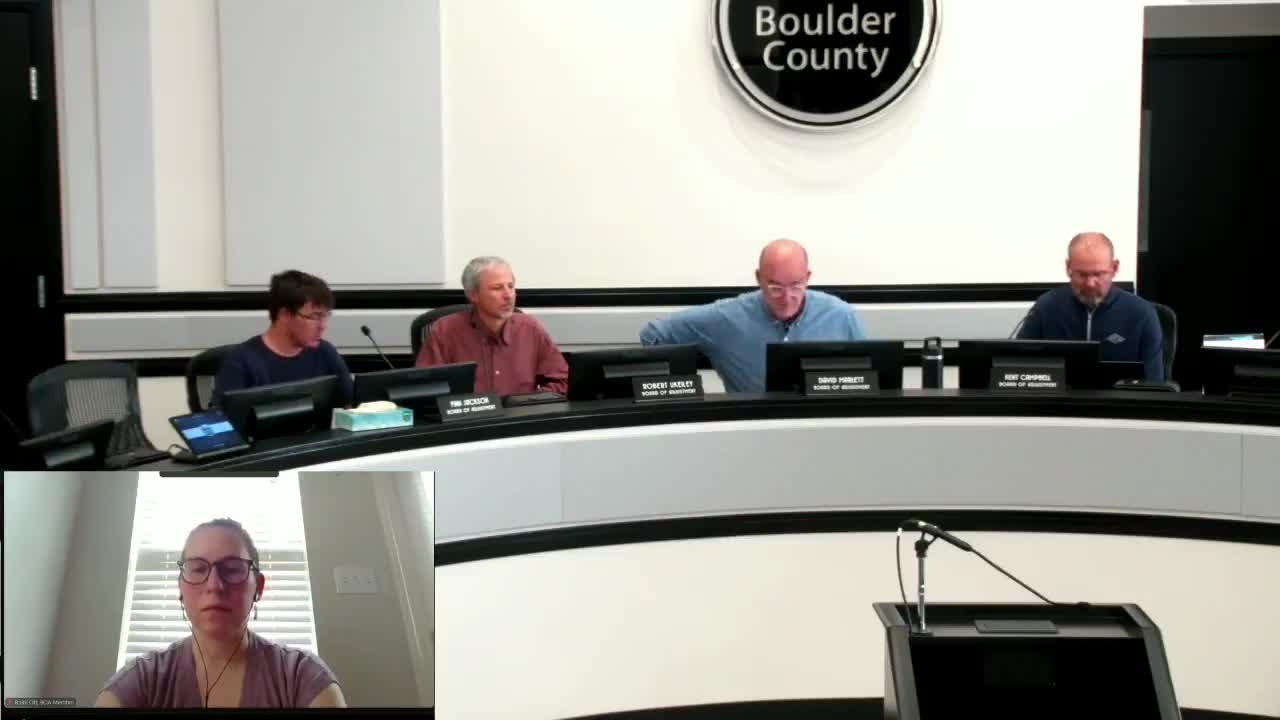
On June 4, 2025, the Boulder County Board of Adjustment denied a variance request that would have reduced the required 25-foot western setback to 12 feet to allow construction of a detached studio at 129 County Road 90 in Allen's Park.
The board's decision followed a staff recommendation to deny the request, a presentation from the property owners and their architect, and more than an hour of questions and discussion. Sam Walker, the planner assigned to the case, told the board that staff found the parcel has developable area outside the setbacks and that the variance criteria — including an “exceptional or extraordinary physical circumstance” — were not met. Walker said, “staff recommend that the Board of Adjustment deny docket VAR 25-0001, the Kersting Mata setback reductions.”
The applicants, property owners Jeffrey Kersting and Denise Mata, and their architect, Thomas Beck, argued the lot's small size, the location of an existing septic leach field and septic tank (permitted in February 2011), and the desire to protect the existing cabin's historic appearance justified the variance. Beck said he “totally disagree[d] respectfully of the staff, that there are hardships.” The owners said the proposed studio is 375 square feet and that moving the septic would be costly; their contractor estimated a replacement at about $30,000–$50,000.
Staff presented a diagram showing a 960-square-foot area on the parcel that would lie outside required setbacks where development could occur without a variance. Sam Walker said that the green shaded area in staff materials is 960 square feet and that the applicant’s structure as revised would not be the only way to gain roughly the studio’s square footage without a variance. The staff analysis noted the parcel is in the Forestry Zoning District, that the original submittal included both north and west setback reductions but the applicant later withdrew the northern request, and that wildfire-mitigation standards could be required (for example, ignition-resistant materials) if the board were to grant encroachment.
Board members asked detailed questions about the exact location of the septic system on the ground versus what is shown in county records, whether the Allen's Park Water and Sanitation District boundaries allow hookup (staff clarified that while the parcel is within the district boundary, there are no sewer lines or sewage-treatment plant in Allen’s Park), and how building-permit review and required surveys would enforce any approved setback. Deputy Director Kim Sanchez explained that a building permit is held pending the board’s variance decision and that building-permit review and required setback/foundation surveys would be used to ensure any approved encroachment matches the board’s motion.
Members of the board repeatedly returned to the variance criteria. Several members said aesthetics and owner preference are not valid grounds for a variance; Board Member Robert Kiley told the hearing, “The aesthetic preference of the applicant is not, one of the criteria.” Conversely, some board members acknowledged Allen's Park contains many small, older lots and said that could inform whether the parcel is exceptional; others said the evidence presented did not demonstrate an extraordinary physical circumstance. Concerns also surfaced about access standards for the driveway and whether narrower-than-standard access created safety issues relevant to review criteria.
After deliberation, Board Member Robert Kiley moved to deny the variance. The motion carried with all board members voting in the affirmative. The board’s roll-call voting record shows each present member voting to deny the requested setback reduction. The denial means the applicants must either revise their proposal to locate new square footage within the existing setbacks, seek alternative designs (such as an addition that complies with zoning), or return with additional evidence if they choose to reapply.
The board also noted that the county could require additional technical information in future applications — for example, precise septic field survey data, final grading/topography, or a final site plan — to better assess hardship under the variance criteria.
The Board of Adjustment public hearing record for the item includes written comments received before the staff recommendation (four submitted before the packet, plus two additional adjacent-neighbor letters submitted by the owners the day before the hearing). Three of the earlier comments expressed no concerns, one expressed support, and two raised concerns about neighborhood character.
The board's decision followed a staff recommendation to deny the request, a presentation from the property owners and their architect, and more than an hour of questions and discussion. Sam Walker, the planner assigned to the case, told the board that staff found the parcel has developable area outside the setbacks and that the variance criteria — including an “exceptional or extraordinary physical circumstance” — were not met. Walker said, “staff recommend that the Board of Adjustment deny docket VAR 25-0001, the Kersting Mata setback reductions.”
The applicants, property owners Jeffrey Kersting and Denise Mata, and their architect, Thomas Beck, argued the lot's small size, the location of an existing septic leach field and septic tank (permitted in February 2011), and the desire to protect the existing cabin's historic appearance justified the variance. Beck said he “totally disagree[d] respectfully of the staff, that there are hardships.” The owners said the proposed studio is 375 square feet and that moving the septic would be costly; their contractor estimated a replacement at about $30,000–$50,000.
Staff presented a diagram showing a 960-square-foot area on the parcel that would lie outside required setbacks where development could occur without a variance. Sam Walker said that the green shaded area in staff materials is 960 square feet and that the applicant’s structure as revised would not be the only way to gain roughly the studio’s square footage without a variance. The staff analysis noted the parcel is in the Forestry Zoning District, that the original submittal included both north and west setback reductions but the applicant later withdrew the northern request, and that wildfire-mitigation standards could be required (for example, ignition-resistant materials) if the board were to grant encroachment.
Board members asked detailed questions about the exact location of the septic system on the ground versus what is shown in county records, whether the Allen's Park Water and Sanitation District boundaries allow hookup (staff clarified that while the parcel is within the district boundary, there are no sewer lines or sewage-treatment plant in Allen’s Park), and how building-permit review and required surveys would enforce any approved setback. Deputy Director Kim Sanchez explained that a building permit is held pending the board’s variance decision and that building-permit review and required setback/foundation surveys would be used to ensure any approved encroachment matches the board’s motion.
Members of the board repeatedly returned to the variance criteria. Several members said aesthetics and owner preference are not valid grounds for a variance; Board Member Robert Kiley told the hearing, “The aesthetic preference of the applicant is not, one of the criteria.” Conversely, some board members acknowledged Allen's Park contains many small, older lots and said that could inform whether the parcel is exceptional; others said the evidence presented did not demonstrate an extraordinary physical circumstance. Concerns also surfaced about access standards for the driveway and whether narrower-than-standard access created safety issues relevant to review criteria.
After deliberation, Board Member Robert Kiley moved to deny the variance. The motion carried with all board members voting in the affirmative. The board’s roll-call voting record shows each present member voting to deny the requested setback reduction. The denial means the applicants must either revise their proposal to locate new square footage within the existing setbacks, seek alternative designs (such as an addition that complies with zoning), or return with additional evidence if they choose to reapply.
The board also noted that the county could require additional technical information in future applications — for example, precise septic field survey data, final grading/topography, or a final site plan — to better assess hardship under the variance criteria.
The Board of Adjustment public hearing record for the item includes written comments received before the staff recommendation (four submitted before the packet, plus two additional adjacent-neighbor letters submitted by the owners the day before the hearing). Three of the earlier comments expressed no concerns, one expressed support, and two raised concerns about neighborhood character.
View the Full Meeting & All Its Details
This article offers just a summary. Unlock complete video, transcripts, and insights as a Founder Member.
✓
Watch full, unedited meeting videos
✓
Search every word spoken in unlimited transcripts
✓
AI summaries & real-time alerts (all government levels)
✓
Permanent access to expanding government content
30-day money-back guarantee
