Jefferson County Planning Commission backs rezoning for Havencrest, caps development at 20 homes
May 28, 2025 | Jefferson County, Colorado
This article was created by AI summarizing key points discussed. AI makes mistakes, so for full details and context, please refer to the video of the full meeting. Please report any errors so we can fix them. Report an error »
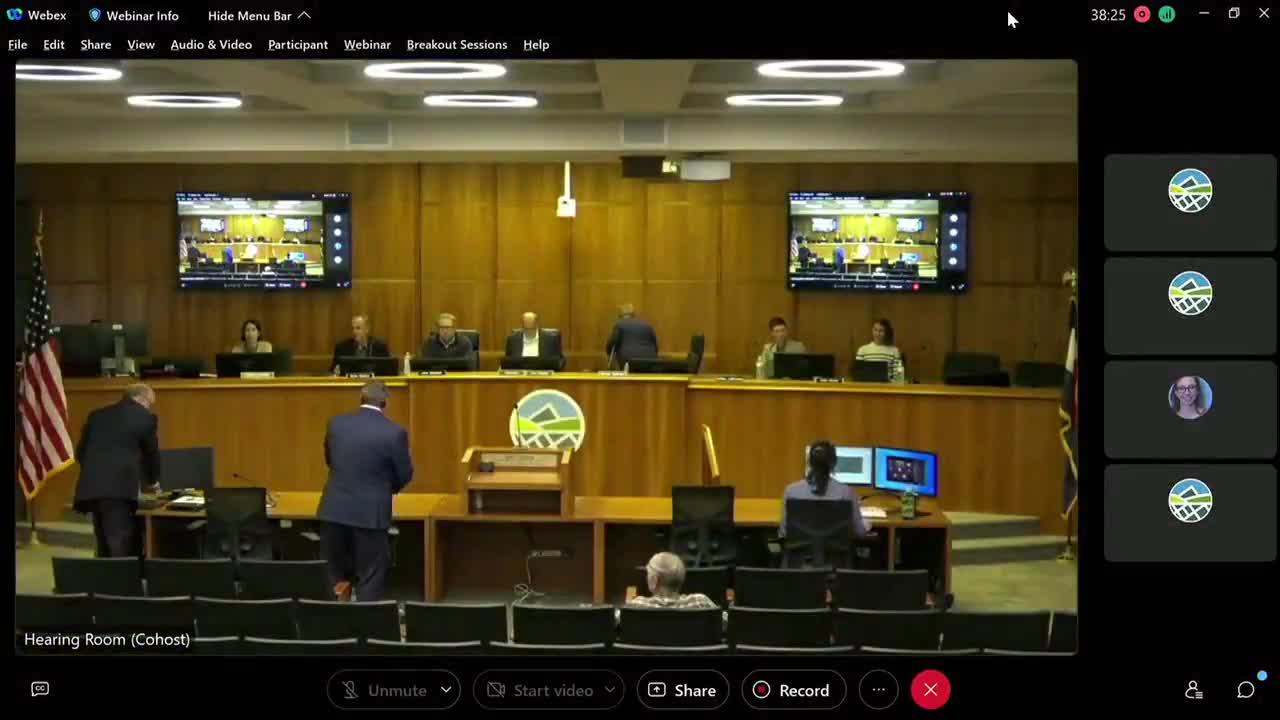
The Jefferson County Planning Commission on May 28 recommended approval of a rezoning request that would allow the Havencrest official development plan to add up to 20 single‑family homes on a roughly 5‑acre parcel at 13645 West 50 Second Avenue in unincorporated Jefferson County.
The motion, moved by Commissioner Spencer and seconded by Commissioner Messner, passed unanimously. The recommendation now goes to the Jefferson County Board of County Commissioners, which has final authority; staff said that body will consider the case at a public hearing scheduled for June 24.
Staff said the planned development (PD) follows the Residential 1B (R‑1B) standards but caps the number of residential lots at 20 to align with the Comprehensive Master Plan (CMP). “This plan development document does align with that recommendation because it is a 5‑acre lot, as verified by our cartography staff,” said Sarah Hallmeier, case manager for Jefferson County Planning & Zoning, explaining the PD text limits and how it differs from a straight R‑1B rezoning.
Why it matters: the PD designation limits the kind of uses allowed on the parcel and, in this application, imposes a numerical cap that staff and commissioners said is more restrictive than simply rezoning to R‑1B. Residents who spoke at the hearing raised concerns about flooding, perched groundwater and drainage, increased traffic on West 50 Second Avenue, and whether the lot sizes and house styles would fit the existing neighborhood.
What staff and the applicant said: Hallmeier told the commission the ODP (official development plan) follows the R‑1B uses and standards but adds a hard cap of 20 lots and modestly modified side setbacks along West 50 Second Avenue. She noted setback and lot‑size distinctions among the county’s residential zone districts: R‑1 (12,500 sq. ft. minimum), R‑1A (9,000 sq. ft. minimum), and R‑1B (7,500 sq. ft. minimum). She emphasized the rezoning stage establishes allowable uses and density while the subsequent plat stage will evaluate engineering details such as grading, drainage and road design.
Donald Rosier, managing partner at Community Design Collaborative and agent for the applicant, and owner Steve Lindsey of Linco Construction outlined the proposed project as 20 single‑family detached lots accessed from a central cul‑de‑sac with a landscaped 10‑foot tract along West 50 Second Avenue and a sidewalk to complete the missing north‑side segment. “We are installing detention. The detention will be designed and installed pursuant to Jefferson County regulations,” Rosier said, explaining the applicant’s plan for stormwater attenuation and maintenance obligations.
Community concerns: Several neighbors who live within a block or two of the site testified about recurrent flooding and perched groundwater, and expressed skepticism that a detention feature would prevent overflow into backyards. Hubert Barton, a nearby resident, said, “I don't want the same thing in my backyard,” citing a nearby retention area he described as full of debris and ineffective during heavy rains. Multiple residents also described heavy school‑period traffic near Drake and the potential for the additional 20 houses to exacerbate congestion and safety risks for pedestrians and schoolchildren.
Engineering and process clarifications: Lauren Caruso, county review engineer, explained that a detailed Phase 3 drainage report will be required during the preliminary/final plat process. That technical report will quantify impervious surfaces, roof and driveway runoff, and evaluate capture, infiltration and water‑quality measures tied to the proposed detention pond in the southeast corner of the site. Caruso said the plat review — a separate, public, multi‑month process — is where most of the technical engineering will be finalized.
Fire access and street design: The applicant said the internal street geometry was revised at the request of Arvada Fire to provide an offset cul‑de‑sac and turning radii that accommodate fire apparatus. Steve Lindsey said his firm builds primarily single‑story ranch homes with basements and three‑car garages and that a homeowners association will maintain common features, including the detention area and landscaping.
Density, lot sizes and compatibility: Staff and the applicant said the PD caps lots at 20 to meet the CMP recommendation of up to 4 dwelling units per acre. Some residents questioned parcel size; one speaker cited county maps that list the parcel as 4.7 acres and said that subtracting road area and detention might make fewer lots feasible. Hallmeier and staff replied that the county’s cartography and the legal description used in the application record the property as 5 acres and that the PD caps lots at 20 as a maximum; Hallmeier added that the developer could build fewer than 20 lots if plat engineering or other requirements make 20 infeasible.
Commissioner comments and vote: Commissioners thanked residents for their participation and noted that many of the engineering and safety concerns will be addressed during the plat review and by referral agencies. Several commissioners said the PD's cap and proposed design make the proposal compatible with surrounding residential uses; Commissioner Dunn said that if the property instead were R‑1A it would allow roughly 18 lots in a mock‑up he ran, and the difference between 18 and 20 was negligible for impacts. The commission voted unanimously to recommend approval, with the record reflecting that the applicant must still satisfy plat, engineering and referral requirements before building permits can be issued.
What’s next: The commission’s recommendation will be forwarded to the Jefferson County Board of County Commissioners for final action at a public hearing. If the board approves the rezoning, the applicant must complete the platting process and receive county approvals for grading, drainage, utilities and building permits before construction can begin.
Reported by: Jefferson County Planning Commission hearing record and staff presentations; direct testimony from residents and the applicant team.
The motion, moved by Commissioner Spencer and seconded by Commissioner Messner, passed unanimously. The recommendation now goes to the Jefferson County Board of County Commissioners, which has final authority; staff said that body will consider the case at a public hearing scheduled for June 24.
Staff said the planned development (PD) follows the Residential 1B (R‑1B) standards but caps the number of residential lots at 20 to align with the Comprehensive Master Plan (CMP). “This plan development document does align with that recommendation because it is a 5‑acre lot, as verified by our cartography staff,” said Sarah Hallmeier, case manager for Jefferson County Planning & Zoning, explaining the PD text limits and how it differs from a straight R‑1B rezoning.
Why it matters: the PD designation limits the kind of uses allowed on the parcel and, in this application, imposes a numerical cap that staff and commissioners said is more restrictive than simply rezoning to R‑1B. Residents who spoke at the hearing raised concerns about flooding, perched groundwater and drainage, increased traffic on West 50 Second Avenue, and whether the lot sizes and house styles would fit the existing neighborhood.
What staff and the applicant said: Hallmeier told the commission the ODP (official development plan) follows the R‑1B uses and standards but adds a hard cap of 20 lots and modestly modified side setbacks along West 50 Second Avenue. She noted setback and lot‑size distinctions among the county’s residential zone districts: R‑1 (12,500 sq. ft. minimum), R‑1A (9,000 sq. ft. minimum), and R‑1B (7,500 sq. ft. minimum). She emphasized the rezoning stage establishes allowable uses and density while the subsequent plat stage will evaluate engineering details such as grading, drainage and road design.
Donald Rosier, managing partner at Community Design Collaborative and agent for the applicant, and owner Steve Lindsey of Linco Construction outlined the proposed project as 20 single‑family detached lots accessed from a central cul‑de‑sac with a landscaped 10‑foot tract along West 50 Second Avenue and a sidewalk to complete the missing north‑side segment. “We are installing detention. The detention will be designed and installed pursuant to Jefferson County regulations,” Rosier said, explaining the applicant’s plan for stormwater attenuation and maintenance obligations.
Community concerns: Several neighbors who live within a block or two of the site testified about recurrent flooding and perched groundwater, and expressed skepticism that a detention feature would prevent overflow into backyards. Hubert Barton, a nearby resident, said, “I don't want the same thing in my backyard,” citing a nearby retention area he described as full of debris and ineffective during heavy rains. Multiple residents also described heavy school‑period traffic near Drake and the potential for the additional 20 houses to exacerbate congestion and safety risks for pedestrians and schoolchildren.
Engineering and process clarifications: Lauren Caruso, county review engineer, explained that a detailed Phase 3 drainage report will be required during the preliminary/final plat process. That technical report will quantify impervious surfaces, roof and driveway runoff, and evaluate capture, infiltration and water‑quality measures tied to the proposed detention pond in the southeast corner of the site. Caruso said the plat review — a separate, public, multi‑month process — is where most of the technical engineering will be finalized.
Fire access and street design: The applicant said the internal street geometry was revised at the request of Arvada Fire to provide an offset cul‑de‑sac and turning radii that accommodate fire apparatus. Steve Lindsey said his firm builds primarily single‑story ranch homes with basements and three‑car garages and that a homeowners association will maintain common features, including the detention area and landscaping.
Density, lot sizes and compatibility: Staff and the applicant said the PD caps lots at 20 to meet the CMP recommendation of up to 4 dwelling units per acre. Some residents questioned parcel size; one speaker cited county maps that list the parcel as 4.7 acres and said that subtracting road area and detention might make fewer lots feasible. Hallmeier and staff replied that the county’s cartography and the legal description used in the application record the property as 5 acres and that the PD caps lots at 20 as a maximum; Hallmeier added that the developer could build fewer than 20 lots if plat engineering or other requirements make 20 infeasible.
Commissioner comments and vote: Commissioners thanked residents for their participation and noted that many of the engineering and safety concerns will be addressed during the plat review and by referral agencies. Several commissioners said the PD's cap and proposed design make the proposal compatible with surrounding residential uses; Commissioner Dunn said that if the property instead were R‑1A it would allow roughly 18 lots in a mock‑up he ran, and the difference between 18 and 20 was negligible for impacts. The commission voted unanimously to recommend approval, with the record reflecting that the applicant must still satisfy plat, engineering and referral requirements before building permits can be issued.
What’s next: The commission’s recommendation will be forwarded to the Jefferson County Board of County Commissioners for final action at a public hearing. If the board approves the rezoning, the applicant must complete the platting process and receive county approvals for grading, drainage, utilities and building permits before construction can begin.
Reported by: Jefferson County Planning Commission hearing record and staff presentations; direct testimony from residents and the applicant team.
Don't Miss a Word: See the Full Meeting!
Go beyond summaries. Unlock every video, transcript, and key insight with a Founder Membership.
✓
Get instant access to full meeting videos
✓
Search and clip any phrase from complete transcripts
✓
Receive AI-powered summaries & custom alerts
✓
Enjoy lifetime, unrestricted access to government data
30-day money-back guarantee
