City Council approves 10‑year PILOT for Cirrus Aircraft expansion, tying completion milestones and conditions to incentives
June 02, 2025 | Grand Forks, Grand Forks County, North Dakota
This article was created by AI summarizing key points discussed. AI makes mistakes, so for full details and context, please refer to the video of the full meeting. Please report any errors so we can fix them. Report an error »
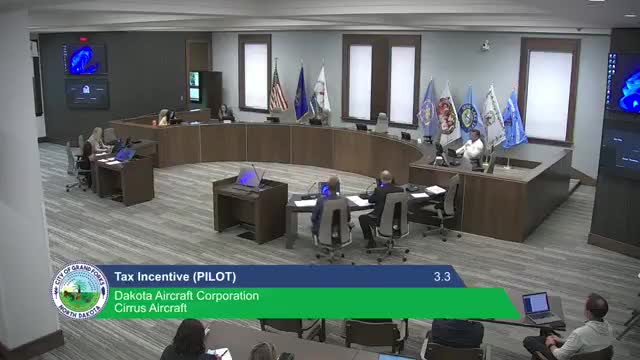
The Grand Forks City Council on June 2 approved a 10‑year payment‑in‑lieu‑of‑taxes (PILOT) development agreement to support a 30,000‑square‑foot expansion and renovation at Cirrus Aircraft’s Grand Forks facility.
City staff presented the PILOT, describing it as part of a larger planned expansion that staff estimated at about $15 million for current work and indicating an additional 60,000 to 90,000 square feet of potential expansion over the next five years. Mr. Phelan, a city staff presenter, said the company planned to begin construction this summer if approvals proceeded on schedule and that the JDA had already approved related PACE financing. “All told, it’s an estimated amount by about a $15,000,000 investment,” Phelan said.
City legal staff reviewed the pilot agreement with council. The agreement requires the expansion’s substantial completion and issuance of a certificate of occupancy before pilot payments begin, sets a completion window (commence by August 2025, complete by April 2026), and lists annual conditions — including no defaults and continued accuracy of developer representations — that must be satisfied on each assessment date for the pilot to remain in force. The pilot applies only to the identified project and operator; special assessments remain unaffected and other property‑tax incentives are ineligible during the pilot term.
City legal staff cited Century Code requirements for pilot findings and said the council must find the pilot is in the best interest of the city; that finding is required by statute (Century Code 40‑57.1‑3, subsection 5, as read into the record). City staff said the existing building and land remain taxable; only the qualified expansion area is eligible for the pilot once the project reaches substantial completion.
Council members asked procedural questions about the checklist of public notices and local advisory steps; staff presented a timeline showing notices to the Department of Commerce, local government advisory committee meetings and briefings to the school board and county commission. Council member Rosalind voiced concern about offering incentives to firms with foreign ownership; that comment was recorded on the public record but did not change the motion. The council moved to approve the development agreement and pilot; the motion passed with one dissent (Osovsky).
The council’s approval authorizes the mayor and staff to finalize the pilot documents; the pilot becomes operative only after the project meets the agreement’s completion and non‑default conditions and as the developer requests pilot status under the terms of the agreement.
City staff presented the PILOT, describing it as part of a larger planned expansion that staff estimated at about $15 million for current work and indicating an additional 60,000 to 90,000 square feet of potential expansion over the next five years. Mr. Phelan, a city staff presenter, said the company planned to begin construction this summer if approvals proceeded on schedule and that the JDA had already approved related PACE financing. “All told, it’s an estimated amount by about a $15,000,000 investment,” Phelan said.
City legal staff reviewed the pilot agreement with council. The agreement requires the expansion’s substantial completion and issuance of a certificate of occupancy before pilot payments begin, sets a completion window (commence by August 2025, complete by April 2026), and lists annual conditions — including no defaults and continued accuracy of developer representations — that must be satisfied on each assessment date for the pilot to remain in force. The pilot applies only to the identified project and operator; special assessments remain unaffected and other property‑tax incentives are ineligible during the pilot term.
City legal staff cited Century Code requirements for pilot findings and said the council must find the pilot is in the best interest of the city; that finding is required by statute (Century Code 40‑57.1‑3, subsection 5, as read into the record). City staff said the existing building and land remain taxable; only the qualified expansion area is eligible for the pilot once the project reaches substantial completion.
Council members asked procedural questions about the checklist of public notices and local advisory steps; staff presented a timeline showing notices to the Department of Commerce, local government advisory committee meetings and briefings to the school board and county commission. Council member Rosalind voiced concern about offering incentives to firms with foreign ownership; that comment was recorded on the public record but did not change the motion. The council moved to approve the development agreement and pilot; the motion passed with one dissent (Osovsky).
The council’s approval authorizes the mayor and staff to finalize the pilot documents; the pilot becomes operative only after the project meets the agreement’s completion and non‑default conditions and as the developer requests pilot status under the terms of the agreement.
Don't Miss a Word: See the Full Meeting!
Go beyond summaries. Unlock every video, transcript, and key insight with a Founder Membership.
✓
Get instant access to full meeting videos
✓
Search and clip any phrase from complete transcripts
✓
Receive AI-powered summaries & custom alerts
✓
Enjoy lifetime, unrestricted access to government data
30-day money-back guarantee
