Suffolk city attorneys outline 2025 General Assembly bills that will require code changes, new municipal policies
June 04, 2025 | Suffolk City, Virginia
This article was created by AI summarizing key points discussed. AI makes mistakes, so for full details and context, please refer to the video of the full meeting. Please report any errors so we can fix them. Report an error »
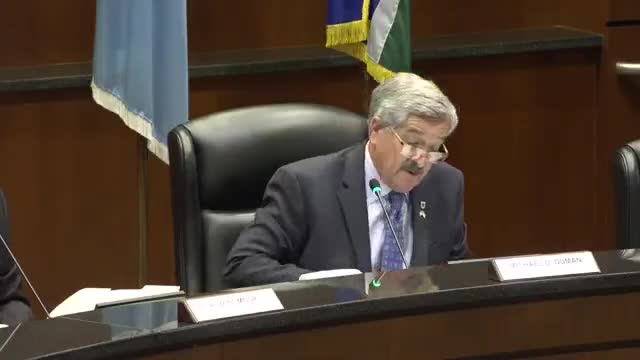
The City Attorney’s Office on Wednesday reviewed dozens of bills enacted by the 2025 Virginia General Assembly and flagged several that will require Suffolk City Council action or optional local ordinances.
The report, delivered by Assistant City Attorneys Rebecca Powers, Patrick Macaluso and Michael Patterson, drew council questions about tree-canopy fees, derelict-property procedures and tax-exemption changes.
The most immediately actionable items the city attorney identified are: shortening approval times for subdivision plats and site plans (House Bill 2660), changes to the city’s photo speed-monitoring ordinance to match state language for school crossing zones (House Bill 2718), and updates to zoning fine schedules and administrative review authority to align with state law for repeat or enhanced zoning violations (Senate Bills 9974, 1267 and 1422). City staff said an ordinance to update subdivision timing will be presented at an upcoming council meeting.
Rebecca Powers summarized one optional, locally adoptable measure: “This allows the city to pass an ordinance that establishes a tree canopy fund to collect, maintain and distribute fees collected from developers that cannot provide for full tree canopy requirements where the development project is situated.” Under the new state law, monies placed into a local tree canopy fund must be spent within five years and cost units must be based on average pricing for 2-inch-caliper nursery-stock trees.
The presentation also covered legislative changes affecting procurement, information-technology accessibility, tax exemptions and blighted-property procedures. Assistant City Attorney Patrick Macaluso described procurement and contract changes intended to protect local jurisdictions, saying, of a new IT procurement provision, that “any of those provisions would be void” if they require Virginia localities to accept out-of-state dispute-resolution clauses that conflict with Virginia law.
The city attorney team briefed council on a suite of local-tax and exemption changes. House Bill 2029 lets localities require applicants for elderly and disabled real‑property tax exemptions to pay prior delinquent taxes, enter installment agreements up to 72 months, or obtain the treasurer’s agreement to an offer in compromise; the bill also allows prorated exemptions for the portion of the taxable year during which a taxpayer qualifies. Michael Patterson summarized changes affecting towing fees that are informational for the city: “It’s an increasing from $150 to $210.”
On derelict and blighted properties, the General Assembly authorized an option for localities to petition circuit court to have a special commissioner convey real estate to the locality, a land bank or a designated nonprofit in lieu of a public auction. The statute requires that a purchaser begin repairs or renovation within six months and complete code-required repairs within two years. Council members asked whether the bill allows naming more than one nonprofit; city attorneys said the statute refers to “an existing nonprofit entity,” and local practice and further legal review will determine whether multiple designees are permissible.
City staff told council the city’s Unified Development Ordinance already contains tree-canopy requirements for many site plans and that the new tree‑canopy fund is an optional tool for small sites that cannot meet on‑site planting requirements. Council member Johnson asked whether fund money could be used by Parks and Recreation; Powers replied the law allows localities to use the fund to plant and maintain trees on public or private property or engage a 501(c)(3) nonprofit to perform the work.
Several bills were provided for informational purposes and do not themselves change local code but could prompt future action. Those include a Department of Housing and Community Development directive to publish guidance on using tax-exempt nonprofit property for affordable housing (House Bill 2153), clarifications allowing tiny homes and accessory-dwelling units to be included in comprehensive plans (House Bill 2533), and changes addressing notarial acts and electronic notaries (House Bill 1889).
City attorneys flagged items that will require ordinance drafting if council chooses to act: adjustments to subdivision and site-plan review timelines, changes to zoning civil-penalty minimums and maximums for repeat violations, and text updates to the city’s photo speed-monitoring ordinance to reflect state requirements for school crossing-zone photos. On several measures the office recommended limited code changes; on others the city retains optional authority.
Council members asked for follow-up details on the amount and mechanics of tree‑canopy fees, whether Suffolk has a land bank (staff said the city does not), and whether the two‑year coding requirement for blighted properties allows extensions. Counsel answered that the statute permits localities to add “reasonable conditions,” but the two‑year completion period appears in the statute and may limit extensions unless further legal mechanisms are used.
City attorneys said they will return with draft ordinance language where statutory changes require local code amendments. No formal council votes were taken during the presentation.
For now, council members described the legislative round-up as useful and instructed staff to draft necessary ordinance changes and to brief council again when draft language is ready.
The report, delivered by Assistant City Attorneys Rebecca Powers, Patrick Macaluso and Michael Patterson, drew council questions about tree-canopy fees, derelict-property procedures and tax-exemption changes.
The most immediately actionable items the city attorney identified are: shortening approval times for subdivision plats and site plans (House Bill 2660), changes to the city’s photo speed-monitoring ordinance to match state language for school crossing zones (House Bill 2718), and updates to zoning fine schedules and administrative review authority to align with state law for repeat or enhanced zoning violations (Senate Bills 9974, 1267 and 1422). City staff said an ordinance to update subdivision timing will be presented at an upcoming council meeting.
Rebecca Powers summarized one optional, locally adoptable measure: “This allows the city to pass an ordinance that establishes a tree canopy fund to collect, maintain and distribute fees collected from developers that cannot provide for full tree canopy requirements where the development project is situated.” Under the new state law, monies placed into a local tree canopy fund must be spent within five years and cost units must be based on average pricing for 2-inch-caliper nursery-stock trees.
The presentation also covered legislative changes affecting procurement, information-technology accessibility, tax exemptions and blighted-property procedures. Assistant City Attorney Patrick Macaluso described procurement and contract changes intended to protect local jurisdictions, saying, of a new IT procurement provision, that “any of those provisions would be void” if they require Virginia localities to accept out-of-state dispute-resolution clauses that conflict with Virginia law.
The city attorney team briefed council on a suite of local-tax and exemption changes. House Bill 2029 lets localities require applicants for elderly and disabled real‑property tax exemptions to pay prior delinquent taxes, enter installment agreements up to 72 months, or obtain the treasurer’s agreement to an offer in compromise; the bill also allows prorated exemptions for the portion of the taxable year during which a taxpayer qualifies. Michael Patterson summarized changes affecting towing fees that are informational for the city: “It’s an increasing from $150 to $210.”
On derelict and blighted properties, the General Assembly authorized an option for localities to petition circuit court to have a special commissioner convey real estate to the locality, a land bank or a designated nonprofit in lieu of a public auction. The statute requires that a purchaser begin repairs or renovation within six months and complete code-required repairs within two years. Council members asked whether the bill allows naming more than one nonprofit; city attorneys said the statute refers to “an existing nonprofit entity,” and local practice and further legal review will determine whether multiple designees are permissible.
City staff told council the city’s Unified Development Ordinance already contains tree-canopy requirements for many site plans and that the new tree‑canopy fund is an optional tool for small sites that cannot meet on‑site planting requirements. Council member Johnson asked whether fund money could be used by Parks and Recreation; Powers replied the law allows localities to use the fund to plant and maintain trees on public or private property or engage a 501(c)(3) nonprofit to perform the work.
Several bills were provided for informational purposes and do not themselves change local code but could prompt future action. Those include a Department of Housing and Community Development directive to publish guidance on using tax-exempt nonprofit property for affordable housing (House Bill 2153), clarifications allowing tiny homes and accessory-dwelling units to be included in comprehensive plans (House Bill 2533), and changes addressing notarial acts and electronic notaries (House Bill 1889).
City attorneys flagged items that will require ordinance drafting if council chooses to act: adjustments to subdivision and site-plan review timelines, changes to zoning civil-penalty minimums and maximums for repeat violations, and text updates to the city’s photo speed-monitoring ordinance to reflect state requirements for school crossing-zone photos. On several measures the office recommended limited code changes; on others the city retains optional authority.
Council members asked for follow-up details on the amount and mechanics of tree‑canopy fees, whether Suffolk has a land bank (staff said the city does not), and whether the two‑year coding requirement for blighted properties allows extensions. Counsel answered that the statute permits localities to add “reasonable conditions,” but the two‑year completion period appears in the statute and may limit extensions unless further legal mechanisms are used.
City attorneys said they will return with draft ordinance language where statutory changes require local code amendments. No formal council votes were taken during the presentation.
For now, council members described the legislative round-up as useful and instructed staff to draft necessary ordinance changes and to brief council again when draft language is ready.
Don't Miss a Word: See the Full Meeting!
Go beyond summaries. Unlock every video, transcript, and key insight with a Founder Membership.
✓
Get instant access to full meeting videos
✓
Search and clip any phrase from complete transcripts
✓
Receive AI-powered summaries & custom alerts
✓
Enjoy lifetime, unrestricted access to government data
30-day money-back guarantee
