HRTPO engineer finds downtown Suffolk has several feasible station sites; ridership and funding studies next
June 04, 2025 | Suffolk City, Virginia
This article was created by AI summarizing key points discussed. AI makes mistakes, so for full details and context, please refer to the video of the full meeting. Please report any errors so we can fix them. Report an error »
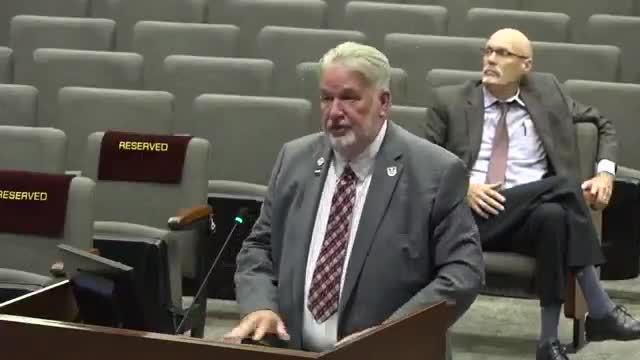
A preliminary feasibility review by the Hampton Roads Transportation Planning Organization (HRTPO) identified multiple locations in downtown Suffolk that meet basic space and platform requirements for a potential Amtrak stop, but city and regional officials cautioned that formal ridership, revenue and siting studies will be required before the project can move into funding and design stages.
Director of Public Works Robert Lewis and HRTPO chief transportation engineer Dr. Rob Case presented the early assessment, which searched for parcels that meet minimum platform length, siding and site-size requirements and avoid major residential impacts. Lewis told council that the City’s capital improvement plan includes funding to begin the formal studies after the new fiscal year: “To get a stop, it's a little more than just saying we wish the train would stop here,” he said.
Dr. Case described the analytical approach and screening of roughly 10 locations between Lake Kilby and the Washington Street railroad crossing. He said he used a five‑criteria test — platform length and width, siding length, and minimum site size among them — and rejected several locations because of street closures, residential neighborhoods or dead-end spurs. He recommended two commercial sites that meet the screening thresholds, and a third site on a spur that could work but would require train maneuvers.
“I came up with a list of requirements for station location before I looked at locations and I came up with these 5 requirements,” Case said, summarizing the methodology.
City staff emphasized that the HRTPO study is an early, conceptual look and does not meet federal requirements for adding an Amtrak stop. Lewis said the next steps are a federal-standard ridership and revenue study and a more detailed siting study; together those two efforts typically take nine to 12 months. If the ridership study shows a Suffolk stop would be viable and would not unacceptably reduce ridership at existing stations, staff will pursue federal approvals and then funding options.
Council members asked about funding and location alternatives. Lewis said the Newport News station was partly funded through regional programs and that funding opportunities, including CMAQ and other federal programs, would be explored after the viability studies. Council member Rector asked whether sites outside downtown had been considered; staff said they focused on downtown because of walkability and connections to local transit but agreed outlying sites could be evaluated in follow-up work.
The HRTPO’s early work concluded that downtown sites could create synergy with Suffolk’s downtown-development goals by allowing walkable access and making the station a destination. The city manager and deputy manager plan to attend a statewide train‑station community meeting in Richmond to continue coordination with regional partners.
No formal action or funding commitment beyond the existing capital‑plan study funding was taken at Wednesday’s work session.
Director of Public Works Robert Lewis and HRTPO chief transportation engineer Dr. Rob Case presented the early assessment, which searched for parcels that meet minimum platform length, siding and site-size requirements and avoid major residential impacts. Lewis told council that the City’s capital improvement plan includes funding to begin the formal studies after the new fiscal year: “To get a stop, it's a little more than just saying we wish the train would stop here,” he said.
Dr. Case described the analytical approach and screening of roughly 10 locations between Lake Kilby and the Washington Street railroad crossing. He said he used a five‑criteria test — platform length and width, siding length, and minimum site size among them — and rejected several locations because of street closures, residential neighborhoods or dead-end spurs. He recommended two commercial sites that meet the screening thresholds, and a third site on a spur that could work but would require train maneuvers.
“I came up with a list of requirements for station location before I looked at locations and I came up with these 5 requirements,” Case said, summarizing the methodology.
City staff emphasized that the HRTPO study is an early, conceptual look and does not meet federal requirements for adding an Amtrak stop. Lewis said the next steps are a federal-standard ridership and revenue study and a more detailed siting study; together those two efforts typically take nine to 12 months. If the ridership study shows a Suffolk stop would be viable and would not unacceptably reduce ridership at existing stations, staff will pursue federal approvals and then funding options.
Council members asked about funding and location alternatives. Lewis said the Newport News station was partly funded through regional programs and that funding opportunities, including CMAQ and other federal programs, would be explored after the viability studies. Council member Rector asked whether sites outside downtown had been considered; staff said they focused on downtown because of walkability and connections to local transit but agreed outlying sites could be evaluated in follow-up work.
The HRTPO’s early work concluded that downtown sites could create synergy with Suffolk’s downtown-development goals by allowing walkable access and making the station a destination. The city manager and deputy manager plan to attend a statewide train‑station community meeting in Richmond to continue coordination with regional partners.
No formal action or funding commitment beyond the existing capital‑plan study funding was taken at Wednesday’s work session.
Don't Miss a Word: See the Full Meeting!
Go beyond summaries. Unlock every video, transcript, and key insight with a Founder Membership.
✓
Get instant access to full meeting videos
✓
Search and clip any phrase from complete transcripts
✓
Receive AI-powered summaries & custom alerts
✓
Enjoy lifetime, unrestricted access to government data
30-day money-back guarantee
