Gallatin County finance staff says $641,000 available for ongoing spending; one-time requests far exceed one-time resources
June 04, 2025 | Gallatin County, Montana
This article was created by AI summarizing key points discussed. AI makes mistakes, so for full details and context, please refer to the video of the full meeting. Please report any errors so we can fix them. Report an error »
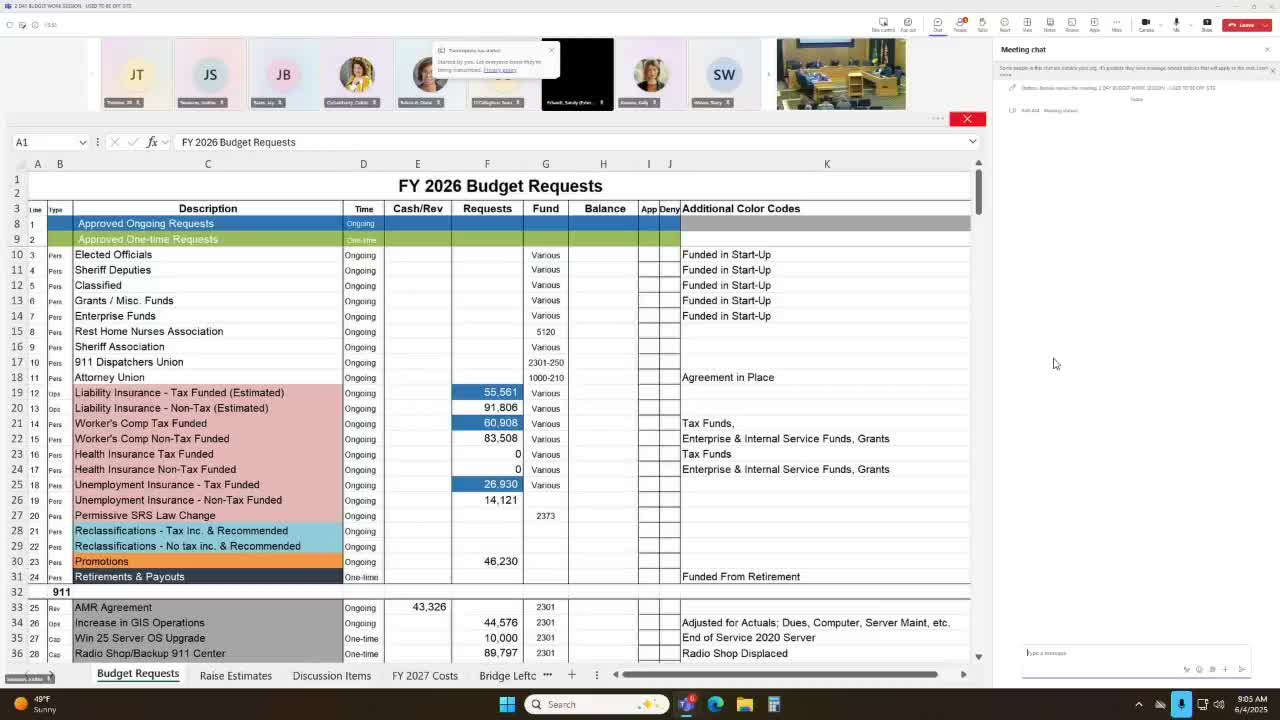
Justine, a member of county finance staff, opened the budget session with an overview of the county’s fiscal position and the requests submitted for fiscal year 2026.
“We have about $641,000. That is what's available left before we meet our mill cap,” Justine said, describing the county’s available ongoing resources. She added an estimate for newly taxable property the commission earmarks for capital or other one-time projects: “The best I could come up with is about $700,000.”
The finance summary showed roughly $17,300,000 in one-time requests from departments and about $19,000,000 in requests that can be funded from sources other than the county’s operating mills; staff flagged grant-funded items in red on the budget spreadsheet. Justine cautioned that the $641,000 continues to be constrained by recurring obligations such as insurance and other unavoidable costs.
Commissioners and staff discussed how departments that increased their own revenue estimates—specifically the clerk and recorder’s office and planning—reduced their reliance on property tax support and thereby freed some operating mills for other requests. Finance staff noted the startup budget already incorporated a 3% increase for classified employees and elected officials approved earlier in the process.
The overview framed the decisions the commission faced in the rest of the day: match available operating mills to priority ongoing requests while recognizing most one-time requests cannot be funded in full.
The commission moved from that overview directly into votes on personnel and insurance lines later in the session.
“We have about $641,000. That is what's available left before we meet our mill cap,” Justine said, describing the county’s available ongoing resources. She added an estimate for newly taxable property the commission earmarks for capital or other one-time projects: “The best I could come up with is about $700,000.”
The finance summary showed roughly $17,300,000 in one-time requests from departments and about $19,000,000 in requests that can be funded from sources other than the county’s operating mills; staff flagged grant-funded items in red on the budget spreadsheet. Justine cautioned that the $641,000 continues to be constrained by recurring obligations such as insurance and other unavoidable costs.
Commissioners and staff discussed how departments that increased their own revenue estimates—specifically the clerk and recorder’s office and planning—reduced their reliance on property tax support and thereby freed some operating mills for other requests. Finance staff noted the startup budget already incorporated a 3% increase for classified employees and elected officials approved earlier in the process.
The overview framed the decisions the commission faced in the rest of the day: match available operating mills to priority ongoing requests while recognizing most one-time requests cannot be funded in full.
The commission moved from that overview directly into votes on personnel and insurance lines later in the session.
View the Full Meeting & All Its Details
This article offers just a summary. Unlock complete video, transcripts, and insights as a Founder Member.
✓
Watch full, unedited meeting videos
✓
Search every word spoken in unlimited transcripts
✓
AI summaries & real-time alerts (all government levels)
✓
Permanent access to expanding government content
30-day money-back guarantee
