Commission approves multiple personnel additions and pay adjustments, including a new payroll clerk and higher temporary wages for elections staff
June 04, 2025 | Gallatin County, Montana
This article was created by AI summarizing key points discussed. AI makes mistakes, so for full details and context, please refer to the video of the full meeting. Please report any errors so we can fix them. Report an error »
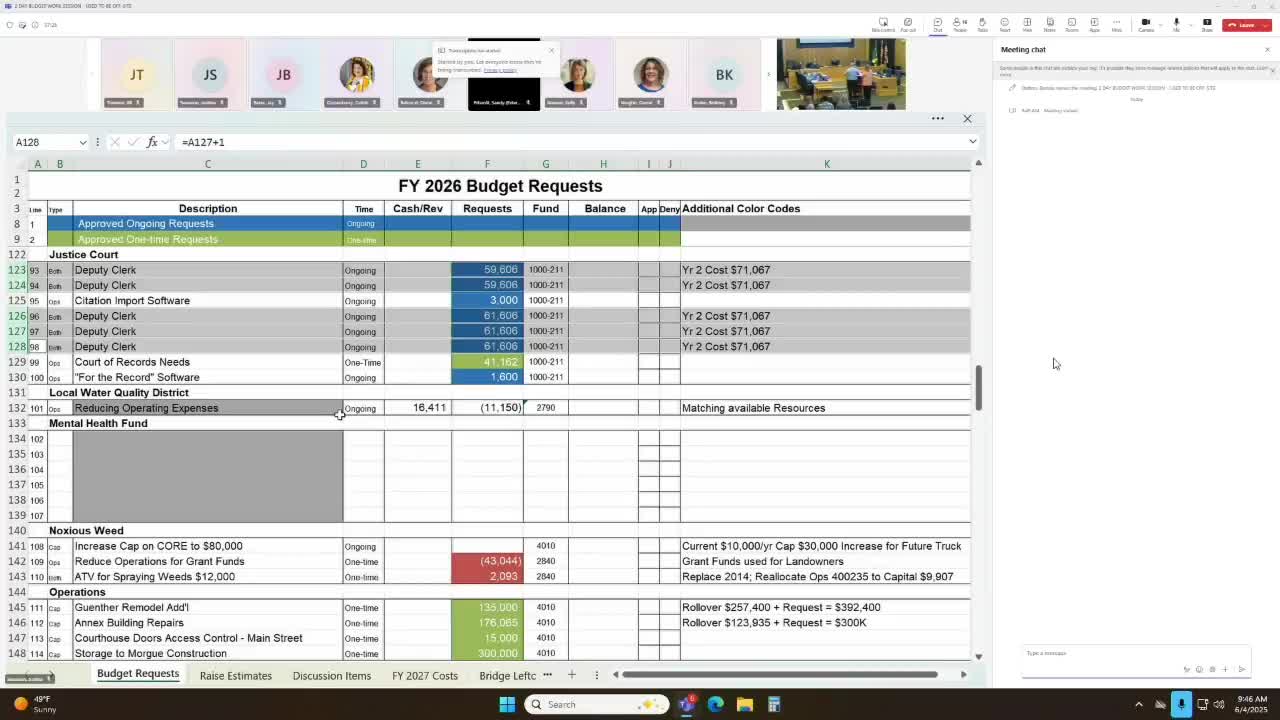
The commission took a series of votes on personnel requests after department heads outlined their needs.
HR asked for a payroll clerk to provide backup and capacity for a payroll function that handles more than 500 employees; several department heads voiced support for the position during public comment and commissioners approved the request. Mara Stevens of the HR team described the role’s purpose: to manage day-to-day ADP payroll processing, improve accuracy and provide vital backup to prevent disruption.
The commission approved a deputy clerk position for Justice Court after Justice Court staff presented workload indicators showing steep increases in filings vs. prior years. Miranda, the Clerk of Justice Court, and a justice court representative said workload metrics justified additional support.
The county attorney’s office received approval for at least one legal-assistant position and a DCA (deputy county attorney) promotion was approved; the office explained it remains under-resourced relative to caseload and cited burnout risks. The commission approved one-time funding for a summer prosecutor intern program and authorized a one-year clerkship-style position funded from cash to assist workload and pipeline recruitment.
Several sheriff’s office and detention-center personnel items were approved, including reclassification/promotion for a detention corporal and a special service officer to support civil and court building operations. Sheriff Dan Springer described caseload increases and said patrol and detention needs are growing.
Elections staff asked to continue a $17/hour temporary pay rate for election prep temps (up from $13 previously) and requested a modest overtime increase; commissioners approved $5,000 additional overtime and the temp payroll increase request to reflect historical usage and the higher hourly rate.
The commission also approved a temporary lead gate position at the fairgrounds and several solid waste and road-and-bridge seasonal/temporary adjustments. Health department personnel changes tied to grant funding were discussed as grant-supported and not charged to the general fund; commissioners deferred some grant-funded operations until later review.
Commissioners repeatedly emphasized that many departments had compelling staffing requests but that available ongoing funds are limited. Several personnel approvals were funded from ongoing mills; others were funded one-time from cash or grant sources; commissioners directed finance staff to reflect each decision in the updated budget schedules.
HR asked for a payroll clerk to provide backup and capacity for a payroll function that handles more than 500 employees; several department heads voiced support for the position during public comment and commissioners approved the request. Mara Stevens of the HR team described the role’s purpose: to manage day-to-day ADP payroll processing, improve accuracy and provide vital backup to prevent disruption.
The commission approved a deputy clerk position for Justice Court after Justice Court staff presented workload indicators showing steep increases in filings vs. prior years. Miranda, the Clerk of Justice Court, and a justice court representative said workload metrics justified additional support.
The county attorney’s office received approval for at least one legal-assistant position and a DCA (deputy county attorney) promotion was approved; the office explained it remains under-resourced relative to caseload and cited burnout risks. The commission approved one-time funding for a summer prosecutor intern program and authorized a one-year clerkship-style position funded from cash to assist workload and pipeline recruitment.
Several sheriff’s office and detention-center personnel items were approved, including reclassification/promotion for a detention corporal and a special service officer to support civil and court building operations. Sheriff Dan Springer described caseload increases and said patrol and detention needs are growing.
Elections staff asked to continue a $17/hour temporary pay rate for election prep temps (up from $13 previously) and requested a modest overtime increase; commissioners approved $5,000 additional overtime and the temp payroll increase request to reflect historical usage and the higher hourly rate.
The commission also approved a temporary lead gate position at the fairgrounds and several solid waste and road-and-bridge seasonal/temporary adjustments. Health department personnel changes tied to grant funding were discussed as grant-supported and not charged to the general fund; commissioners deferred some grant-funded operations until later review.
Commissioners repeatedly emphasized that many departments had compelling staffing requests but that available ongoing funds are limited. Several personnel approvals were funded from ongoing mills; others were funded one-time from cash or grant sources; commissioners directed finance staff to reflect each decision in the updated budget schedules.
Don't Miss a Word: See the Full Meeting!
Go beyond summaries. Unlock every video, transcript, and key insight with a Founder Membership.
✓
Get instant access to full meeting videos
✓
Search and clip any phrase from complete transcripts
✓
Receive AI-powered summaries & custom alerts
✓
Enjoy lifetime, unrestricted access to government data
30-day money-back guarantee
