House Revenue panel advances bills changing estate-tax natural-resource exemption
June 13, 2025 | Revenue, House of Representatives, Committees, Legislative, Oregon
This article was created by AI summarizing key points discussed. AI makes mistakes, so for full details and context, please refer to the video of the full meeting. Please report any errors so we can fix them. Report an error »
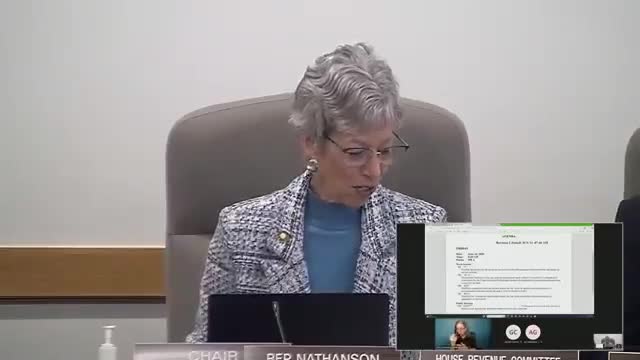
The House Committee on Revenue on June 13 moved several related measures to the floor with due-pass recommendations that would change Oregon's estate-tax natural-resource exemption and add portability for surviving spouses.
Committee staff said the base measure, House Bill 2,093, was introduced as a study bill that would require the Legislative Revenue Office to study the estate tax, but a dash-1 amendment replaces that language and combines concepts from multiple bills previously heard by the committee.
Staff explained the package incorporates provisions from Senate Bill 485, which changes qualification criteria for forest land under the exemption and specifies small-forest-land sizes; House Bill 3,630, which expands eligible ownership to certain businesses and trusts and allows replacement property; and a portability provision from House Bill 3,934 allowing a surviving spouse to elect additional exclusion based on an unused amount from a prior deceased spouse.
“The base bill is a study bill that would require LRO to study the estate tax,” the presenter said. The presenter also described technical changes that move the exemption closer to a true exclusion so qualifying property is not included in the taxable-estate calculation.
Committee members emphasized participation requirements tied to the exemption. The bills retain five‑year participation windows before and after a decedent's death and remove a prior 75% “days” threshold for active management; staff told the committee the change replaces a 75%‑of‑days test with a requirement that active management be “appropriate to the land” and its life cycle. The presenter said that, on balance, those changes are likely to tighten qualification in some respects and allow other clarifications such as permitting replacement of qualifying equipment.
Fiscal materials filed with the committee describe the revenue impact as minimal for most estates; staff said the change to the calculation moves the statutory treatment closer to assumptions used when the original exemption was estimated two years earlier.
House Bill 2,093’s public hearing record showed no members of the public signed up to testify; the committee closed that hearing before proceeding to work sessions on the related bills. During work sessions, members moved House Bill 3,630 and Senate Bill 485 to the floor with due-pass recommendations and assigned carriers: Representative Mannix for House Bill 3,630 and Representative Osborne for Senate Bill 485. Representative Hudson moved the measures to the floor; motions passed without recorded objections.
The measures will next go to the full House for consideration, where legislative sponsors and committee carriers will determine floor scheduling.
Committee staff said the base measure, House Bill 2,093, was introduced as a study bill that would require the Legislative Revenue Office to study the estate tax, but a dash-1 amendment replaces that language and combines concepts from multiple bills previously heard by the committee.
Staff explained the package incorporates provisions from Senate Bill 485, which changes qualification criteria for forest land under the exemption and specifies small-forest-land sizes; House Bill 3,630, which expands eligible ownership to certain businesses and trusts and allows replacement property; and a portability provision from House Bill 3,934 allowing a surviving spouse to elect additional exclusion based on an unused amount from a prior deceased spouse.
“The base bill is a study bill that would require LRO to study the estate tax,” the presenter said. The presenter also described technical changes that move the exemption closer to a true exclusion so qualifying property is not included in the taxable-estate calculation.
Committee members emphasized participation requirements tied to the exemption. The bills retain five‑year participation windows before and after a decedent's death and remove a prior 75% “days” threshold for active management; staff told the committee the change replaces a 75%‑of‑days test with a requirement that active management be “appropriate to the land” and its life cycle. The presenter said that, on balance, those changes are likely to tighten qualification in some respects and allow other clarifications such as permitting replacement of qualifying equipment.
Fiscal materials filed with the committee describe the revenue impact as minimal for most estates; staff said the change to the calculation moves the statutory treatment closer to assumptions used when the original exemption was estimated two years earlier.
House Bill 2,093’s public hearing record showed no members of the public signed up to testify; the committee closed that hearing before proceeding to work sessions on the related bills. During work sessions, members moved House Bill 3,630 and Senate Bill 485 to the floor with due-pass recommendations and assigned carriers: Representative Mannix for House Bill 3,630 and Representative Osborne for Senate Bill 485. Representative Hudson moved the measures to the floor; motions passed without recorded objections.
The measures will next go to the full House for consideration, where legislative sponsors and committee carriers will determine floor scheduling.
Don't Miss a Word: See the Full Meeting!
Go beyond summaries. Unlock every video, transcript, and key insight with a Founder Membership.
✓
Get instant access to full meeting videos
✓
Search and clip any phrase from complete transcripts
✓
Receive AI-powered summaries & custom alerts
✓
Enjoy lifetime, unrestricted access to government data
30-day money-back guarantee
