Mass. Probation Service details reentry, housing and behavioral-health supports to state commission
June 13, 2025 | 2025 Legislature MA, Massachusetts
This article was created by AI summarizing key points discussed. AI makes mistakes, so for full details and context, please refer to the video of the full meeting. Please report any errors so we can fix them. Report an error »
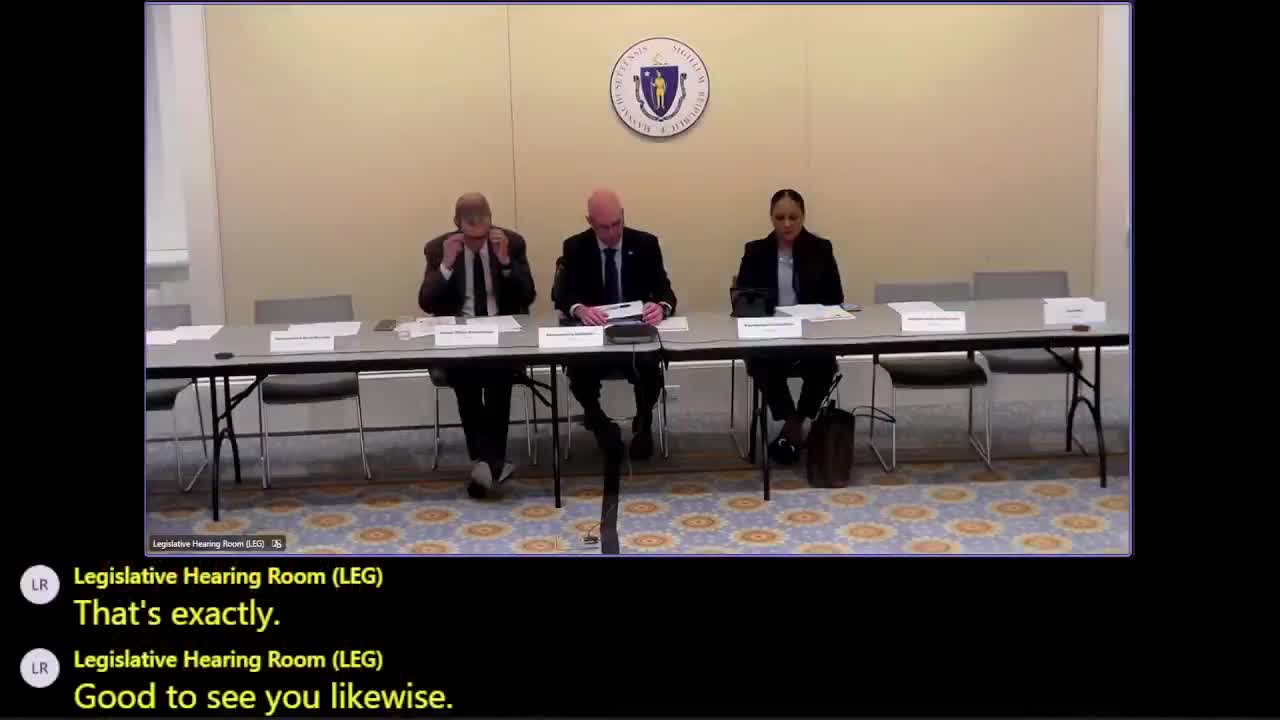
The Massachusetts Probation Service told a state commission that it is expanding community-based reentry supports, emphasizing housing, behavioral health and coordinated handoffs among probation, parole, sheriffs and the Department of Correction.
At the Special Commission on Correctional Consolidation and Collaboration, the commissioner of the Massachusetts Probation Service said the agency is “the largest post release supervision agency in the Commonwealth, with a legislative directive to support the justice involved and to be a good faith partner in managing shared resources.” The commissioner added that the service has reduced standard probation conditions and is working to lower technical violations.
Why it matters: Commission members and presenters told the panel that the probation service’s programs — especially the Community Justice Support Centers and a MassHealth-backed behavioral-health initiative — are intended to keep people in the community, reduce costly revocations, and improve long-term outcomes after release from incarceration.
Key details and outcomes
- Caseloads and violations: Presenters said the Massachusetts Probation Service supervises about 60,000 people at any given time and that the agency reduced the number of standard probation conditions “from 22 to 16,” a change they said has helped lower violation rates. According to the presentation, overall supervision-related violations fell nationally from roughly 31,000 in 2019 to 17,000 in 2023; presenters said about two-thirds of the 2023 violations were technical (noncriminal) violations.
- From-and-after sentences and compliance credits: The presenters described the practice of judges imposing post-release probation (sometimes called “from-and-after” sentences). They said about 1,300 people had those sentences as of April 2025 and that compliance-credit policies enacted in the Criminal Justice Reform changes allow people to shorten probation when they meet conditions.
- Community Justice Support Centers: The presentation said the centers — originally established in 1996 and deliberately rebranded as “community justice support centers” following UMass user research — provide a mix of clinical programming, case management and reentry services. As of 2023 the centers offered roughly 70 programming options (about 40 clinical) and use validated risk-and-need tools (ORAS, LSI-R) to tailor treatment plans.
- Evidence and outcomes: The presenters summarized a 2018 UMass analysis that compared people sent to the centers with similar people supervised under probation-as-usual. Using multiple statistical matching techniques, the study found lower one-year re-arrest rates for people who were placed in the centers; the presenters reported reductions on the order of roughly 26%–36% depending on method. Presenters said they are working with Northeastern University to update the analysis with more recent and longer-term outcomes.
- Behavioral-health initiative and MassHealth waivers: The commission heard that the trial court and probation service partnered with MassHealth and outside technical vendors to create a statewide behavioral-health initiative for justice-involved people. Presenters said the initiative generated nearly 11,000 referrals and about 7,500 enrollments, a roughly 70% engagement rate; they credited active coordination among courts, probation, parole, sheriffs and providers for improving uptake, particularly for people reached while still incarcerated.
- Housing and transitional placements: Presenters described two housing pathways: longer-term transitional houses (programs such as Brook House, McGrath House and the Western Massachusetts Reentry Center) and short-term sober/transitional placements (initially created with CARES Act and other funds). They said the state-funded housing allocation has grown since 2019 and that the program currently supports about 169 transitional beds statewide and roughly 500–600 sober-housing placements per month.
- Program operations and quality control: The probation service described fidelity monitoring and implementation support provided by UMass and Penn State, performance-based contracting elements, and community advisory boards that include people with lived experience. Presenters said the offices have increased workforce diversity (from about 21% to about 32–33% diversity) and are recruiting staff with clinical and social-service backgrounds rather than only law-enforcement experience.
Quotes from presenters
- “We’re the largest post release supervision agency in the Commonwealth, with a legislative directive to support the justice involved and to be a good faith partner in managing shared resources,” the commissioner said during the presentation.
- On system-level improvements the commissioner said: “We have reduced the standard conditions of probation from 22 to 16, and that has resulted in significant reductions in our violation rates.”
- On violation trends, Mike Coelho (Massachusetts Probation Service presenter) said: “We had about 31,000 violations in ’19. It dropped to 17,000 in 2023 even though our caseload is 85 percent of where it was pre-COVID.”
Commission follow-up and materials
Commission members asked for further breakdowns (for example, numbers on pretrial participants with and without consent, the number of people on parole, and more recent recidivism tracking). The panel asked that the presentation slides and a monthly snapshot be posted; staff said the slides would be shared on the commission website and that the probation team would provide more detailed monthly data and links.
Votes at a glance
- Motion to approve minutes from May 5: moved by State Rep. Lawrence Mathon; second not specified in the transcript. Chair declared the motion adopted after an “aye” vote.
- Motion to adjourn: moved and seconded on the record; chair declared the ayes to have it and adjourned the meeting.
What remained discussion-only
The meeting recorded no formal commission votes on policy changes or funding allocations beyond routine approvals and adjournment. The bulk of the session was a staff presentation and Q&A; commission members asked for additional data and follow-up materials rather than issuing new directives at the hearing.
Ending
Presenters told the commission they consider the centers and the behavioral-health and housing initiatives to be a shared resource that requires continuous coordination and monitoring. Commissioners and attendees thanked probation staff and partner agencies for the work and asked staff to circulate the slide deck and monthly performance snapshots for follow-up review.
At the Special Commission on Correctional Consolidation and Collaboration, the commissioner of the Massachusetts Probation Service said the agency is “the largest post release supervision agency in the Commonwealth, with a legislative directive to support the justice involved and to be a good faith partner in managing shared resources.” The commissioner added that the service has reduced standard probation conditions and is working to lower technical violations.
Why it matters: Commission members and presenters told the panel that the probation service’s programs — especially the Community Justice Support Centers and a MassHealth-backed behavioral-health initiative — are intended to keep people in the community, reduce costly revocations, and improve long-term outcomes after release from incarceration.
Key details and outcomes
- Caseloads and violations: Presenters said the Massachusetts Probation Service supervises about 60,000 people at any given time and that the agency reduced the number of standard probation conditions “from 22 to 16,” a change they said has helped lower violation rates. According to the presentation, overall supervision-related violations fell nationally from roughly 31,000 in 2019 to 17,000 in 2023; presenters said about two-thirds of the 2023 violations were technical (noncriminal) violations.
- From-and-after sentences and compliance credits: The presenters described the practice of judges imposing post-release probation (sometimes called “from-and-after” sentences). They said about 1,300 people had those sentences as of April 2025 and that compliance-credit policies enacted in the Criminal Justice Reform changes allow people to shorten probation when they meet conditions.
- Community Justice Support Centers: The presentation said the centers — originally established in 1996 and deliberately rebranded as “community justice support centers” following UMass user research — provide a mix of clinical programming, case management and reentry services. As of 2023 the centers offered roughly 70 programming options (about 40 clinical) and use validated risk-and-need tools (ORAS, LSI-R) to tailor treatment plans.
- Evidence and outcomes: The presenters summarized a 2018 UMass analysis that compared people sent to the centers with similar people supervised under probation-as-usual. Using multiple statistical matching techniques, the study found lower one-year re-arrest rates for people who were placed in the centers; the presenters reported reductions on the order of roughly 26%–36% depending on method. Presenters said they are working with Northeastern University to update the analysis with more recent and longer-term outcomes.
- Behavioral-health initiative and MassHealth waivers: The commission heard that the trial court and probation service partnered with MassHealth and outside technical vendors to create a statewide behavioral-health initiative for justice-involved people. Presenters said the initiative generated nearly 11,000 referrals and about 7,500 enrollments, a roughly 70% engagement rate; they credited active coordination among courts, probation, parole, sheriffs and providers for improving uptake, particularly for people reached while still incarcerated.
- Housing and transitional placements: Presenters described two housing pathways: longer-term transitional houses (programs such as Brook House, McGrath House and the Western Massachusetts Reentry Center) and short-term sober/transitional placements (initially created with CARES Act and other funds). They said the state-funded housing allocation has grown since 2019 and that the program currently supports about 169 transitional beds statewide and roughly 500–600 sober-housing placements per month.
- Program operations and quality control: The probation service described fidelity monitoring and implementation support provided by UMass and Penn State, performance-based contracting elements, and community advisory boards that include people with lived experience. Presenters said the offices have increased workforce diversity (from about 21% to about 32–33% diversity) and are recruiting staff with clinical and social-service backgrounds rather than only law-enforcement experience.
Quotes from presenters
- “We’re the largest post release supervision agency in the Commonwealth, with a legislative directive to support the justice involved and to be a good faith partner in managing shared resources,” the commissioner said during the presentation.
- On system-level improvements the commissioner said: “We have reduced the standard conditions of probation from 22 to 16, and that has resulted in significant reductions in our violation rates.”
- On violation trends, Mike Coelho (Massachusetts Probation Service presenter) said: “We had about 31,000 violations in ’19. It dropped to 17,000 in 2023 even though our caseload is 85 percent of where it was pre-COVID.”
Commission follow-up and materials
Commission members asked for further breakdowns (for example, numbers on pretrial participants with and without consent, the number of people on parole, and more recent recidivism tracking). The panel asked that the presentation slides and a monthly snapshot be posted; staff said the slides would be shared on the commission website and that the probation team would provide more detailed monthly data and links.
Votes at a glance
- Motion to approve minutes from May 5: moved by State Rep. Lawrence Mathon; second not specified in the transcript. Chair declared the motion adopted after an “aye” vote.
- Motion to adjourn: moved and seconded on the record; chair declared the ayes to have it and adjourned the meeting.
What remained discussion-only
The meeting recorded no formal commission votes on policy changes or funding allocations beyond routine approvals and adjournment. The bulk of the session was a staff presentation and Q&A; commission members asked for additional data and follow-up materials rather than issuing new directives at the hearing.
Ending
Presenters told the commission they consider the centers and the behavioral-health and housing initiatives to be a shared resource that requires continuous coordination and monitoring. Commissioners and attendees thanked probation staff and partner agencies for the work and asked staff to circulate the slide deck and monthly performance snapshots for follow-up review.
View the Full Meeting & All Its Details
This article offers just a summary. Unlock complete video, transcripts, and insights as a Founder Member.
✓
Watch full, unedited meeting videos
✓
Search every word spoken in unlimited transcripts
✓
AI summaries & real-time alerts (all government levels)
✓
Permanent access to expanding government content
30-day money-back guarantee
