Castle Rock Phase 3 primary-plat review deferred after residents and engineer raise wetlands, drainage and pipeline issues
June 19, 2025 | St John Town, Lake County, Indiana
This article was created by AI summarizing key points discussed. AI makes mistakes, so for full details and context, please refer to the video of the full meeting. Please report any errors so we can fix them. Report an error »
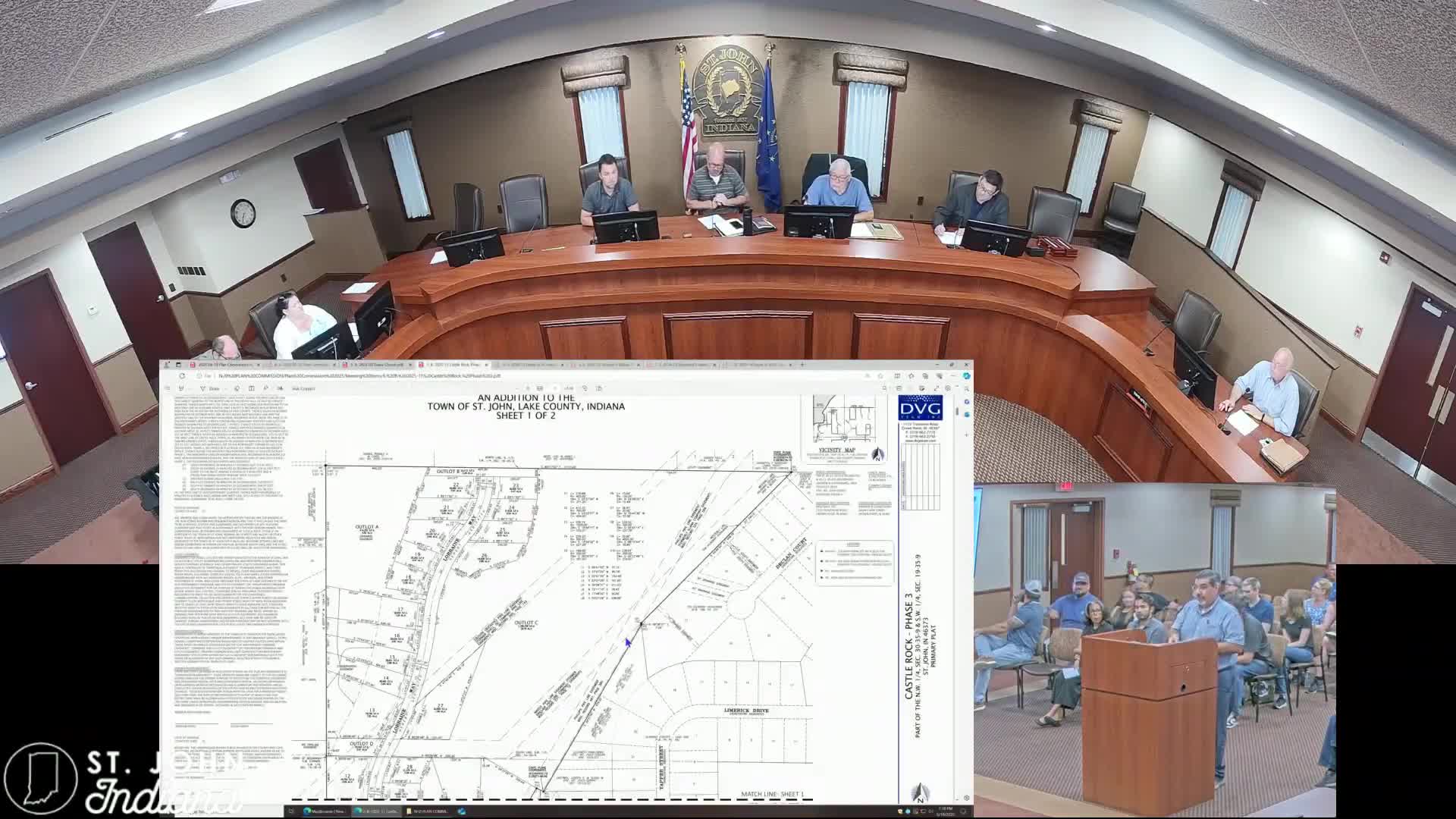
The Plan Commission on June 18 deferred the primary plat for Castle Rock Phase 3, a residential subdivision north of existing Castle Rock, after hearing detailed engineering review comments and extensive public concerns about wetlands and drainage.
Developer Doug Redick said the proposal is for R-2 lots meeting local zoning standards and acknowledged the site contains wetlands and drainage ways. "We have wetlands that are governed by the Army Corps of Engineers, federally regulated wetlands, and we have wetlands that are regulated by IDEM," Redick said, adding the design intends to leave those wetlands intact.
Town Engineer John Dykstra summarized the technical reviews: the submittal generated about 21 plat comments and roughly 30 engineering comments that require response, covering sanitary sewer, water mains, storm sewer, grading and erosion-control details. Dykstra noted an existing regional detention basin east of the property that serves several hundred acres and said the new phase will add smaller detention basins on the west side to manage local drainage.
Multiple residents described long-standing flooding on adjacent properties. Nancy Beer, who said her 20-acre parcel adjoins the site, presented photographs and said runoff from the developer's wetlands has flooded her hayfield and limited access. Another resident noted a 48-inch storm sewer and historical drain tile that once drained the area; she said the area was farmed decades ago but now functions as a wetland and regional detention basin.
Redick said the developer has conducted a formal wetland delineation and submitted jurisdictional determinations to the U.S. Army Corps of Engineers and Indiana Department of Environmental Management; the team intends to replace an outfall structure and restore drainage tile where needed. He also acknowledged three pipelines that cross the property and said the developer is coordinating with pipeline owners for utility crossings and permitting.
Planning staff and the engineer recommended deferral to allow the applicant to address outstanding engineering and plat comments. The commission voted to defer the item to the July meeting.
Discussion vs. decision: the hearing was discussion-heavy; no approval was granted. The deferral was a formal action to allow the applicant to resolve engineering responses and address resident concerns.
Outstanding technical issues included survey/plat corrections, a set of engineering plan responses, clarification of right-of-way and road-dedication questions, and coordination for sanitary sewer routing and pipeline crossings prior to returning for a final recommendation to the town council.
The commission directed the applicant to provide updated responses to the engineering review prior to the July meeting.
Developer Doug Redick said the proposal is for R-2 lots meeting local zoning standards and acknowledged the site contains wetlands and drainage ways. "We have wetlands that are governed by the Army Corps of Engineers, federally regulated wetlands, and we have wetlands that are regulated by IDEM," Redick said, adding the design intends to leave those wetlands intact.
Town Engineer John Dykstra summarized the technical reviews: the submittal generated about 21 plat comments and roughly 30 engineering comments that require response, covering sanitary sewer, water mains, storm sewer, grading and erosion-control details. Dykstra noted an existing regional detention basin east of the property that serves several hundred acres and said the new phase will add smaller detention basins on the west side to manage local drainage.
Multiple residents described long-standing flooding on adjacent properties. Nancy Beer, who said her 20-acre parcel adjoins the site, presented photographs and said runoff from the developer's wetlands has flooded her hayfield and limited access. Another resident noted a 48-inch storm sewer and historical drain tile that once drained the area; she said the area was farmed decades ago but now functions as a wetland and regional detention basin.
Redick said the developer has conducted a formal wetland delineation and submitted jurisdictional determinations to the U.S. Army Corps of Engineers and Indiana Department of Environmental Management; the team intends to replace an outfall structure and restore drainage tile where needed. He also acknowledged three pipelines that cross the property and said the developer is coordinating with pipeline owners for utility crossings and permitting.
Planning staff and the engineer recommended deferral to allow the applicant to address outstanding engineering and plat comments. The commission voted to defer the item to the July meeting.
Discussion vs. decision: the hearing was discussion-heavy; no approval was granted. The deferral was a formal action to allow the applicant to resolve engineering responses and address resident concerns.
Outstanding technical issues included survey/plat corrections, a set of engineering plan responses, clarification of right-of-way and road-dedication questions, and coordination for sanitary sewer routing and pipeline crossings prior to returning for a final recommendation to the town council.
The commission directed the applicant to provide updated responses to the engineering review prior to the July meeting.
View the Full Meeting & All Its Details
This article offers just a summary. Unlock complete video, transcripts, and insights as a Founder Member.
✓
Watch full, unedited meeting videos
✓
Search every word spoken in unlimited transcripts
✓
AI summaries & real-time alerts (all government levels)
✓
Permanent access to expanding government content
30-day money-back guarantee
