DeBary council advances Southwest Sector mobility plan and new mobility fees on first reading, includes Dirksen Road funding set‑aside
June 19, 2025 | City of DeBary, Volusia County, Florida
This article was created by AI summarizing key points discussed. AI makes mistakes, so for full details and context, please refer to the video of the full meeting. Please report any errors so we can fix them. Report an error »
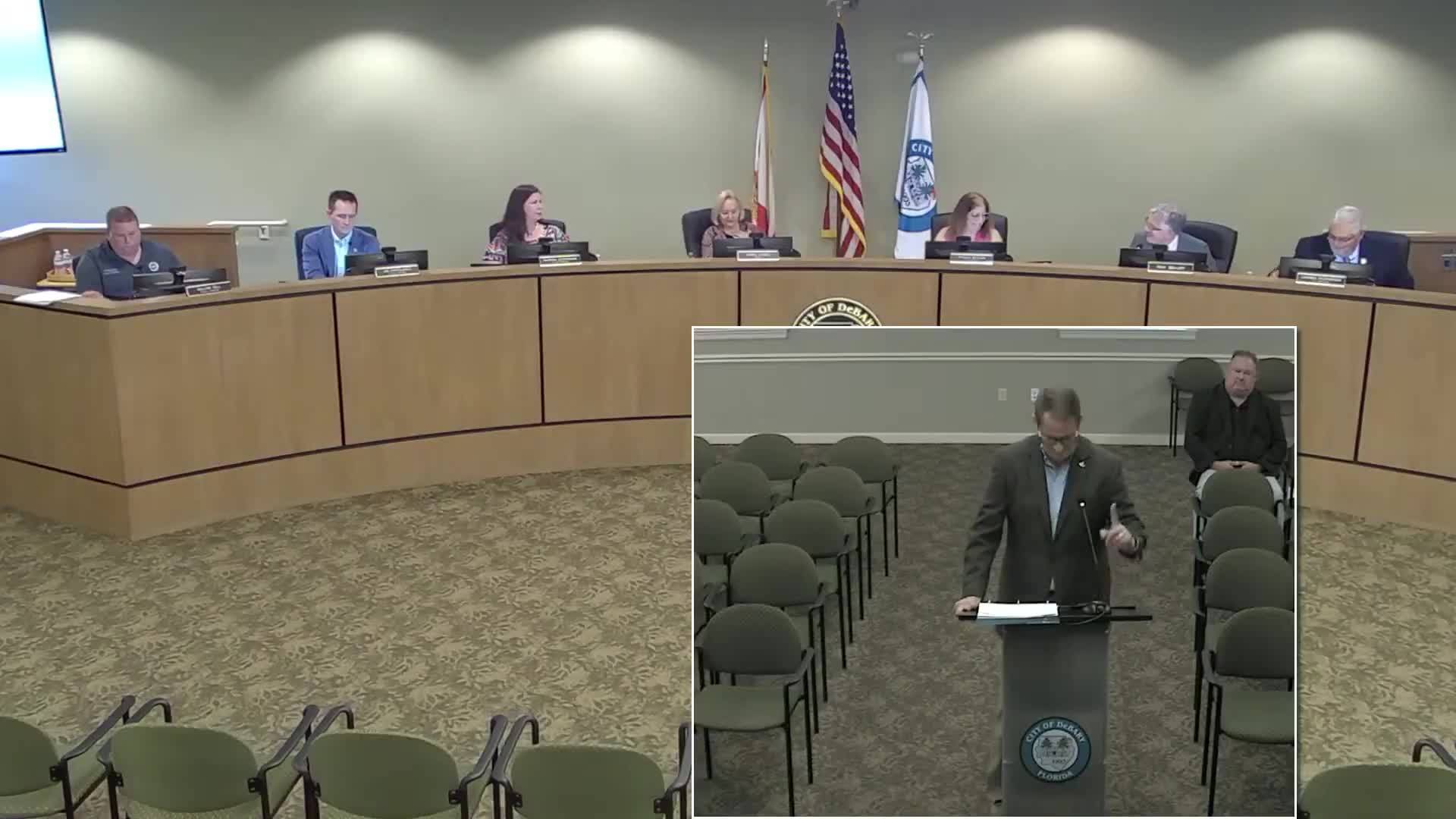
The City of DeBary City Council on first reading approved Ordinance O4-2025 to amend the land development code, adopt the DeBary Southwest Sector Mobility Plan and a mobility fee schedule intended to fund multimodal transportation improvements around the SunRail transit‑oriented development (TOD) area.
Stephen Bap, Growth Management Director for the City of DeBary, introduced the ordinance and said the city selected New Urban Concepts to update the plan. Jonathan Paul, principal of New Urban Concepts, described the mobility fee as “a mitigation paid by new development to offset their impact to the city's transportation system.” Paul emphasized the fee applies to new development only and is a one‑time payment.
Paul said the mobility program covers about a 20‑year horizon and includes projects around the SunRail station: intersections, roadway improvements, trails, transit access and signalization. The technical report estimates the plan cost at approximately $44,000,000, of which roughly $8.5 million is the estimated cost to add a center turn lane on Dirksen Road from State Road 1792 to Interstate 4. The recommended fee area largely mirrors the 2020 boundary but extends north to include land south of Benson Junction to account for potential redevelopment, including a former rock quarry.
Paul explained recent state law changes — House Bill 479 — require a single fee collected by the permitting authority and clarified that the city and county must coordinate how that single fee is spent. Because Volusia County currently collects a full county road impact fee inside the Southwest Sector, developers in the area now pay both the county and city fees. Under the new structure, the city would collect the single fee for the area and could set aside a portion for county roads such as Dirksen if an interlocal agreement is reached.
Paul presented example mobility fee calculations by land use: a single‑family dwelling in the assessment area would pay about $7,400 (current combined city and county charge: roughly $7,500); multifamily units about $4,500 (current combined about $4,200); hotels about $5,200 (current about $4,200); offices about $7,300 (current about $6,100); retail about $10,800 (current about $9,400). He noted the technical update reflects increases in trip generation, updated household travel survey data, and significant construction‑cost inflation since 2018 (city construction cost factors up roughly 130% in the plan area since the prior plan).
Because Florida statute generally requires fee increases above specified thresholds to be phased in unless a locality makes a documented finding of “extraordinary circumstances,” staff presented an extraordinary‑circumstances study supporting full adoption of the calculated fee. The justification cited the state law change, local growth projections, updated data sources, and materially higher construction and project costs. The ordinance as presented includes a finding of extraordinary circumstances and directs adoption at the full (100%) calculated rates.
Council members who spoke — Council member Papalardo, Council member Stevenson, Vice Mayor Butlin and Council member Sowell — expressed support for including Dirksen Road, for escrowing city funds until an interlocal agreement with Volusia County enables expenditure on Dirksen improvements, and for the city to pursue negotiated allocation with the county. Mayor Karen Chazet and the city manager noted the city will pursue an interlocal agreement with Volusia County; the manager said staff have met with the county twice and expect a draft interlocal in the next 60 to 90 days.
Louis Rotondo, identified by staff as the author/advocate behind House Bill 479, addressed the council and described the statute’s intent: to allow one collecting entity (the permitting authority) to collect a fee that better demonstrates local rational nexus and ensures mitigation funds are available for capacity projects that benefit fee payers in the same area. Rotondo urged the council to work with the county on an interlocal agreement that specifies project eligibility and funding disbursement.
Council voted to approve first reading of Ordinance O4-2025 as drafted, including the staff recommendation to find extraordinary circumstances and adopt the fee schedule at 100% of the calculated rates. Recorded votes were: Vice Mayor Butlin — yes; Council member Stevenson — yes; Council member Papalardo — yes; Council member Sells — yes; Council member Sowell — yes; Mayor Karen Chazet — yes.
Staff and the consultant indicated they held two public workshops during the update; city clerk reported no public comments on the night of this hearing. The city manager said staff will continue negotiations with Volusia County on an interlocal agreement, expected to return to council for approval within 60–90 days.
What the council approved on first reading sets the mobility plan, fee schedule and the city’s extraordinary‑circumstance finding. Final adoption will require second reading (statutory timeline) and completion of any statutorily required notice and adoption steps.
Stephen Bap, Growth Management Director for the City of DeBary, introduced the ordinance and said the city selected New Urban Concepts to update the plan. Jonathan Paul, principal of New Urban Concepts, described the mobility fee as “a mitigation paid by new development to offset their impact to the city's transportation system.” Paul emphasized the fee applies to new development only and is a one‑time payment.
Paul said the mobility program covers about a 20‑year horizon and includes projects around the SunRail station: intersections, roadway improvements, trails, transit access and signalization. The technical report estimates the plan cost at approximately $44,000,000, of which roughly $8.5 million is the estimated cost to add a center turn lane on Dirksen Road from State Road 1792 to Interstate 4. The recommended fee area largely mirrors the 2020 boundary but extends north to include land south of Benson Junction to account for potential redevelopment, including a former rock quarry.
Paul explained recent state law changes — House Bill 479 — require a single fee collected by the permitting authority and clarified that the city and county must coordinate how that single fee is spent. Because Volusia County currently collects a full county road impact fee inside the Southwest Sector, developers in the area now pay both the county and city fees. Under the new structure, the city would collect the single fee for the area and could set aside a portion for county roads such as Dirksen if an interlocal agreement is reached.
Paul presented example mobility fee calculations by land use: a single‑family dwelling in the assessment area would pay about $7,400 (current combined city and county charge: roughly $7,500); multifamily units about $4,500 (current combined about $4,200); hotels about $5,200 (current about $4,200); offices about $7,300 (current about $6,100); retail about $10,800 (current about $9,400). He noted the technical update reflects increases in trip generation, updated household travel survey data, and significant construction‑cost inflation since 2018 (city construction cost factors up roughly 130% in the plan area since the prior plan).
Because Florida statute generally requires fee increases above specified thresholds to be phased in unless a locality makes a documented finding of “extraordinary circumstances,” staff presented an extraordinary‑circumstances study supporting full adoption of the calculated fee. The justification cited the state law change, local growth projections, updated data sources, and materially higher construction and project costs. The ordinance as presented includes a finding of extraordinary circumstances and directs adoption at the full (100%) calculated rates.
Council members who spoke — Council member Papalardo, Council member Stevenson, Vice Mayor Butlin and Council member Sowell — expressed support for including Dirksen Road, for escrowing city funds until an interlocal agreement with Volusia County enables expenditure on Dirksen improvements, and for the city to pursue negotiated allocation with the county. Mayor Karen Chazet and the city manager noted the city will pursue an interlocal agreement with Volusia County; the manager said staff have met with the county twice and expect a draft interlocal in the next 60 to 90 days.
Louis Rotondo, identified by staff as the author/advocate behind House Bill 479, addressed the council and described the statute’s intent: to allow one collecting entity (the permitting authority) to collect a fee that better demonstrates local rational nexus and ensures mitigation funds are available for capacity projects that benefit fee payers in the same area. Rotondo urged the council to work with the county on an interlocal agreement that specifies project eligibility and funding disbursement.
Council voted to approve first reading of Ordinance O4-2025 as drafted, including the staff recommendation to find extraordinary circumstances and adopt the fee schedule at 100% of the calculated rates. Recorded votes were: Vice Mayor Butlin — yes; Council member Stevenson — yes; Council member Papalardo — yes; Council member Sells — yes; Council member Sowell — yes; Mayor Karen Chazet — yes.
Staff and the consultant indicated they held two public workshops during the update; city clerk reported no public comments on the night of this hearing. The city manager said staff will continue negotiations with Volusia County on an interlocal agreement, expected to return to council for approval within 60–90 days.
What the council approved on first reading sets the mobility plan, fee schedule and the city’s extraordinary‑circumstance finding. Final adoption will require second reading (statutory timeline) and completion of any statutorily required notice and adoption steps.
View the Full Meeting & All Its Details
This article offers just a summary. Unlock complete video, transcripts, and insights as a Founder Member.
✓
Watch full, unedited meeting videos
✓
Search every word spoken in unlimited transcripts
✓
AI summaries & real-time alerts (all government levels)
✓
Permanent access to expanding government content
30-day money-back guarantee
